
























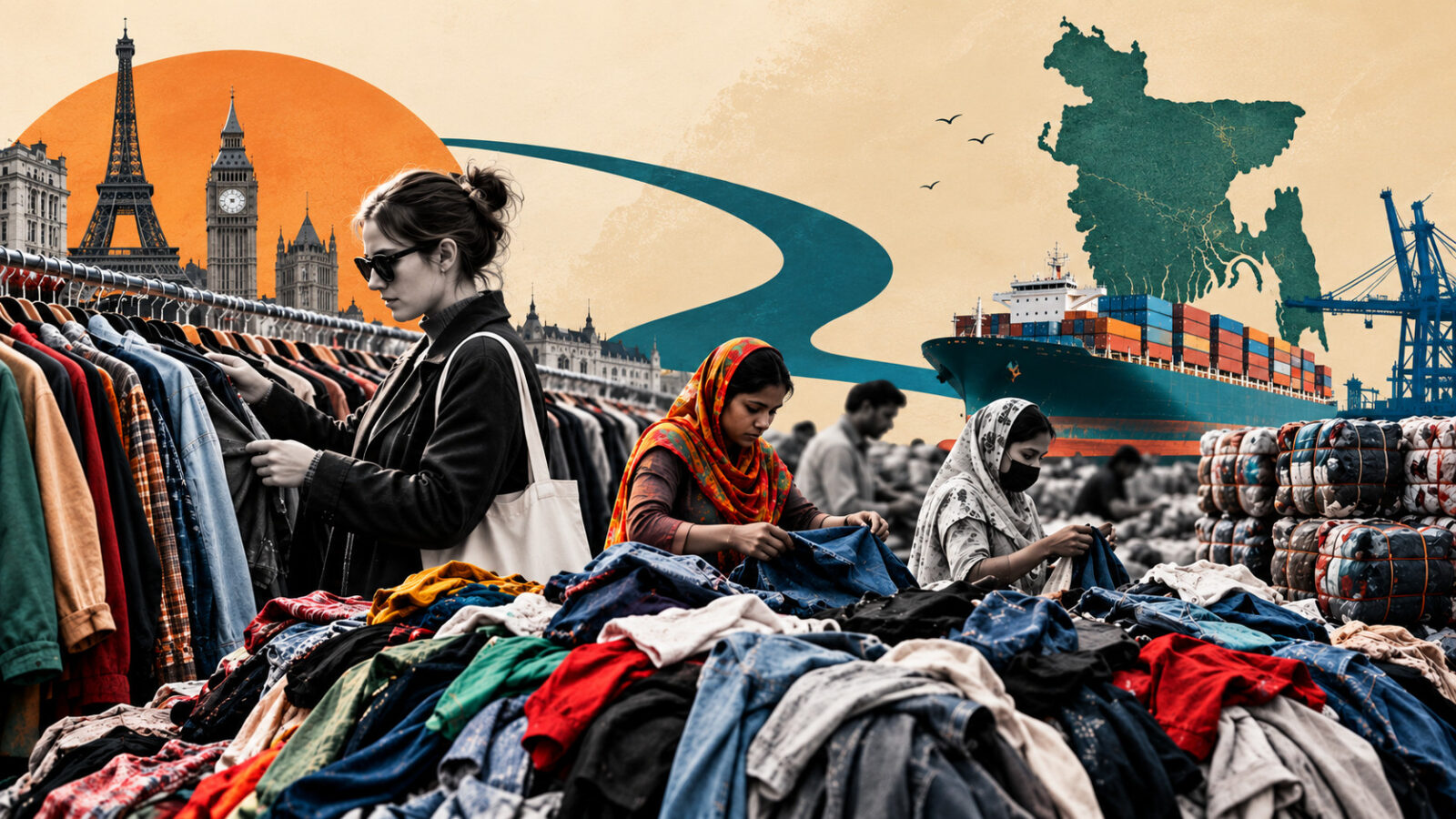
Britain spent $1.84 billion on sustainable fashion in 2025, but almost 93% of that spending went towards clothes that had already been worn. According to an ICEX report cited by Textile Today, UK consumers spent $1.71 billion on secondhand fashion, compared with just $124.6 million on newly produced sustainable clothing. The numbers point to a bigger change in how consumers approach fashion. Sustainability is increasingly about keeping garments in circulation for longer, rather than simply producing new clothes with greener materials.
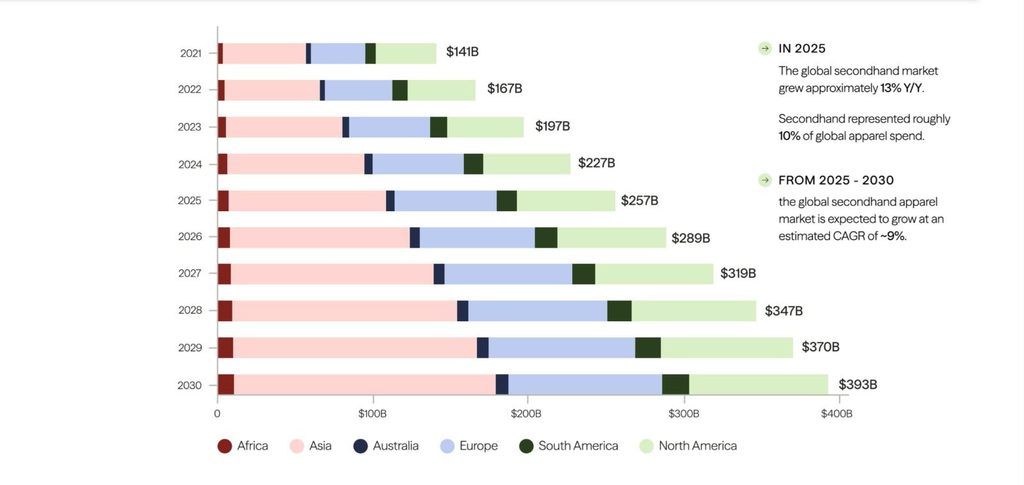
The global resale market reflects this shift. ThredUp’s 2026 Resale Report projects that the global secondhand apparel market will reach $393 billion by 2030, growing twice as fast as the overall apparel market. Gen Z and Millennials are expected to drive 71% of that growth, while the US secondhand market alone is projected to reach $78.8 billion by 2030. As resale becomes more mainstream, clothing is increasingly being viewed as something consumers can sell again, rather than a product whose value ends after its first purchase.
For Bangladesh, this trend raises a much bigger question than whether people in London or New York will shop at thrift stores: what happens to a country whose garment industry depends heavily on selling newly made clothes to those very markets? Bangladesh’s ready-made garment (RMG) industry earned $38.70 billion in FY2025-26, making apparel the country’s biggest export sector. The US imported $7.74 billion worth of Bangladeshi garments, while the UK imported $4.39 billion and the European Union another $19.06 billion. The EU accounted for 49.25% of Bangladesh’s total RMG exports, while the US represented another 20.01%.
The concern is not that consumers will suddenly stop buying new clothes. Rather, they may buy differently, keeping garments for longer, reselling them and placing greater importance on what happens after the first sale. If this shift reduces the frequency with which consumers replace their wardrobes, it could eventually affect demand for newly manufactured apparel. However, resale does not automatically mean fewer new garments will be produced. Every secondhand item had to be manufactured in the first place, and a growing resale market can also encourage consumers to buy new products that hold their value.
ThredUp’s 2026 report highlights a shift in consumer behaviour: 60% of surveyed consumers say resale value is an important factor when buying new apparel, up 13% year on year. Another 39% say they would buy new apparel if they knew it had a high resale value, while 49% of younger-generation consumers have already reduced purchases of low-quality apparel because it cannot be resold. The report also finds that 57% of shoppers resell clothing for income, while 52% of Gen Z and Millennial shoppers attempt to resell more than half of their wardrobes. These figures suggest that resale could change not only how often people buy clothes, but also what they look for when purchasing them. A garment that retains its shape, withstands repeated washing and remains desirable after years of use has a better chance of finding another owner. For Bangladesh, which has built much of its export strength around large volumes of relatively basic apparel, this creates a reason to move further up the value chain. Competing on price and production capacity will remain important, but there is a growing case for investing in better construction, higher-quality fabrics, product development and more specialised garments that can retain their value for longer.

The shift is already visible in some international retailers’ sourcing and sustainability priorities, although it would be premature to claim that resale has broadly changed purchase-order volumes or specifications across the industry. Primark reported in November 2025 that 74% of its clothing was made from recycled or more sustainably sourced fibres, that it was expanding durability testing and circular design, and that all its clothing, textile and footwear suppliers had joined its traceability programme. Fast Retailing, the parent company of Uniqlo, has also reported progress in recycled polyester use and supply-chain traceability. These developments do not prove that retailers are ordering fewer basic garments because of resale, but they show that material choices, durability and the ability to verify supply-chain information are becoming more prominent in sourcing strategies.
For Bangladeshi manufacturers, this distinction matters. The opportunity is not to abandon basic garments overnight, but to build the capabilities needed to serve buyers whose expectations may extend beyond cost, volume and delivery speed. That means improving quality control, investing in product innovation, developing recycled-fibre sourcing and strengthening the documentation needed to demonstrate where materials come from and how products are made.
Regulation is likely to reinforce this direction. The European Union’s Digital Product Passport initiative for textiles and apparel is intended to make product information more accessible, with textiles identified as a priority category and textile-specific requirements planned for development. The detailed requirements are still evolving, but the direction is clear: manufacturers selling into Europe may increasingly need reliable information about material composition, production and product sustainability. A garment’s competitiveness could depend not only on how cheaply it is made, but also on how well its materials and production history can be documented.
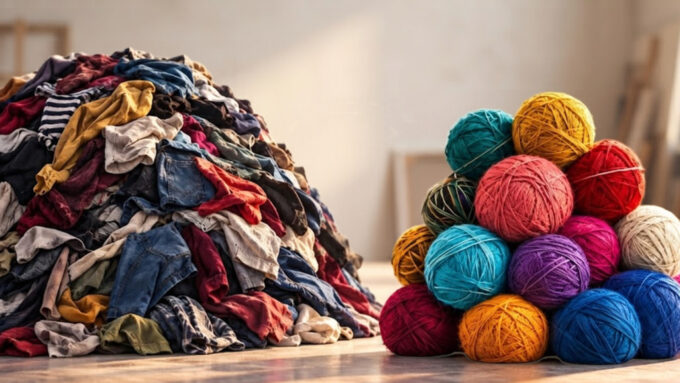
Bangladesh also has an opportunity to build on its existing textile-waste economy. The country already has an extensive informal network for collecting, sorting and trading garment-production leftovers, locally known as jhut or jhoot. A 2026 study published in Circular Economy and Sustainability found that up to 95% of apparel production leftovers are reused or recycled through existing informal systems. Yet the country still lacks sufficient formal mechanical-recycling capacity, with the study estimating that less than 5% of available cotton textile waste can currently be recycled into yarn domestically.
The scale of the waste makes this gap significant. Bangladesh’s textile industry generates up to 577,000 metric tons of textile waste annually, according to Reuters. Expanding domestic recycling could potentially save the country around $700 million a year in imports, while creating opportunities to turn discarded fibres into new raw materials. Instead of relying almost entirely on imported cotton and other virgin inputs, manufacturers could gradually build supply chains that recover more value from the waste already generated within the industry.
However, formalising textile recycling should not mean pushing aside the people who have kept this system running for decades. Informal collectors, sorters, traders and small recycling businesses possess practical knowledge and established networks that a new formal system would struggle to replace quickly. If higher-value textile waste is redirected towards certified recyclers, these workers could lose access to materials and income unless they are included in the transition. Bringing existing businesses into organised collection networks, offering training and safety support, and creating partnerships between informal traders, manufacturers and formal recyclers could help preserve livelihoods while improving traceability and recycling standards.
The secondhand boom is therefore neither a straightforward threat nor an automatic opportunity for Bangladesh. Its impact will depend on how the country responds to changing consumer preferences, evolving buyer requirements and the growing importance of circular production. Bangladesh does not need to choose between making new clothes and supporting a world that buys more secondhand. It needs to ensure that its garments remain valuable for longer, that more textile waste can be recovered locally, and that the workers already involved in this system share in the benefits. In a fashion economy increasingly shaped by a garment’s quality, lifespan and second life, the next competitive advantage may come from creating more value from every piece of fabric produced.
For more updates, be with Markedium.














Leave a comment