































In 2025, Bangladesh ranked 24th out of 148 countries in the World Economic Forum Global Gender Gap Report. This high ranking suggests strong gender parity on a national level. Workforce data from established financial institutions inside Bangladesh in 2026 reveals a more complicated situation.
The Bangladesh Bank Gender Equality report for January to June 2026 shows banks and financial companies are hiring more women. Many of these newly hired women remain in entry-level positions rather than advancing to senior corporate roles.

Workforce Distribution in Banking
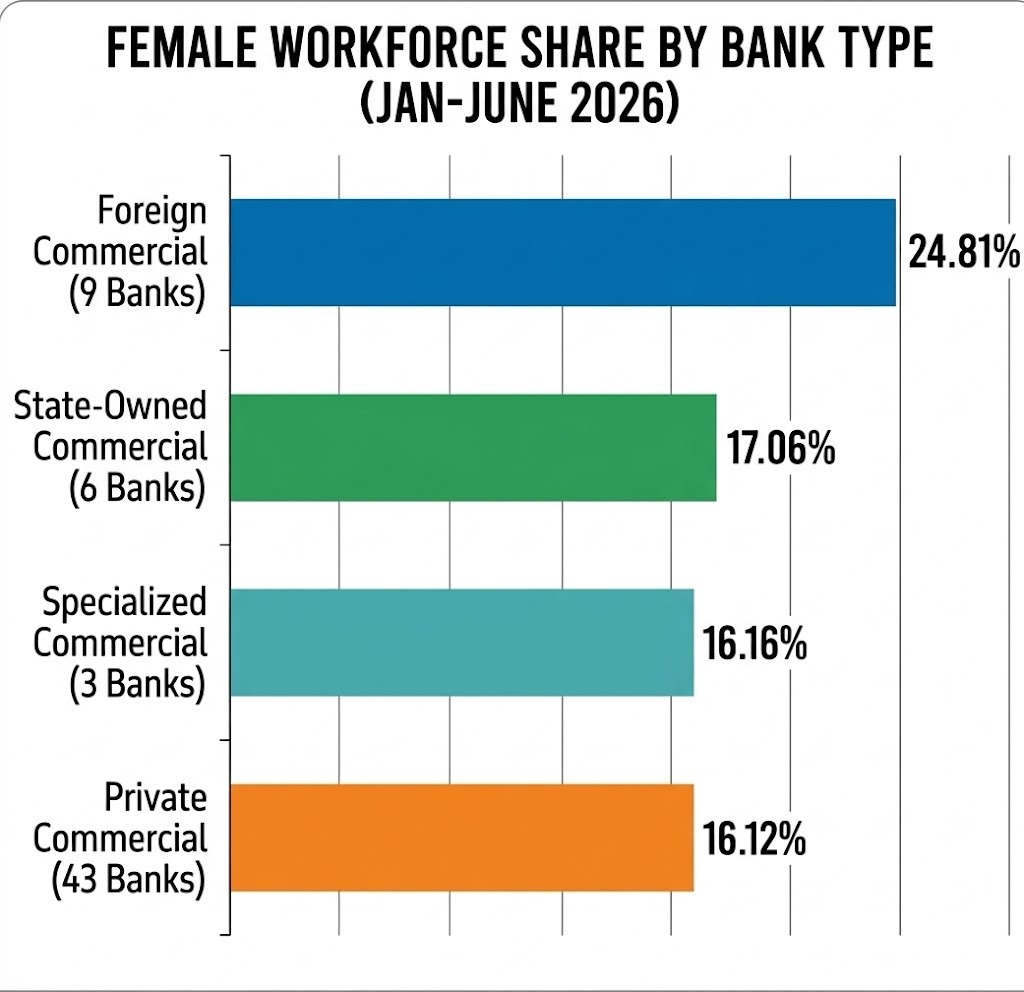
Women make up 16.51% of the total 217,818 employees across 61 scheduled banks in Bangladesh. The female banking headcount increased by 2.6% from 35,061 in the previous six months to reach 35,971 in the first half of 2026. Private commercial banks employ the highest absolute number of women with 23,524 female staff members. Foreign commercial banks employ 931 women. These foreign banks maintain the highest female workforce representation at 24.81%.
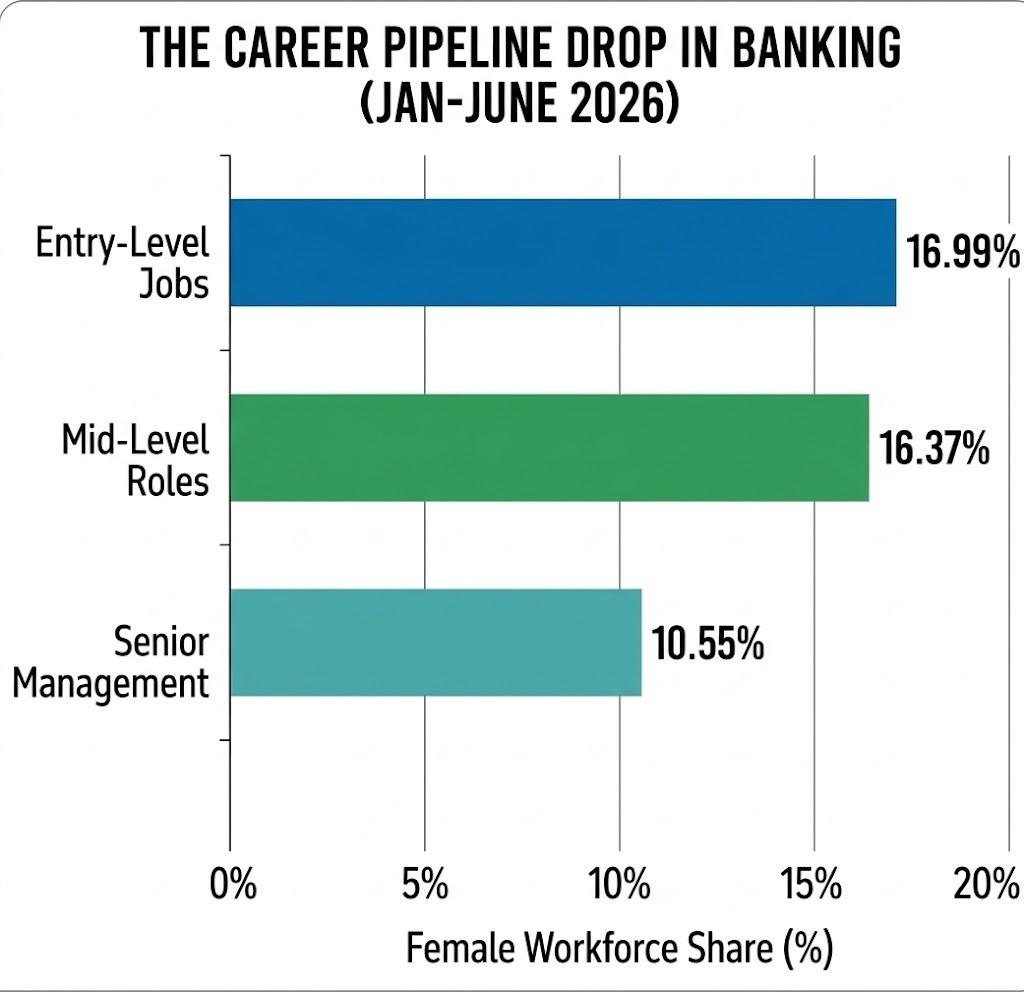
The percentage of female employees drops significantly at higher corporate ranks. Women hold 16.99% of entry-level bank jobs. The proportion of female employees stays relatively stable at the mid-level with women holding 16.37% of roles. Female representation then drops to 10.55% at the senior bank level. Women hold just 13.14% of board seats across all banks. Foreign banks lead the sector with 17.24% female board members. State-owned banks have the lowest board representation at 4.00%. Age demographics suggest the banking sector successfully recruits young women but struggles to retain them over time. Women account for 21.10% of bank employees under the age of 30. The female share falls to 11.00% for bank employees over the age of 50. A female turnover rate of 13.87% during this period indicates recent hiring gains do not naturally translate into long-term careers.
Representation in Finance Companies
Bangladesh Bank data shows a more challenging scenario inside the 35 non-bank financial companies of Bangladesh. Women account for 17.05% of the total workforce in these non-bank finance companies. Female employees hold 27.25% of all positions among finance company staff under 30 years old.
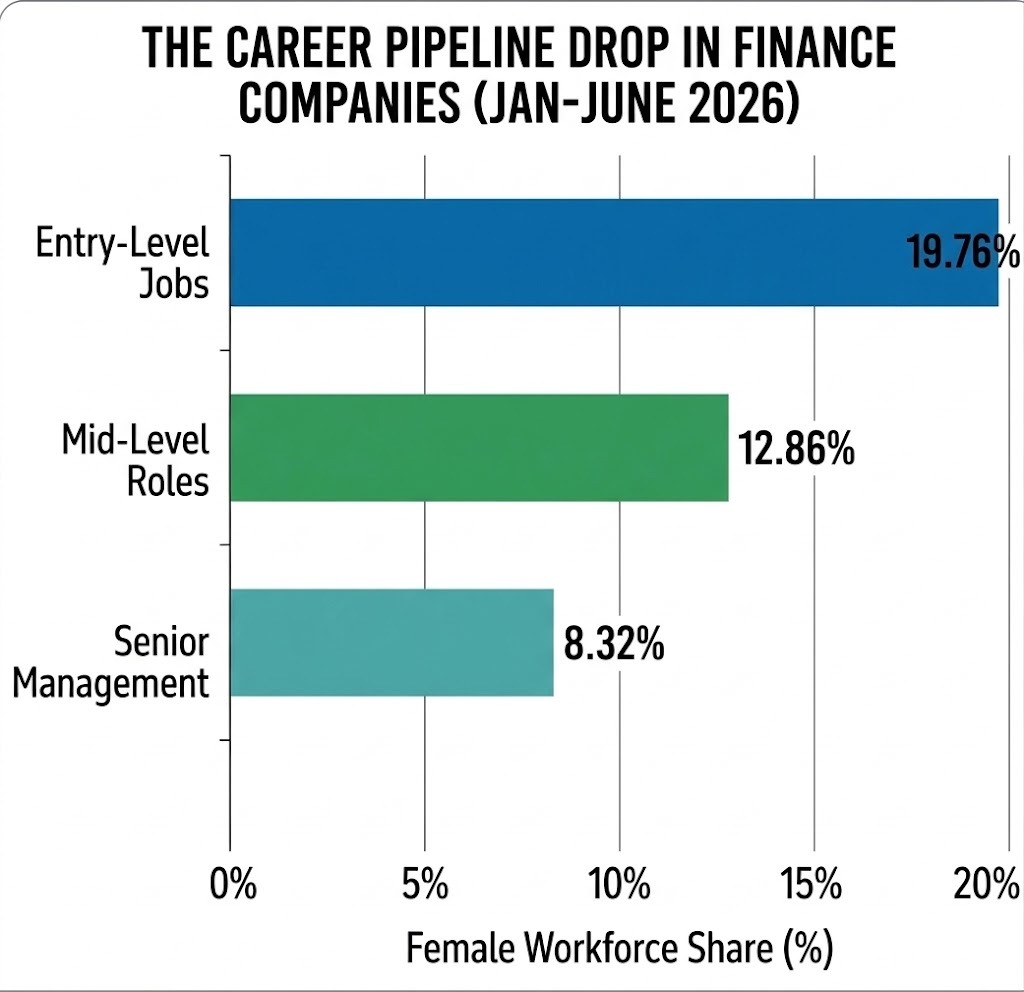
The drop in seniority is steeper in finance companies than in traditional banks. Entry-level roles in finance companies are 19.76% female. Mid-level roles in finance companies have 12.86% female representation. Senior positions in finance companies retain only 8.32% women. This 8.32% figure is the lowest representation metric in the entire 2026 Bangladesh Bank report.
Board representation in finance companies sits slightly higher than banks at 14.78%. The total female headcount in finance companies declined by one person between the second half of 2025 and the first half of 2026.

Changes in Workplace Support Systems
Basic regulatory compliance is strong across the banking sector of Bangladesh. All 61 scheduled banks provide six months of maternity leave and maintain sexual harassment policies. But voluntary workplace support infrastructure shows a downward trend in 2026. The banking sector added 910 female staff members between the second half of 2025 and the first half of 2026. Essential support facilities shrank across the sector during that exact same period. The Bangladesh Bank Gender Equality report monitors these workplace provisions as part of the Corporate Social Responsibility commitments of financial institutions. Tracking support systems like daycare and transport under Corporate Social Responsibility frameworks often means banks treat these facilities as optional discretionary projects.

The number of banks offering daycare centers dropped from 38 to 37. Banks providing dedicated after-hours transport for women fell from 38 to 36. Institutions running gender equality awareness training decreased from 53 to 49. Finance companies mirror this reduction in support facilities. Only four out of 35 finance companies in Bangladesh currently offer daycare centers. Two finance companies closed their daycare facilities over the six-month reporting period. Transport facilities after office hours declined to 23 from 24 in these finance companies. Finance companies running gender awareness training programmes decreased from 23 to 21.
Changes in Financial Sector Workplace Support Systems (2025–2026)
| Metric | Jul-Dec 2025 | Jan–Jun 2026 | Net change |
| Banks (61 total) | |||
| Female workforce | 35,061 Staff | 35,971 Staff | +910 |
| Daycare centers | 38 Banks | 37 Banks | -1 |
| Dedicated after-hours transport | 38 Banks | 36 Banks | -2 |
| Gender equality awareness training | 53 Institutions | 49 Institutions | -4 |
| Regulatory compliance (maternity leave / harassment policy) | Universal | Universal | No Change |
| Finance companies (35 total) | |||
| Female workforce | 1,018 Staff | 1,019 Staff | +1 |
| Daycare centers | 6 Companies | 4 Companies | -2 |
| After-hours transport facilities | 24 Facilities | 23 Facilities | -1 |
| Gender awareness training programs | 23 Companies | 21 Companies | -2 |
Fahmida Khatun,a distinguished fellow at the Centre for Policy Dialogue in Bangladesh stated in September 2026 that the recent increase in female employment is encouraging. She also noted that declining workplace support suggests progress remains largely numerical rather than institutional. Khatun further explained, “We need daycare facilities, safe transport after office hours and gender-awareness training for women’s recruitment, retention and career advancement, especially into senior management. If there is any deterioration in these areas, there may be increased work-family pressures, safety concerns and attrition among female employees.”
The decline in facilities suggests financial institutions treat support provisions as optional Corporate Social Responsibility (CSR) benefits instead of core human resource investments. Fahmida Khatun suggested that Bangladesh Bank should establish measurable standards, require time-bound improvement plans and monitor compliance regularly. Sustainable gender equality in workplaces requires not only hiring more women but also creating safe, supportive and inclusive workplaces where they can progress.
For more updates, be with Markedium.















Leave a comment