






























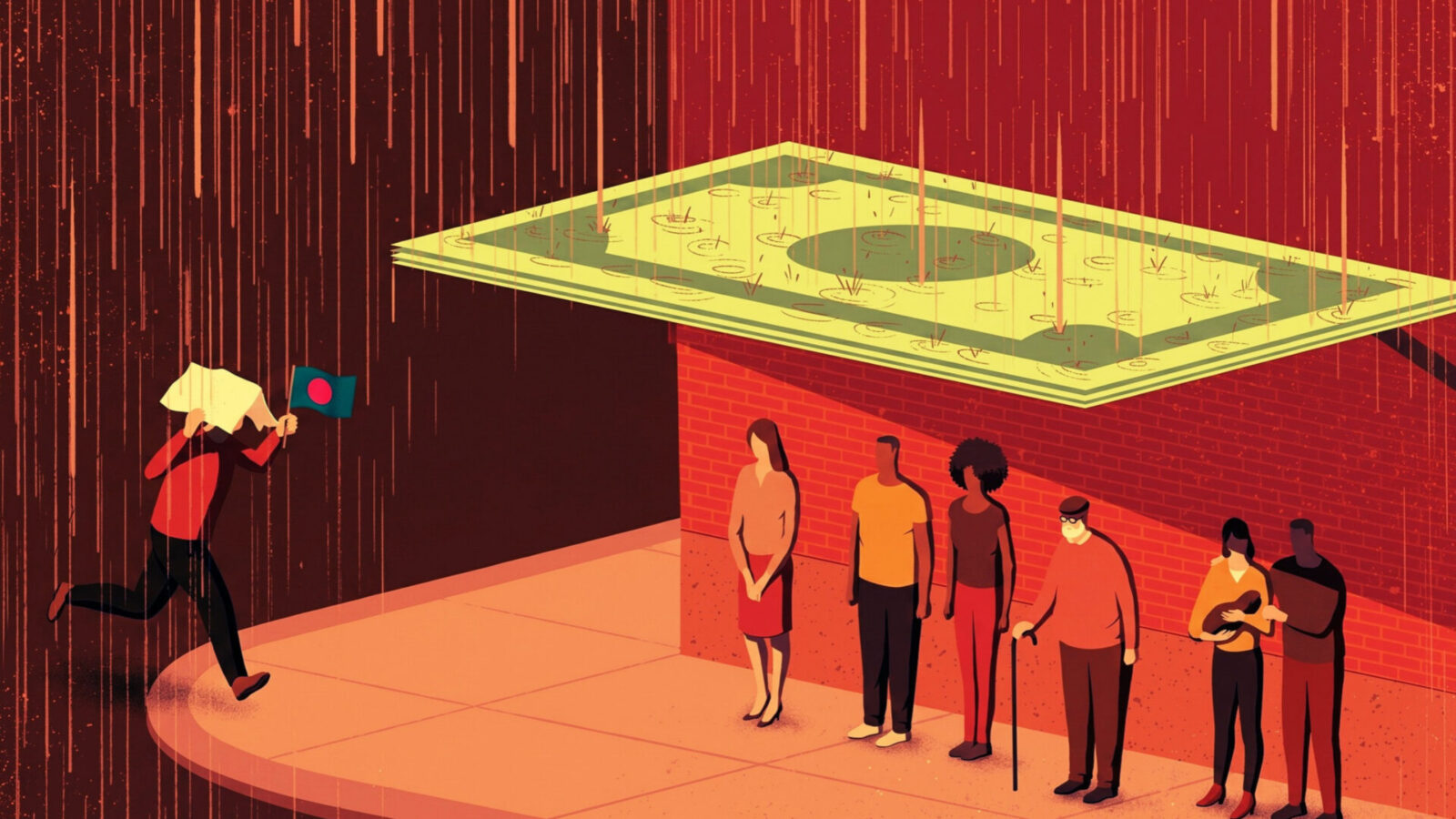
Imagine walking across a busy street in Dhaka today. A speeding bus hits you. You survive the crash. But the real disaster begins at the hospital billing counter.
In Bangladesh, a medical emergency can quickly turn into a financial crisis. Bangladeshis paid 79.3 percent of total healthcare costs out of pocket in 2024, the highest rate in South Asia, according to a Bangladesh Institute of Development Studies (BIDS) study. For the poorest households, healthcare consumed as much as 35 percent of income, compared to just 5 percent for the wealthiest. A separate, earlier BIDS study using 2022 household expenditure data found that out-of-pocket healthcare spending pushed 6.1 million people into poverty that year. Insurance exists specifically to absorb these catastrophic costs. So where is it when millions of Bangladeshi families need it most?

Boundaries of the Insurance Market
Worldwide, insurance works like a shared emergency fund. Average insurance penetration across reporting jurisdictions stood at 5.4 percent of GDP in 2024, and 6.2 percent among OECD countries specifically. Separately, industry research describes insurance penetration in emerging markets at roughly 2 percent, versus about 4 percent in advanced markets.
Bangladesh’s own insurance penetration has run at roughly 0.40 to 0.50 percent of GDP in recent years. Regional neighbors fare far better, with India at around 4 percent penetration. Bangladesh also has a striking mismatch between company count and market size: the sector has 82 insurance companies, versus 57 in India, despite India’s economy being many times larger. The Bangladeshi insurance market collected BDT 18,534 crore in 2025 or roughly USD 1.5 billion. With so many companies competing for such a small market local insurers often end up fighting over the same customers instead of building better products.
A few large companies dominate the life insurance space in Bangladesh. MetLife Bangladesh remains the market leader with roughly 27.1 percent of the market according to Insurance Development and Regulatory Authority data. National Life Insurance holds 14.1 percent and Delta Life Insurance accounts for 7.43 percent. These traditional insurers built their reach through vast networks of individual sales agents.
This distribution model shaped an aggressive sales culture driven by front loaded commissions. Under the regulatory schedule agents selling policies with terms of twenty years or more can earn up to 35 percent commission in the first year. This payout drops to 12.5 percent in year two and 5 percent from year three onward. Because earnings concentrate heavily in the first year agents have little financial incentive to maintain ongoing contact with clients. SM Ibrahim Hossain is the director of the Bangladesh Insurance Academy. He notes that agents frequently stop monitoring policies once personal connections have secured the initial sale and commission. He also pointed out that Bangladesh still lacks a structured and professional agent workforce compared to regional peers.
For more updates, be with Markedium.













Leave a comment