































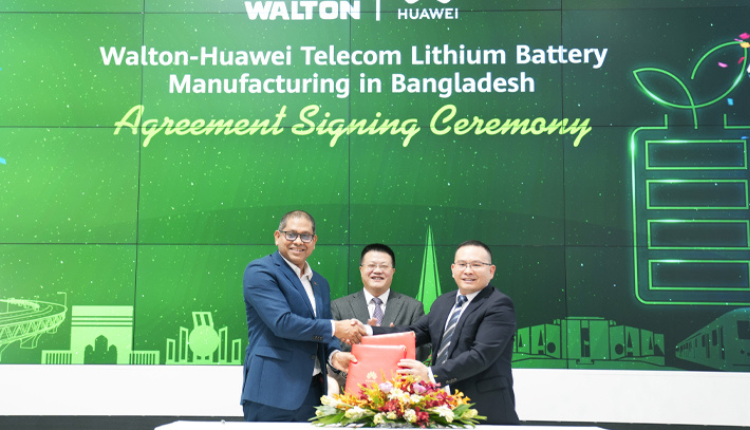
Walton has teamed up with Chinese tech giant Huawei to locally produce lithium batteries in Bangladesh, a move set to reduce costs for the country’s telecom operators and contribute to global carbon emission reduction efforts.
As part of the collaboration, Walton will establish an advanced, fully-automated production line with an annual capacity of 80,000 units. This facility will also oversee nationwide sales and after-sales services. The agreement was formalized at the Huawei Bangladesh Academy, with Huawei Bangladesh CEO Pan Junfeng and Walton Digi-Tech Industries Limited Chairman S M Rezaul Alam signing the deal.
Chinese Ambassador to Bangladesh Yao Wen attended the signing ceremony as the chief guest, along with representatives from Grameenphone and around 30 other telecom carriers.
Currently, Bangladesh’s telecom operators rely on imported batteries for their Base Transceiver Stations (BTS), which are essential for power backup. Under this agreement, Walton will begin producing lithium batteries domestically, aiming to bring the product to market within the next seven months. Huawei will provide technical support, including design expertise, raw materials, and guidance throughout the manufacturing process.
Traditionally, BTS towers have used lead-acid batteries as backup power sources. However, these batteries are not environmentally friendly, producing 50% more CO2 emissions compared to lithium-ion batteries. They also contribute to air and soil pollution and are less efficient, with only 80-85% efficiency, shorter lifespans, and lower energy density. Furthermore, lead-acid batteries require more installation space and frequent maintenance.
Lithium-ion batteries, on the other hand, offer nearly 100% efficiency, longer lifespans, and require less maintenance. They are also more environmentally friendly when recycled. As a result, lithium-ion batteries have become the industry standard for BTS power backup. In Bangladesh, however, low-quality non-intelligent lithium batteries are still commonly used. These batteries have shorter lifespans, require frequent maintenance, and cannot be managed by a Network Management System (NMS).
Walton’s new plant, set to begin production in February 2025, will have an annual capacity of 80,000 units, which is projected to meet the telecom industry’s demand for the next five years.
For more updates, be with Markedium.













Leave a comment