






























Oracle now carries somewhere between $122 billion and $167 billion in debt, depending on which measure and which quarter you pick. Its credit rating sits one notch above junk. Its free cash flow, which was comfortably positive as recently as early 2025, has gone deeply negative. On the other side of Oracle’s biggest contract sits OpenAI, which has publicly committed $300 billion to buying Oracle’s computing capacity over the next five years but carries almost none of the debt behind it. Both facts are true. Neither is improper. But together they force a question worth answering carefully rather than rhetorically: if Oracle is holding the obligation for capacity that OpenAI merely promised to pay for later, is Oracle actually the first domino in an AI infrastructure debt unwind — or is that the wrong way to think about what’s happening?
Well, Oracle is unlikely to be the first company in this cycle to default or restructure. It is, however, already functioning as the market’s chosen pressure gauge for the entire AI capex story, and has been for the better part of a year. Those are two different claims, and most of the current commentary on Oracle collapses them into one — which is where the panic, and the dismissiveness, both go wrong.

How Oracle got here
Thirty years of enterprise software-licensing built Oracle into a machine that printed cash at seventy-percent margins. Then it lost the first cloud war to Amazon, Microsoft, and Google, and spent much of the 2010s being discussed in the past tense. The AI buildout gave Oracle a second act, and it took it aggressively: total debt grew from roughly $80.5 billion in fiscal 2024 to $100 billion in fiscal 2025 and $122.3 billion by the end of fiscal 2026, with some measures — including total liabilities and mid-2026 quarterly snapshots, running as high as $167 billion.
Capital expenditure hit $55.7 billion in fiscal 2026 alone, overshooting Oracle’s own guidance, and free cash flow for the year came in at negative $23.7 billion even as operating cash flow hit a record $32 billion.
The gap between those two numbers is the entire story: Oracle is generating plenty of cash from its existing business, and spending all of it, plus tens of billions more, building capacity for a business that doesn’t exist yet.
In July 2026, S&P Global responded by cutting Oracle’s long-term issuer rating to BBB-, one notch above speculative grade, citing the scale and pace of that spending.
The customer side of the ledger looks nothing like Oracle’s. OpenAI’s $300 billion, five-year compute commitment, the anchor of the broader Stargate build-out — is a purchase contract, not a loan. OpenAI’s own balance sheet holds over $73 billion in cash and a revolving credit facility of roughly $4.7 billion; it hasn’t borrowed to fund the commitment itself. What it has done is burn cash at a startling rate: $3.7 billion in a single quarter against $5.7 billion of revenue, a $21.3 billion net loss in that same quarter, and no profitable year in its history.
So, the mechanics behind the original question hold up: Oracle borrowed the money to build the data centers. OpenAI made the promise to eventually pay for using them.

Where the exposure actually sits
The risk in that arrangement isn’t abstract. Roughly 54% of Oracle’s $638 billion contract backlog is tied to OpenAI alone, and that concentration has already shown it can move the stock — Oracle shares fell in April 2026 when reports surfaced that OpenAI had missed internal revenue targets. Underneath the headline backlog number sits a second problem: margin. Internal documents reported by The Information showed Oracle’s AI cloud server rentals running gross margins averaging around 16%, sometimes dipping below 10%, against a historical corporate gross margin near 70%. Oracle argues this reflects early-stage, sub-scale workloads rather than the business’s steady state, and that may well be true — but it’s the business the balance sheet is now built around, and the market hasn’t fully accepted the reassurance.
The clearest evidence of unease sits in the credit derivatives market, which tends to be a more sober read on a company than its stock price. Oracle’s five-year credit default swap spread — the annual cost of insuring against an Oracle default — climbed from 144 basis points at the start of 2026 to over 200 by midyear, and by August had reached roughly 2.03 percentage points, an eighteen-year high. That’s well above Nvidia’s spread near 78 basis points and Meta’s near 93. Oracle alone accounts for $6.5 billion of the total notional CDS outstanding on major AI-linked tech names — bond investors have effectively made Oracle their preferred instrument for betting against the entire AI capex trade. Michael Burry’s short position, disclosed at $144.63 a share and expanded further this month, rides the same signal: his argument is that circular financing across the AI ecosystem is obscuring how much of the capital sloshing around is now debt, not equity, and that excess compute capacity becomes visible by 2028. Oracle has also already cut roughly 21,000 jobs — about 13% of its workforce — in fiscal 2026 to help fund the buildout, with further reductions reportedly planned before the next fiscal quarter opens.
The case that this isn’t a collapse story
None of that, though, adds up to an imminent default, and three structural facts explain why.
Oracle’s debt is long-dated and staggered rather than concentrated in a near-term wall — maturities run out as far as 2064-65, and the slice coming due in the next one to three years is small relative to the total. Companies rarely default because a balance sheet looks alarming on paper; they default when a specific payment comes due and there’s no cash to make it. Oracle isn’t facing that kind of cliff in any near-term horizon.
Oracle is also actively de-risking its own capital structure rather than doubling down blindly. Roughly $75 billion of its AI contracts are now structured so the customer prepays or supplies the hardware directly, which reduces the capital Oracle itself has to raise, and the company has said it doesn’t intend to issue further debt for the rest of calendar 2026, leaning on equity instead for its fiscal 2027 funding needs.
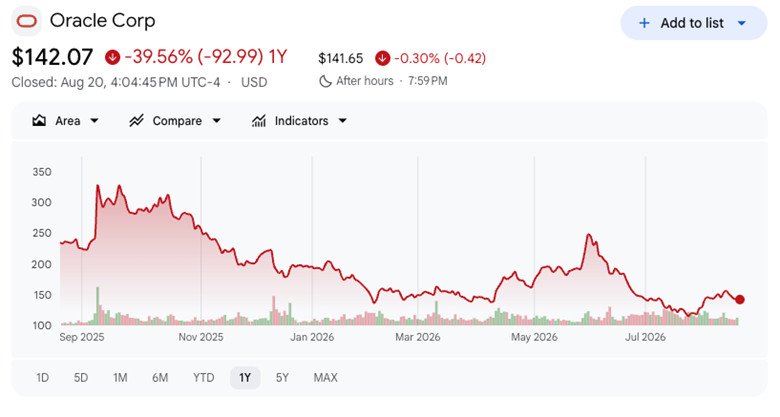
And the demand side of the story, as distinct from the financing side, doesn’t look broken: Oracle’s backlog is genuinely diversifying beyond OpenAI, with Meta, xAI, and Nvidia contracts contributing to recent growth, and management has guided to roughly 12% of the $638 billion backlog converting into revenue within a year. Even analysts who are skeptical of the margin story haven’t abandoned the stock — Morningstar carries a $330 fair value estimate, arguing thin GPU rental margins are an industry-wide feature rather than an Oracle-specific flaw, and the average Wall Street price target of roughly $265 sits well above the stock’s current $141-150 trading range.
Reading the signal correctly
The distinction worth holding onto here is between who defaults first and who cracks first, because those are not the same event and the evidence points in different directions depending on which one is being asked.
On default risk, Oracle looks like the wrong candidate for “first.” Its debt was deliberately structured to avoid a near-term cliff, its interest expense remains covered several times over by operating income, and it’s visibly shrinking the capital intensity of its own model through prepayment and hardware-supply arrangements. A company doesn’t collapse quickly when its debt doesn’t come due for decades — that’s precisely the point of issuing it that way.
On signal risk, Oracle already is the domino that’s wobbling, and has been since roughly the start of 2026. Its CDS spread is the highest of any major AI-linked name and has functioned as the market’s proxy for AI infrastructure debt fears for over a year. Its stock is down roughly 50-60% from its September 2025 peak. Its credit rating has already been cut once, with further downgrade risk explicitly flagged. It’s laying off staff to fund capital spending it can’t cover with operating cash. In the sense that matters to a market watching for the first sign that AI infrastructure economics have outrun the cash they generate, Oracle isn’t a future domino, it’s the current one.
Both of those readings can be true at once without contradicting each other. Oracle is unlikely to fail, and Oracle is the company most likely to keep transmitting stress signals if the broader AI capex thesis turns out to be wrong. The company that goes bankrupt first and the company that tells the market something is wrong first are rarely the same company — the second one usually has too much scrutiny, and too much at stake, to be allowed to fail before the pressure shows up somewhere else in the system first.
What could still change this
The single largest swing factor is OpenAI’s own financial disclosures, expected to become public through its IPO process sometime in the second half of 2026 into 2027 that filing will show, for the first time with real numbers, whether OpenAI’s financing can actually support the $300 billion commitment underpinning more than half of Oracle’s backlog. Oracle’s next one to two quarters of free cash flow matter almost as much: whether the burn rate stabilizes or keeps accelerating past the roughly $25 billion annual pace already logged will say a great deal about whether this is a temporary investment phase or a structural problem. A second credit downgrade would push Oracle into speculative-grade territory outright and mechanically raise its cost of capital at the worst possible moment. The CDS (Credit Default Swap) spread itself is worth watching independently of the stock price, since it has proven to be the more honest gauge of sentiment so far. And the backlog-to-revenue conversion rate Oracle has guided to 12% in the next year, another 34% over the two years after that — is the number that will eventually tell us whether $638 billion was a real asset or a figure that aged badly.
This analysis is based on public financial disclosures, credit market data, and reported financial documents as of mid-August 2026. It is not investment advice, and Markedium is not a licensed financial advisor. Company financials, credit ratings, and market positioning shift quickly in this sector; figures should be verified against the most current filings before being relied upon for any investment decision.
For more updates, be with Markedium.



















Leave a comment