

































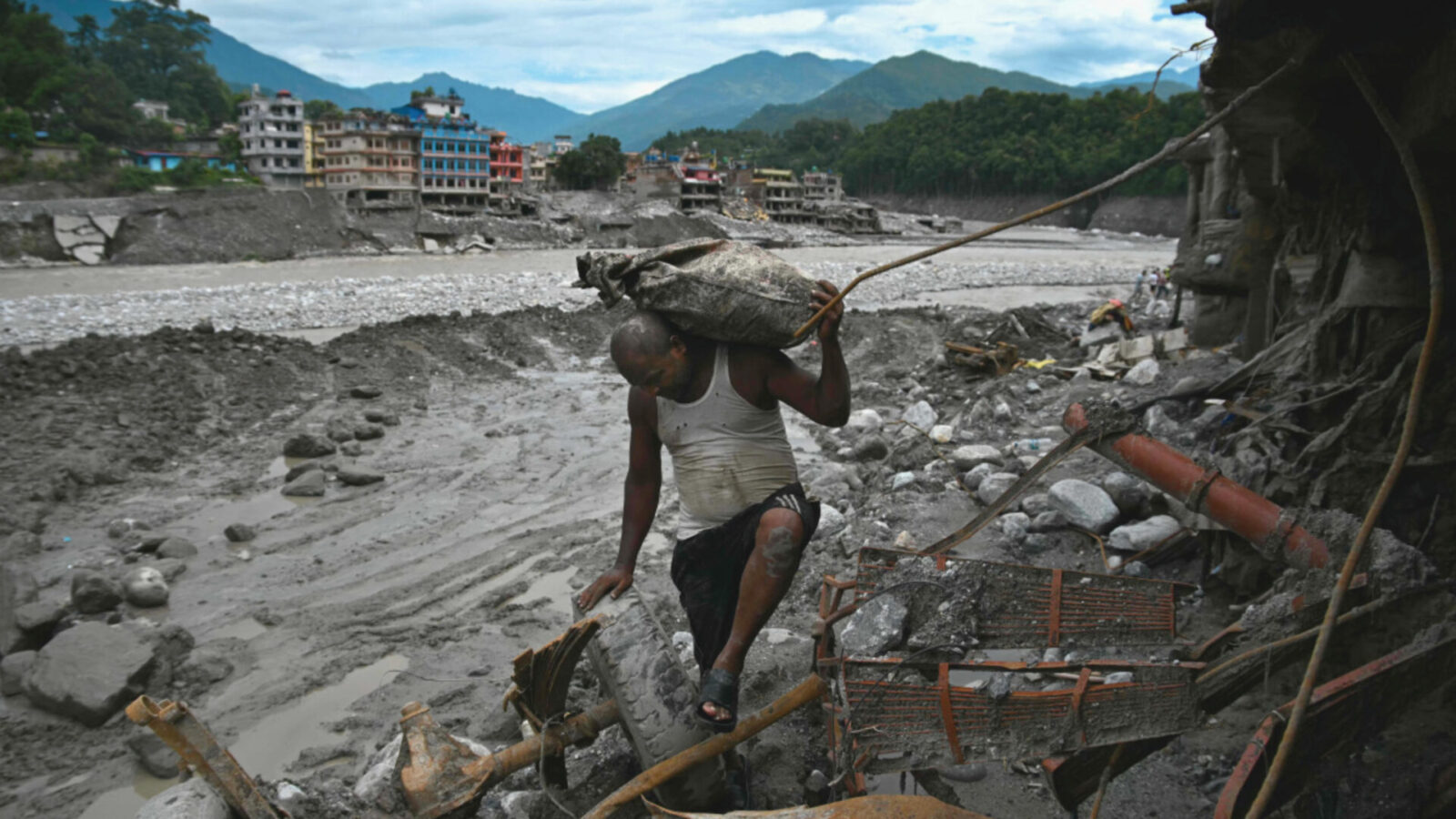
Nepal is facing a disaster bill that could test the capacity of its insurance industry. The devastating floods that struck the country in August are estimated to have caused around $2.56 billion in damage to property, housing and infrastructure. By August 31, 583 flood-related claims representing NPR 25.87 billion ($171 million) in preliminary insured exposure had already been reported. Commercial insurance losses could eventually exceed $132 million, with hydropower projects expected to account for much of the damage.

These figures measure different parts of the disaster, but together they expose a larger problem: who pays for the losses that insurance does not cover?
The question becomes even more complicated when the cost of a disaster is measured beyond buildings, equipment and infrastructure. A recent UN News report, based on a preliminary assessment by the International Labour Organization (ILO), found that around 21,400 employed people live within four kilometres of the flood footprint. This does not mean that all 21,400 people have lost their jobs or incomes, but it provides an indication of the scale of livelihoods potentially exposed to the disruption.
The destruction of homes, workplaces, roads, bridges and energy infrastructure has disrupted businesses and made it harder for people to get to work, access markets and reach essential services. The ILO also warned that the impact could spread beyond the affected areas through supply chains, trade and other interconnected businesses.
Nepal was already struggling with an insurance protection gap before the floods. A study published in August by the United Nations Development Programme (UNDP) and Nepal Insurance Authority found that formal insurance among Nepal’s micro, small and medium enterprises remains limited, complex and poorly aligned with risks such as climate shocks and business interruption.
Agriculture and tourism, two sectors particularly important to Nepal’s economy, are among the most vulnerable. Tourism, agriculture, transport and small businesses have been hit hard, leaving guides, porters, hotel and restaurant workers, transport operators and farmers facing lower incomes and reduced access to customers and markets.

Hydropower Sits at the Centre of the Risk
Nepal’s hydropower industry sits at the centre of the crisis. Hydropower projects across the affected corridor were among the hardest hit, with at least 11 hydropower projects in the affected region according to initial assessments. In many cases, access roads and above-ground infrastructure were washed away.
The Nepal Insurance Authority reported that engineering-related insurance accounted for around NPR 20.5 billion of the preliminary claims, while property insurance contributed another NPR 2.35 billion.
This creates a chain reaction.
A flood damages a hydropower plant. The operator files an insurance claim. The insurer covers the insured portion of the damage. But if the plant remains offline, the company may also lose revenue, struggle with debt repayments and face delays in restarting operations.
The consequences can extend far beyond a single company.
Nepal’s infrastructure is already highly exposed to climate-related disasters. One estimate puts the value of infrastructure exposed to climate-driven disasters at around $124 billion, while average annual climate-related losses have been estimated at nearly $760 million.
The flood also knocked a substantial amount of generation capacity offline, further demonstrating how damage to individual projects can create wider economic consequences.

When Climate Risk Becomes Financial Risk
The pressure does not stop with damaged infrastructure.
Repeated Himalayan disasters could change how insurers and reinsurers price the region’s risks. Industry executives have warned that increasing losses could result in higher premiums, tighter underwriting standards, lower sub-limits, narrower coverage and more exclusions for hydropower and other exposed infrastructure.
That could make future hydropower, tourism and infrastructure projects more expensive to finance.
For small businesses, the consequences could be even more severe. If a hotel loses its building, inventory and months of revenue but only has basic property insurance, the physical asset may eventually be rebuilt while the business itself struggles to survive financially.
This is where the insurance protection gap becomes an economic problem rather than simply an insurance problem.
Who Pays for the Uninsured Losses?
When insurance covers only part of a disaster, the remaining cost does not disappear.
It is absorbed by businesses, households, banks, governments and, eventually, taxpayers.
Nepal therefore needs to move beyond simply increasing insurance penetration. The bigger challenge is making insurance relevant to the risks businesses and households actually face.
Parametric insurance, which pays when predefined triggers such as rainfall levels or river levels are reached, could provide faster financial protection against climate-related disasters.
Better risk mapping, bundled insurance products for MSMEs and stronger public-private catastrophe insurance mechanisms could also make coverage more accessible and relevant. UNDP has already identified stronger regulation, product innovation and public-private partnerships as important elements in closing Nepal’s insurance protection gap.
If climate disasters become more frequent, their cost will not be limited to destroyed homes, roads or hydropower plants. It could appear in the form of higher insurance premiums, more expensive loans, greater government spending and investments that never happen.
So the real question is not only how much the next Himalayan disaster will cost. It is who will ultimately pay for that risk, and whether Nepal can build an economy where climate resilience is cheaper than repeated recovery.

The Warning for Bangladesh
For Bangladesh, this is more than a distant lesson from Nepal, particularly as the country’s own insurance protection gap continues to widen.
Insurance penetration has continued to decline. According to Bangladesh Bank’s Financial Stability Report 2025, the country’s insurance penetration ratio fell to just 0.34% of GDP in 2025, down from 0.36% in 2024 and continuing a steady decline from 2021.
The longer-term deterioration is even more striking. Insurance penetration stood at 0.55% of GDP in 2018, while the number of insured people fell by roughly 40%, from around 1.36 crore in 2018 to 82.2 lakh by the end of 2024.
The weakness becomes even more evident in claims settlement. By March 2026, approximately Tk 7,779 crore in insurance claims remained unsettled, equivalent to more than 73% of claims received. Among non-life insurers, the settlement rate was just 11.3%.
For a country exposed to floods, cyclones, river erosion and other climate-related hazards, Nepal’s experience offers a warning.
A low-insurance economy does not eliminate risk. It simply shifts the burden onto businesses, households, banks and the government.
The question for Bangladesh is whether its insurance industry can build enough trust, capacity and financial strength to absorb climate shocks before those shocks become a wider economic problem.
For more updates, be with Markedium.


















Leave a comment