

























How one of the world’s most famous taglines shifted from crowd scenes to quiet, personal momentum.
For years, Johnnie Walker ads felt like a moving crowd shot.
People spilling into streets after lockdowns. Friends linking arms again. Communities breaking barriers together. The “Keep Walking” line sat on top like a banner at the front of the march, a rallying cry for collective progress in a post-pandemic world.
Now the camera has zoomed in.
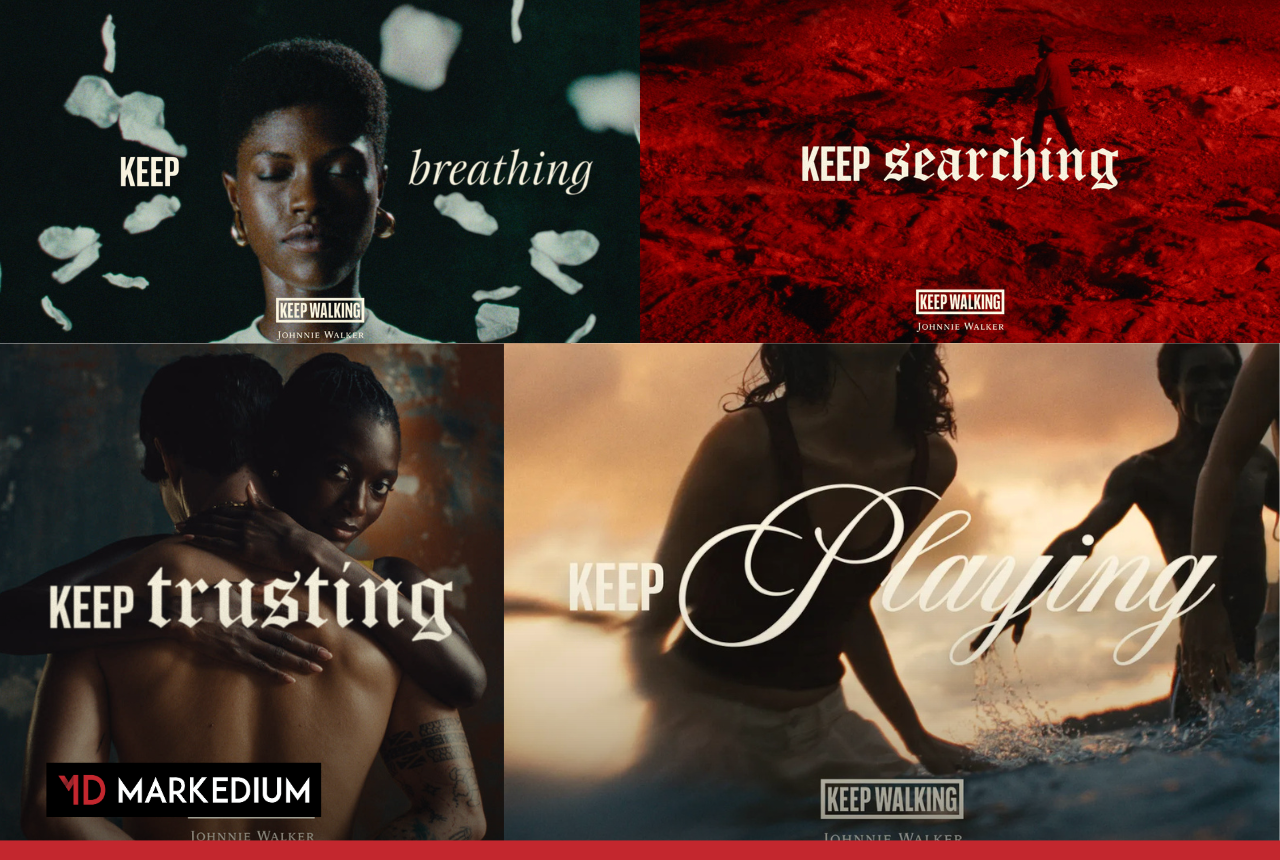
In the latest chapter of the iconic campaign, we’re not watching a crowd any more. We’re watching individuals: one person dancing, one person skating, one person running, each clinging to a little “keep” of their own—keep dreaming, keep playing, keep searching. The line hasn’t changed. The meaning has.
For brand strategists and marketers, this is more than a new film. It’s a clear signal of how fast consumer expectations have shifted—and what it takes for a legacy platform to stay emotionally relevant.
The old Johnnie Walker Keep Walking: a banner for us, not me
When “Keep Walking” first launched back in 1999, it gave Johnnie Walker something rare in spirits marketing: a simple, global idea about progress that could travel from billboard to bar counter.
Over time, the line bent with the world. In the early 2020s, as Covid restrictions lifted, the brand used it to paint hopeful, collective futures—people reconnecting, cities waking up, communities moving forward together after a long, anxious pause.
That made sense in the moment. Progress felt like a group project. The emotional centre of gravity was “us.”
But culture didn’t freeze in that mood. By the mid-2020s, the world had moved on from clap-for-the-neighbours energy. The big, sweeping “we’re all in this together” stories started to feel a little distant from everyday life, especially for younger drinkers whose milestones look nothing like their parents’.
You can feel the friction: a brand still talking in manifesto mode while its audience is quietly trying to figure out how to pay rent, switch careers, or start something of their own.

The customer insight: progress has gone granular
To understand what progress means now, Diageo didn’t just run another survey. It went eavesdropping—in the best possible way.
Through global social listening, the brand team analysed more than 97 million conversations built around the word “keep”. Out of that sea of posts and comments, six recurring themes surfaced: motivation, action, communication, emotion, success, and identity.
In simple terms, people weren’t talking about progress as one big, cinematic leap. They were talking about keeping at something—keeping calm, keeping faith, keeping in touch, keeping it together. Progress had become small, stubborn, and deeply personal.
This matches the wider research. Johnnie Walker’s release nods to McKinsey’s State of the Consumer 2025 report, which shows that people are less defined by old-school milestones—marriage, owning a house, having kids—and more by personal achievements and self-expression
In other words, the ladder of success has been swapped for a messy playground. Instead of everyone climbing the same rungs, people are building their own little routes: side hustles, creative projects, patchwork careers, found families.
If your brand is still only talking about progress as a straight line, you’re speaking the wrong language.
Enter the new idea: focus on the “keep,” not just the “walking”
The creative leap is deceptively simple: don’t rewrite the line—reframe the verb inside it.
The refreshed campaign centres on the word “keep” itself. Not as background noise, but as the emotional engine of the story.
The new 30-second hero film is built like a collage. Short, cinematic vignettes show different people in motion: splashing into water, taking a run, skating, dancing, and creating. No one is giving a TED Talk about progress. They’re just… keeping at something. The final “Keep Walking” line lands almost like a quiet endorsement of these tiny acts of persistence.
It’s a clever shift. Instead of talking about progress in big, abstract terms, the brand tags along with whatever the viewer already feels compelled to keep doing. Progress becomes less like a corporate mission statement and more like a personal whisper: keep going.
How it works: from manifesto to mirror
Think of the old “Keep Walking” films as murals on a city wall—big, bold, aspirational. This new phase behaves more like a mirror you catch in passing.
The mechanism is simple.
First, social listening turns the internet into a gigantic focus group. Those 97 million “keep” conversations act like a giant public diary, revealing how people talk about their struggles and hopes when no brand is in the room.
Then the creative team reduces that complexity into a few core emotional paths—motivation, action, communication, emotion, success, identity—and builds scenes that sit on those paths without needing heavy explanation.
Finally, the media plan puts that mirror in the right places. The hero film debuts in North America and will roll out globally across streaming, digital, paid social, and out-of-home in 2026, showing up in the same feeds and streets where people already share their “keep” stories.
The result is a brand platform that doesn’t shout Here is what progress should look like. It quietly says Whatever you’re trying to keep doing, we see you.

Why it matters: culture, category, and a new generation
For Johnnie Walker, this evolution is about more than just keeping a 25-year-old tagline alive. It’s about staying legible to a generation that often drinks less, questions more, and doesn’t want to be lectured by a bottle.
By leaning into individual pursuits and self-expression, the brand creates space to show up in music, fashion, and sports culture without feeling like an outsider crashing the party. A skater keeping at a new trick, a musician keeping at a riff, a runner keeping to a route—these are all natural homes for “keep” stories where whisky can appear as a quiet companion rather than the main character.
For the wider industry, the move is a useful case study in how to modernise a purpose-driven platform without throwing it away. Many brands rushed into big “we” narratives during and after the pandemic: we rise, we rebuild, we reconnect. That made sense when the wound was fresh. But people don’t live in group therapy forever.
The emotional centre has shifted from collective healing to personal navigation. Brands that don’t make that turn risk sounding stuck in yesterday’s crisis.
This doesn’t mean walking away from the community. It means recognising that communities are now built from the bottom up—one person’s “keep” at a time.
The quiet power of a small word
In science, big shifts often start with someone looking again at something tiny: a particle, a colour, a line in a spectrum. Here, the tiny thing is a four-letter verb.
By staring hard at “keep,” Johnnie Walker has found a way to refresh “Keep Walking” without losing its soul. The platform moves from crowds to individuals, from post-pandemic togetherness to everyday self-expression, from the grand march to the quiet, stubborn steps people take when no one is watching.
For a brand built on progress, that feels like the most honest move it could make.
And for the rest of us in branding and marketing, there’s a simple question hanging in the air: in a world where everyone is writing their own, slightly crooked path forward, are we still painting murals, or are we finally learning to hold up a mirror?











Leave a comment