
































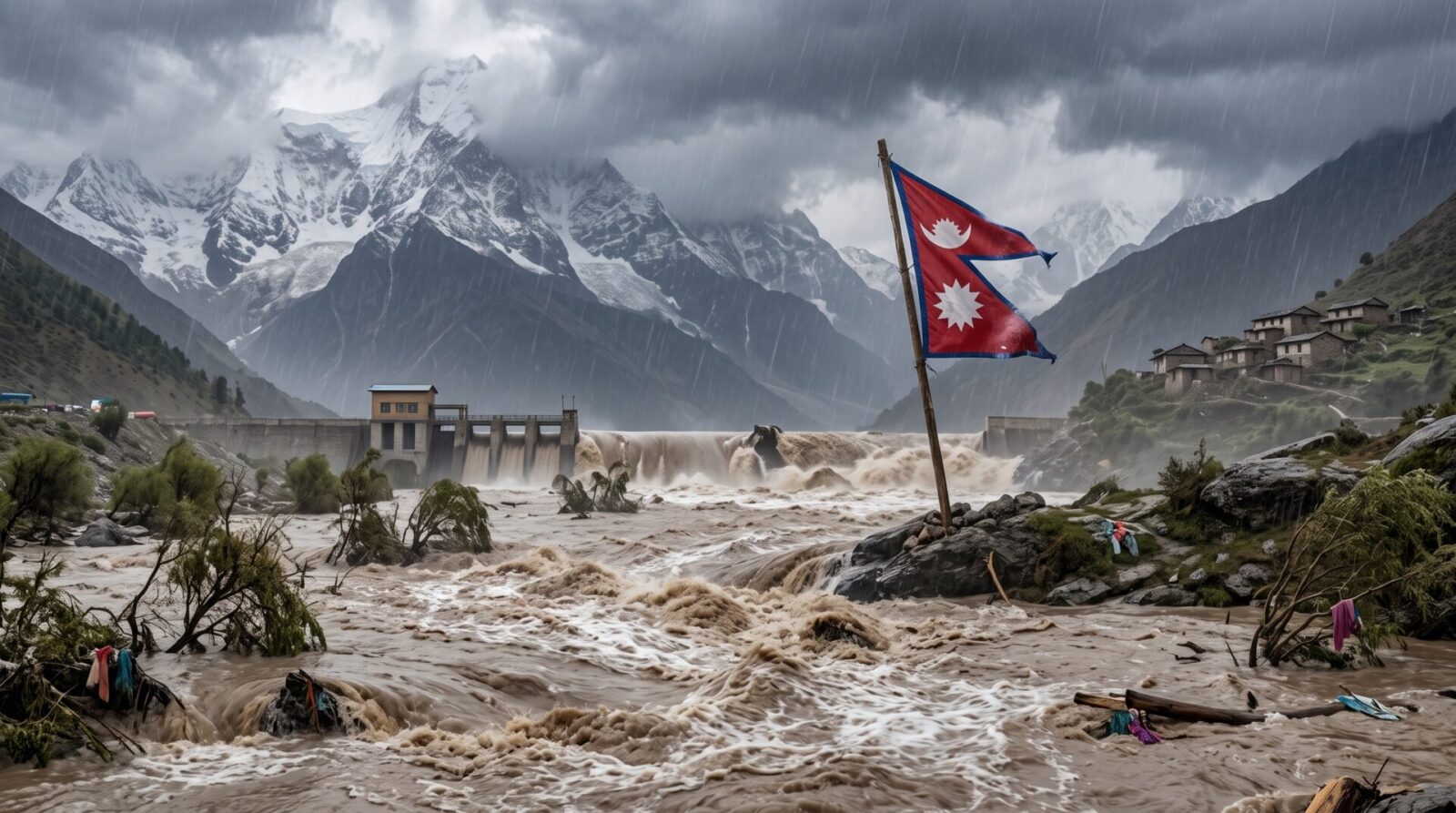
When Nepal’s Foreign Minister Shisir Khanal said the country wants to move from “aid” to “justice and compensation”, he was making a much bigger argument than a request for disaster assistance. Following the August 26 Bhotekoshi floods, Nepal is asking the United States, China, and India to treat post-disaster support not as charity but as a “moral liability.” The argument is straightforward: Nepal produces only about 0.1% of global greenhouse-gas emissions, yet it is increasingly paying for the consequences of a warming planet.
The economic cost is already enormous. Nepal’s preliminary assessment puts the damage from the disaster at NPR 387.54 billion ($2.6 billion) across infrastructure, settlements, agriculture, energy, electricity, telecommunications, health and education. The government estimates another NPR 7.95 billion ($53 million) is needed for early recovery alone. (Nepal Ministry of Foreign Affairs)

Traditionally, countries hit by disasters seek emergency aid, concessional loans and reconstruction assistance. Nepal is trying to change that framework—if climate change contributed to the growing severity of disasters, should countries that contributed disproportionately to global emissions also bear part of the financial cost? It is essentially the polluter-pays principle applied to climate diplomacy. Nepal has already made a similar argument at the International Court of Justice, arguing that countries responsible for historical emissions should bear responsibility for climate-related harm. The ICJ issued its landmark advisory opinion on states’ obligations regarding climate change in July 2025, adding legal weight to the broader international debate, even though an advisory opinion does not automatically create a mechanism forcing a country to pay another country for a specific disaster.
Khanal singled out China, the US and India because of their enormous contribution to global emissions. Together, the three account for roughly 45–48% of global greenhouse-gas emissions, according to figures cited in reporting on his remarks. But historical responsibility complicates the picture. The US has produced approximately 435 gigatonnes of cumulative fossil CO₂ emissions since 1850, compared with about 285 Gt for China and 66 Gt for India.
That raises an uncomfortable question: should responsibility be determined by today’s emissions, cumulative historical emissions, population, income, or some combination of all four? And if India and China are themselves developing economies, should they carry the same responsibility as countries that industrialized much earlier?
Well, there are several possible ways Nepal could finance the damage. Major emitters could provide bilateral climate finance, while Nepal could seek grants and concessional financing from multilateral institutions. It could also turn to the UN-backed Fund for Responding to Loss and Damage, created specifically to help vulnerable developing countries deal with economic and non-economic losses caused by climate change.

The problem is scale. Nepal has already incurred an estimated $2.6 billion in losses from a single disaster. If governments finance increasingly frequent climate shocks through borrowing, vulnerable countries could end up paying for climate change twice: first through destroyed infrastructure and livelihoods, and then through rising debt.
And the risk extends far beyond the immediate flood zone. Nepal’s exposure threatens the foundations of its economy: hydropower, tourism, agriculture, roads, bridges, trade corridors, and infrastructure investment. The World Bank estimates that, without action on climate change, Nepal’s GDP could be at least 7% smaller by 2050.
That makes Nepal’s demand more than a diplomatic statement. It is a question of who carries the balance-sheet risk of climate change. Moral responsibility may be easier to establish than legal liability.
Proving that a particular flood was caused by a particular country’s emissions and then calculating that country’s share of the bill is enormously complicated. But Nepal’s demand could still push an increasingly important question into international negotiations.
For countries like Nepal, climate change is no longer some distant environmental threat. It is already showing up in the form of damaged infrastructure, lost livelihoods, weaker economic growth, and ever-rising reconstruction costs. The question now is whether the countries that contributed the least to the climate crisis will continue to bear the greatest share of its costs alone.
For more updates, be with Markedium.


















Leave a comment