




























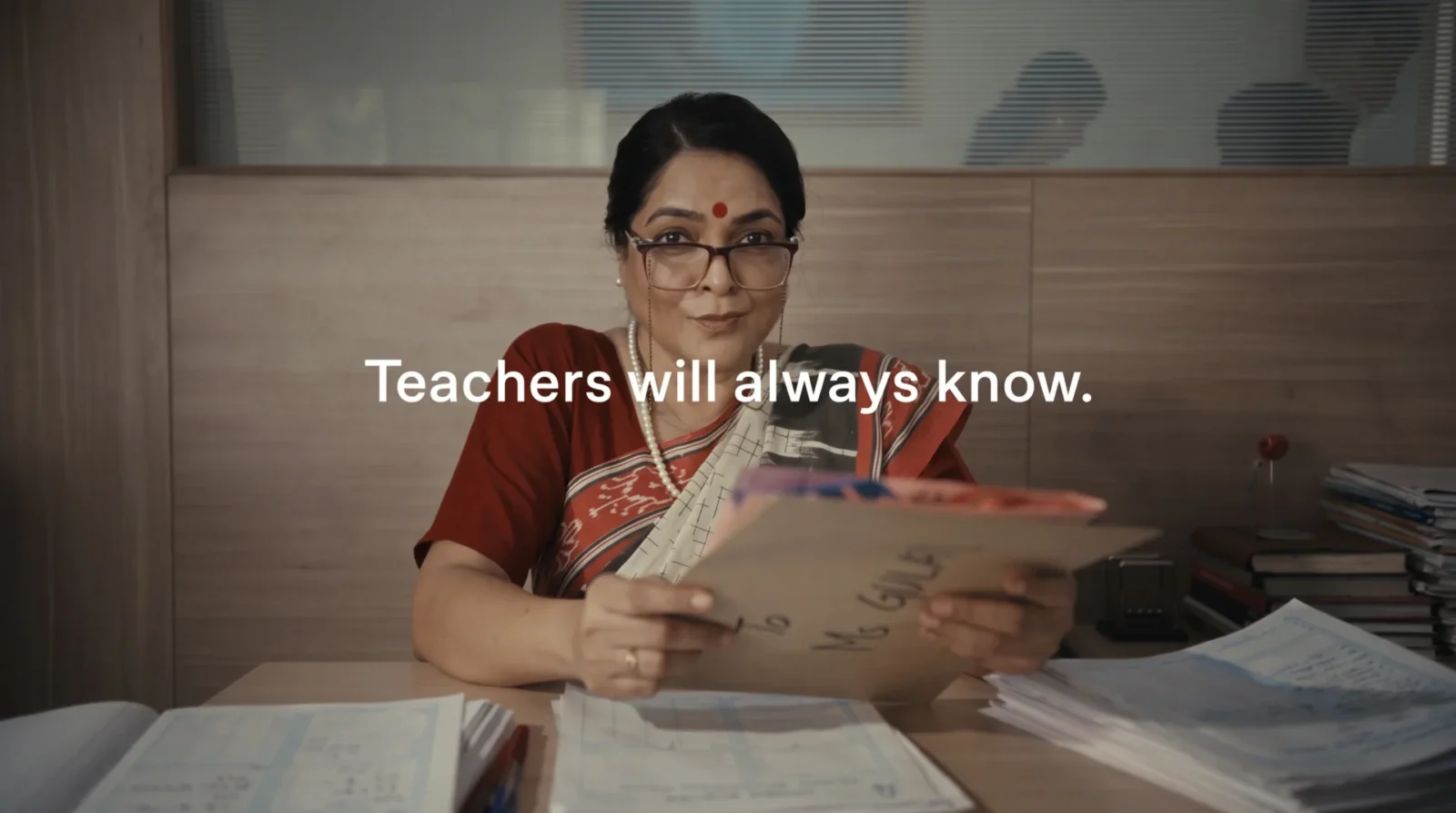
Your homework is perfect. Your answer sounds like it came straight out of a textbook. Your teacher looks at it, nods, and then asks one question: “Can you explain that?” Suddenly, the confidence disappears. That familiar classroom moment is at the heart of OpenAI India’s latest Teachers’ Day campaign, “Teachers know more than you think | Happy Teacher’s Day”. Released on September 5, the ad, created with The New Thing, takes a playful look at one of the biggest tensions surrounding AI and education: students can now get impressive answers in seconds, but can they actually understand them?
The ad builds its humour around students who appear to have mastered their assignments with the help of AI. One student confidently explains a complicated concept but struggles when the teacher asks a basic follow-up question. Another produces unusually polished work before finding it difficult to explain the answer in their own words. The students think they have found an easy way around their homework. Their teachers, however, can tell that something is different. They know how their students usually write, speak and answer questions. So when an assignment suddenly sounds much more advanced than usual, it can be quite easy for them to notice. The campaign does not make AI the villain or turn the film into a lecture about cheating. Instead, it shows a situation that many students can relate to. ChatGPT can help you come up with an answer, but that does not automatically mean you understand the answer. If a teacher asks you to explain it without looking at the screen, you still have to know what you are talking about.
There is also a reason this message fits with what OpenAI has been doing around students and education. In August, OpenAI introduced ChatGPT for Teens with features focused on learning, critical thinking and additional protections for younger users. One of these is Study Mode, which is designed to help students work through a problem instead of simply giving them the final answer. It can ask questions, break difficult topics into smaller steps and check whether the student understands the material. OpenAI says the feature was developed with teachers, scientists and education experts. It also includes quizzes, learning visualisations, Study Hours and reminders that encourage students to work through their homework instead of simply taking a shortcut.
The Teachers’ Day campaign brings all of that into one simple idea. It is not saying that students should stop using ChatGPT. There is a difference between asking AI to finish your homework and asking it to help you learn. A student can use ChatGPT to understand a difficult concept, practise questions, get an explanation in simpler language or figure out where they went wrong. But the student still has to understand the final answer.
OpenAI could have made a typical Teachers’ Day film about thanking teachers or remembering school days. Instead, it shows something teachers have always been good at: knowing their students. Students may use advanced technology to make their homework look smarter, but teachers can still recognise when something does not sound like them. AI and teachers are not presented as enemies either. ChatGPT can help students learn, while teachers can see whether that learning has actually happened. And perhaps that is why the campaign feels more memorable than a typical warning about AI and homework. It does not tell students that they need to understand their work. It simply puts them in the moment when they realise it themselves. Because ChatGPT can write the answer. But your teacher still knows when you don’t know it.
Watch the full campaign here.
Want to stay updated on the latest campaigns and creative ideas? Follow Markedium Campaigns for more.
Have a campaign you think deserves a closer look? Submit it to us here.













Leave a comment