






























In recent court filings, the legal team representing the notorious social media figures Andrew and Christian Tate made a startling revelation to assist with their bail case: the brothers’ vaunted, hypermasculine, ultra-wealthy online lifestyle was entirely a performance. The supercars they paraded were rented, the yachts were promotional assets, and their vast fortune was drastically exaggerated. Their defense counsel explained the mechanism with striking bluntness: the more outlandish their online posts were, the more likely they were to generate the views, likes, and money that fueled their empire.
While this revelation served a legal strategy to convince prosecutors that the brothers lacked the independent resources to flee custody, it exposed a far deeper societal pathology. The Tate empire was built on a psychological vulnerability intrinsic to the digital age: the monetization of curated aspiration. By telling millions of young men and boys that they were “poor because [they had] been lied to”, the Tates sold an engineered formula for success.
This phenomenon is not unique to a single set of influencers. Rather, it is a masterclass in how modern social media operates as a psychological trap, a mechanism best understood through the lenses of Social Comparison Theory and Self-Discrepancy Theory.
- The Digital Mirror: Social Comparison Theory
Developed by psychologist Leon Festinger, Social Comparison Theory posits that humans have an innate drive to evaluate their own personal, social, and economic standing by comparing themselves to others. In the offline world, these comparisons are typically lateral, occurring among peers of similar status. However, social media platforms have fundamentally distorted this process, transforming routine peer interaction into a relentless cycle of upward social comparison.
Upward social comparison occurs when individuals compare themselves to those, they perceive as superior in terms of wealth, physical attractiveness, success, or social status. On platforms like Instagram, TikTok, and YouTube, users passive-consumingly browse highly polished, unrepresentative highlights of others’ lives. Empirical research demonstrates that this upward comparison directly mediates the relationship between passive social media consumption and a decline in self-esteem.
When young, impressionable followers looked at Andrew Tate’s staged presentations of private jets and luxury assets, they were not just viewing content; they were engaging in an upward comparison that threatened their own perceived social standing. Because social media platforms display only the “post” and never the “whole picture”, viewers instinctively compare their own unedited, day-to-day struggles (their actual lives) against another person’s fabricated, gold-plated highlight reel. This constant, unequal comparison breeds a profound sense of inadequacy, dissatisfaction, and psychological vulnerability.
Read more: The First Domino Question: Is Oracle the Crack, or the Collapse?
2. Higgins’ Self-Discrepancy Theory and False Self-Presentation
To understand why the Tate brothers’ curated illusion was so highly effective, and why it caused such deep emotional distress in their followers, we must examine Higgins’ Self-Discrepancy Theory. This psychological framework postulates that individuals possess three primary domains of self:
- The Actual Self: The attributes an individual believes they actually possess.
- The Ideal Self: The hopes, aspirations, and wishes of who they would ideally like to be.
- The Ought Self: The duties, obligations, and societal expectations of who they feel they should be.
Under Higgins’ theory, psychological distress arises when there is a significant gap, or “discrepancy,” between these selves. A massive discrepancy between the Actual Self and the Ideal Self triggers negative emotions, dejection, and depression; a discrepancy between the Actual Self and the Ought Self triggers anxiety and guilt.
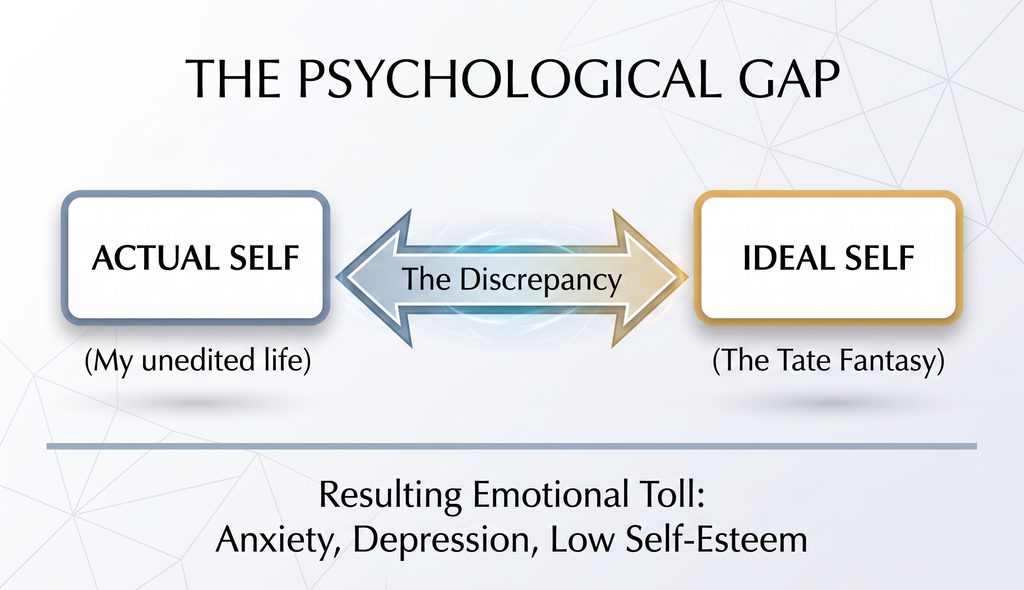
Social media platforms facilitate what researchers call false self-presentation, the deliberate construction and adoption of an online persona that aligns with an “ideal” rather than reality. The Tate brothers utilized false self-presentation on an unprecedented scale, using rented luxury assets to physically construct their “ideal selves” on camera.
By projecting this hyper-idealized, dominant identity, they intentionally widened the self-discrepancy gap in their audience. When Andrew Tate looked into the camera and declared, “I know the secret so pay attention to me and maybe you can have this life too”, he was actively manipulating his viewers’ self-discrepancies. He heightened their awareness of the massive gulf between their Actual Selves (feeling poor, powerless, or ordinary) and their Ideal Selves (desiring extreme wealth, power, and dominance). The audience’s desire to bridge this painful psychological gap is precisely what drove millions of young men to purchase their courses, change how they thought, and adopt their worldview.
3. The Empirical Consequences: Anxiety, Depression, and Vulnerability
The psychological toll of this digital aspiration machine is heavily documented in clinical research. Studies show that technology-based social comparison and feedback-seeking behavior are strongly associated with clinical depressive symptoms.
These negative mental health outcomes are not distributed evenly across the population; they are amplified by specific vulnerability factors:
- Adolescents and Young Adults: These demographics are in a critical stage of identity formation, making them highly susceptible to peer influence and social hierarchy markers.
- Gender Dynamics: Research indicates that young adult females are highly vulnerable to the depressive symptoms triggered by physical and lifestyle comparisons online.
- Offline Popularity and Social Capital: Individuals with lower offline popularity or pre-existing self-esteem issues are significantly more vulnerable to the psychological harms of online comparison.
For young men and boys navigating the modern “manosphere”, the constant exposure to hypermasculine ideals creates a toxic ought-self expectation. When they cannot achieve the unfeasible standards of wealth and dominance displayed by influencers like the Tates, they experience acute psychological vulnerability, lower life satisfaction, and anxiety. Ironically, this distress often drives them deeper into excessive social media use, as they desperately seek online validation and feedback to temporarily soothe their bruised self-esteem—completing a self-reinforcing loop of digital addiction.
4. Deconstructing the Trap: Actionable Insights
The revelation that the Tate brothers’ empire was a carefully staged performance provides a vital, real-world case study for dismantling the digital aspiration trap. To protect mental health in an era of simulated realities, both individuals and mental health professionals must adopt proactive cognitive strategies:
- Internalize the Performative Metric: Users must actively remind themselves of the economic incentives underlying false self-presentation. Outlandish, hyper-polished lifestyles are not authentic benchmarks; they are monetized performances designed specifically to generate views, likes, and revenue.
- Shift from Social Comparison to “Social Savoring”: Emerging psychological interventions suggest replacing active or passive comparison with “social savoring”—the practice of consciously feeling happy for others’ genuine positive experiences rather than using those experiences as a stick to beat oneself with.
- Acknowledge the Discrepancy: Recognizing when an online post is triggering a painful gap between your Actual Self and your Ideal Self can neutralize its emotional power.
- The “Whole Picture” Principle: Developing digital literacy means maintaining the fundamental boundary between a post and a life. A supercar, a filtered face, or a staged success story is a product, not a reality.
Ultimately, the downfall of the Tate brothers’ curated illusion serves as a powerful cautionary tale. It proves that the standards we compare ourselves to online are often entirely fictional. The next time you browse social media and feel a rising sense of inadequacy, remember the courtroom confession of the manosphere’s loudest leaders: you are seeing a post, not the whole picture.
For more updates, be with Markedium.















Leave a comment