
























The real test is whether a sustainable packaging idea can survive the economics of mass-market food.
Cheese is usually thought of as the finished product. But making it also creates something else: whey, the liquid left behind when milk is separated into curds and whey.
Whey is not inherently harmful, but disposing of large quantities without proper treatment can create environmental problems. Its high organic content can drive microorganisms to consume dissolved oxygen in water, putting aquatic ecosystems under pressure. That makes finding productive uses for whey more than a waste-management question.
Nestlé Central America and Ogilvy Colombia saw an unusual opportunity:
What if the byproduct from making cheese could help package the cheese itself?
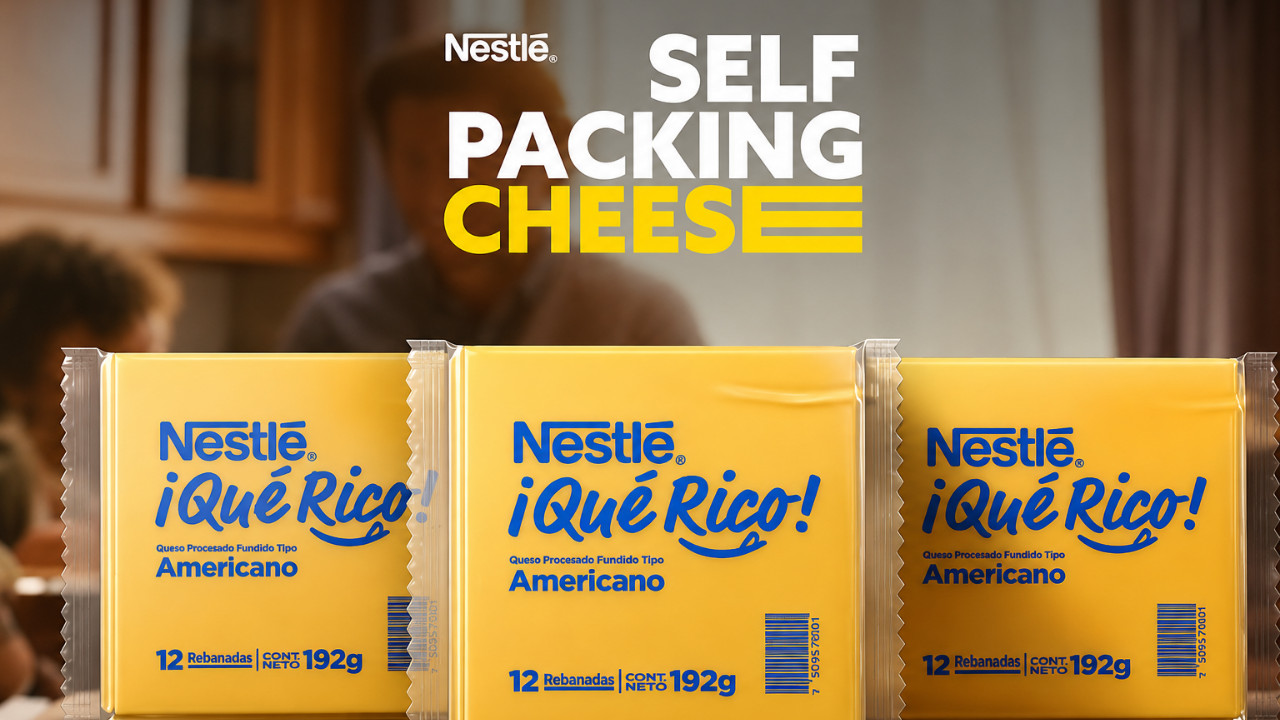
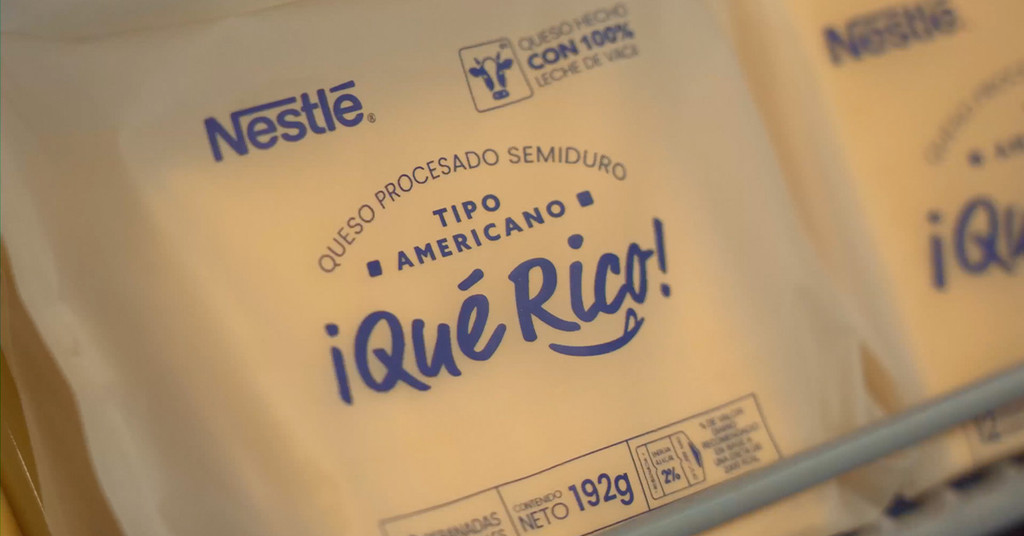
That became Self-Packing Cheese, an experimental packaging project for Nestlé’s ¡Qué Rico! cheese in Panama.
From Whey to Packaging
The concept uses a biotechnological process to transform whey into PHA, or polyhydroxyalkanoates, a biodegradable biopolymer with properties similar to plastic. The resulting material can be processed into a thin film for packaging. The project says the material is designed to preserve the cheese’s freshness, taste and nutritional properties while meeting FDA food-safety standards.
The idea creates a circular chain:
Cheesemaking → whey → PHA → packaging → cheese
That is what makes the project strategically interesting for Nestlé. It isn’t simply replacing one plastic film with another. It is testing whether a production byproduct can become a useful input for the same production system. And this fits into a much broader packaging challenge for the company.
Read more: Furlenco Launches ‘Drop Dead. Gorgeous’ Celebrating Women’s Unwinding Ritual at Home
By the end of 2025, Nestlé says it had reduced its use of virgin plastic packaging by 28% compared with its 2018 baseline, while 87.5% of its packaging was designed for recycling. The company is also exploring alternative materials and circular packaging solutions to further reduce its environmental footprint.
So Why Is It Still a Pilot?
This is where the story becomes less about an impressive prototype and more about business reality.
Nestlé’s own project description still characterises Self-Packing Cheese as something being tested in Panama. The stated target is around 5,500 tonnes of ¡Qué Rico! cheese using the whey-based packaging.
That does not mean the technology has failed. It means moving from a successful demonstration to mass commercial packaging requires answering harder questions.
- Can enough whey be collected and processed consistently?
- Can PHA be produced at a competitive cost?
- Can the film reliably withstand manufacturing, transportation and storage?
- Can it protect food as effectively as conventional packaging?
- And can all of that happen at the scale required by a global FMCG company?
These are not unique problems for PHA. Research continues to identify high production costs, material performance and scalability as major barriers to wider PHA adoption. One recent review puts PHA production costs at roughly $4–6 per kg, compared with around $1–2 per kg for conventional petrochemical plastics, although costs vary significantly by process and feedstock.
That cost gap helps explain why a promising biodegradable material can remain an experiment even when the environmental proposition is compelling.
The Price Question
If the packaging costs more than conventional plastic, the key question is: who pays the difference?
Nestlé could absorb the cost through lower margins, retailers could share the burden, or consumers could face higher prices. But scale could shift the economics. Cheaper feedstocks, more efficient production, and larger facilities could gradually bring PHA costs down, although matching conventional plastic remains challenging.
The real question, then, is whether Nestlé can make sustainable packaging affordable enough for mass consumption.
Would Consumers Actually Pay More?
This is where sustainability meets consumer behaviour.
While some consumers are willing to pay more for sustainable packaging, that willingness has limits. McKinsey’s 2025 research found that although some consumers accept a premium, far fewer are willing to pay significantly more.
This is particularly relevant for Gen Z, a growing consumer group often associated with stronger sustainability expectations. But wanting sustainable products and paying substantially more for them are two different things.
For a mass-market company like Nestlé, the challenge is therefore clear: make sustainable packaging affordable enough that consumers do not have to choose between sustainability and price.
What Happens If Nestlé Cracks It?
The potential goes beyond a single cheese wrapper.
If technically and commercially viable, the concept could be adapted to other packaging applications, supporting Nestlé’s broader push to reduce virgin plastic and expand circular and alternative materials.
But it remains an experiment, not a proven replacement for conventional plastic across Nestlé’s global portfolio. The Panama application is still described as a test.
Even so, the concept has already gained industry recognition, including a Silver Lion in Design at Cannes Lions 2025.
The Real Test Isn’t Whether It Can Be Made
Nestlé has shown that whey can be transformed into packaging material. The bigger challenge is making it affordable, reliable, and scalable enough for everyday FMCG products.
If successful, Self-Packing Cheese could represent more than a packaging innovation. It could demonstrate a different approach to mass-market production: instead of asking how waste should be disposed of, ask whether it can become the next input.
Ultimately, that is the real test of sustainable packaging, not simply whether consumers embrace the idea, but whether the economics can make the greener choice the everyday choice.
For more updates, be with Markedium.










Leave a comment