

























In Conversation with Oliduzzaman Sawon
Background
Breast cancer awareness is not new in Bangladesh. But being aware of the disease does not necessarily mean knowing how to recognise it.
For many women, knowing that breast cancer exists is very different from knowing what its early signs actually look or feel like. There were very few accessible visual references for breast self-examination, while cultural sensitivities often made conversations around the female body difficult to approach openly.
For Finlay, a brand associated with food and everyday nutrition for an elevated audience, this presented an interesting opportunity during Breast Cancer Awareness Month. The question was simple, but not easy to answer: how could a food brand contribute meaningfully to a healthy conversation without simply putting its logo on another awareness message?
The answer started with understanding the audience. Research showed that while most women were familiar with breast cancer as a disease, many did not know how to identify its physical symptoms. The gap was not necessarily information. It was the lack of a visual reference that could make those symptoms easier to understand.
The campaign therefore had to find a way to make something difficult to show easier to see,and do so in a way that felt natural within the cultural context.
Insight
The signs of breast cancer can be incredibly small. Sometimes, a change can be no bigger than a grain. That observation became the bridge between the problem and the brand.
Rice is one of the most familiar things in everyday Bangladeshi life. It is also at the heart of Finlay’s product world. Instead of treating rice simply as something to sell, the team looked at it as a way to communicate.
The thought was straightforward: if the signs can be as small as grains, why not use grains to show them?
The opportunity became even more relevant because breast cancer symptoms had rarely been demonstrated visually in a way that was both clear and culturally comfortable. Rather than relying on explicit imagery, the campaign could use something familiar to explain something that was often difficult to talk about.
That gave Finlay a genuine role in the conversation. It wasn’t simply attaching a brand name to a social cause. The product itself became part of the message.
Idea
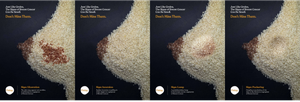
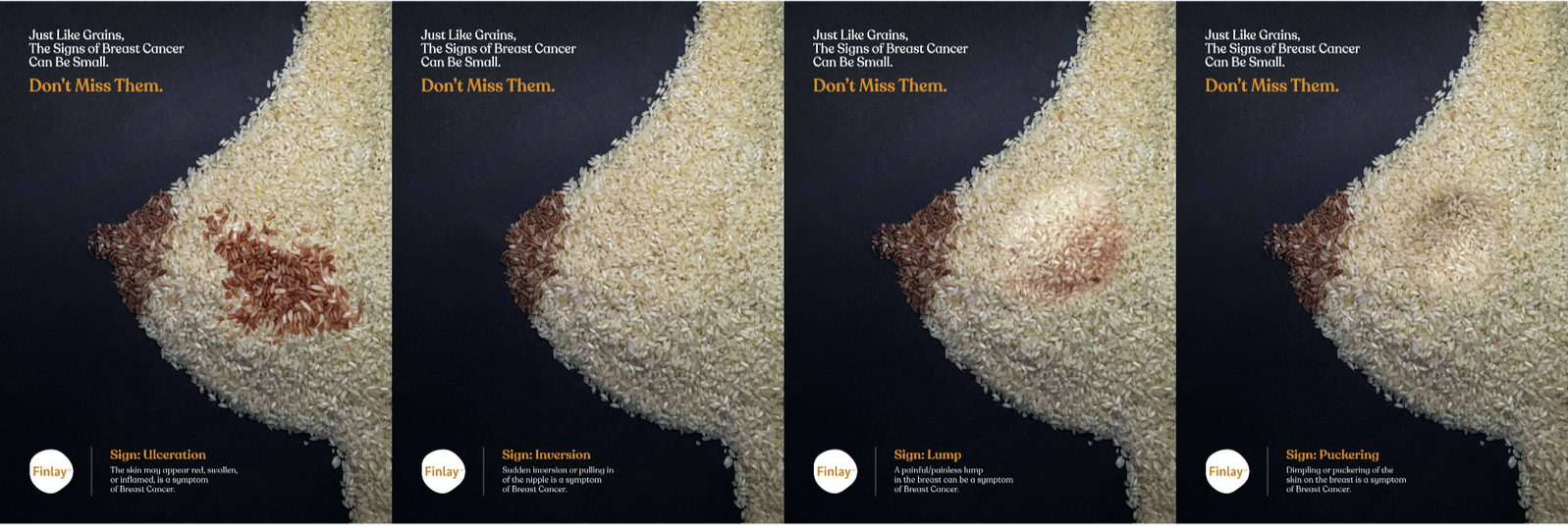
Don’t Miss a Grain of Change turned rice grains into a visual language for breast cancer symptoms.
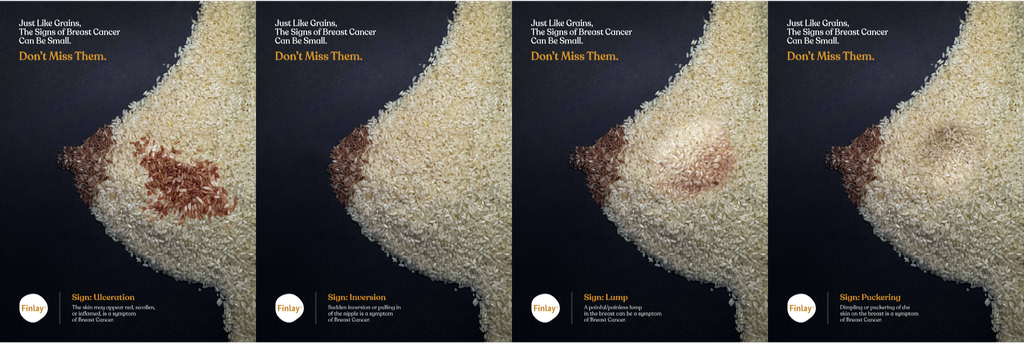
White, red and black fibre rice grains were carefully arranged into breast-shaped visuals. The individual grains represented warning signs including lumps, rashes, puckering, ulceration and nipple inversion.
The campaign carried a simple message:
“Just Like Grains, The Signs of Breast Cancer Can Be Small. Don’t Miss Them.”
The idea worked because the comparison was so easy to understand. A grain is ordinary. It is small. And it is easy to overlook. Some early signs of breast cancer can be exactly the same.
The visual metaphor also gave the campaign a natural connection to Finlay’s fibre rice products. It didn’t feel like a health message that happened to have a food brand attached to it. The brand’s own product became the medium for telling the story.
The campaign was created by Lie to Eye for Finlay and launched in Bangladesh in October 2024.

Execution
The idea was designed to live beyond a single advertisement. The rice-grain visuals became the central creative assets across digital and print communication. Their simplicity made them easy to adapt, while the unusual use of rice gave people a reason to stop and look twice.
But just as important as what the campaign showed was where it showed it.
The visuals were placed beside mirrors in women’s washrooms, including corporate and public spaces. The placement brought the message into a very personal, everyday moment.
A woman finishing her time in the washroom would stand in front of a mirror and see a message asking her to pay closer attention to changes in her own body.
That made the placement more than just a media decision. It became part of the idea itself.
The campaign took something that might otherwise have remained a social-media message and brought it into a real-world moment of self-awareness.
The relatively small budget also meant the idea had to work hard on its own. Fortunately, the visual was simple enough to travel without much explanation. You could see the grains, understand what they represented and immediately grasp the thought behind them.

Results
The campaign generated strong organic attention, with the visuals being widely shared across social platforms. Its shareability took the work beyond its immediate audience, with women’s organisations and international audiences engaging with the campaign.
For Finlay, the campaign created a meaningful role for the brand during Breast Cancer Awareness Month. Instead of simply reminding people that breast cancer exists, it helped communicate something more useful: what women should actually look out for.
The work also received significant recognition within the advertising industry. The campaign went on to win multiple awards, including recognition at Commward, with the wider campaign team reporting seven wins- two Gold, three Silver and two Bronze.
But the most meaningful outcome was perhaps the simplest.
The campaign made a difficult subject easier to approach. A grain became a symptom. A familiar ingredient became a visual reference. And a food brand became part of a conversation about women’s health.
It is a reminder that impactful advertising does not always need a massive budget, complicated technology or even a traditional client brief. Sometimes, the strongest ideas come from looking closely at a problem and noticing a connection that was there all along.
About Oliduzzaman Sawon

Oliduzzaman Sawon is a strategist by profession, a creative thinker by instinct, and an agency change-maker by nature. With more than 12 years of experience in advertising, he has worked across strategy, creative, brand, content and media. His work has involved not only developing campaigns and brands, but also questioning how agencies think, collaborate and solve problems.
Today, he serves as Chief Strategy Officer at Magnito, bringing together strategic thinking, creative problem-solving and a strong understanding of brands, people and culture.
At the heart of his approach is a fairly simple belief:
“At the end of the day, as a strategist, I am solving problems.”
For him, strategy isn’t just about putting together a plan and presenting it neatly. It is about getting to the real problem first,understanding why something is happening, what is getting in the way, and what the brand actually needs to solve.
That same conviction shapes his advice to young advertisers.
“Be brave and believe in your idea.”
But bravery, for him, needs to come with honesty. An idea should be challenged before it is defended. A strategist or creative should be able to recognise when something doesn’t work, even when they are expected to sell it. He says, “If you don’t believe in an idea, don’t sell it.”
And if an idea has to be sold anyway, the first responsibility is to be honest with yourself about it. That honesty, he believes, gives people the clarity to make better decisions rather than simply saying what a client, manager or colleague wants to hear.
For young people entering advertising, his advice isn’t about chasing every new tool or trend. It is about caring enough about the work to keep questioning it.
Passion matters, especially in an industry where problems, unexpected changes and last-minute challenges are part of everyday life.
His message to the next generation is ultimately about having the courage to think for yourself, staying curious, and being honest about the work. “If you are passionate, if you like advertising, then come into advertising.”
Because whether the challenge is a declining sale, a cultural barrier or a change no bigger than a grain of rice, good strategy begins with the same two questions: What is the real problem? And how can we solve it?










Leave a comment