

























Singer Bangladesh, one of the leading electronics manufacturer and retailer in the country, has published its 9M 2026 report. The company posted a net loss of BDT 1,194.4 million, 4.9% higher than the loss of BDT 1,138.8 million in 9M 2025, even though revenue grew 4.1%. This is the second consecutive year of loss.
Singer | Single-Digit Revenue Growth
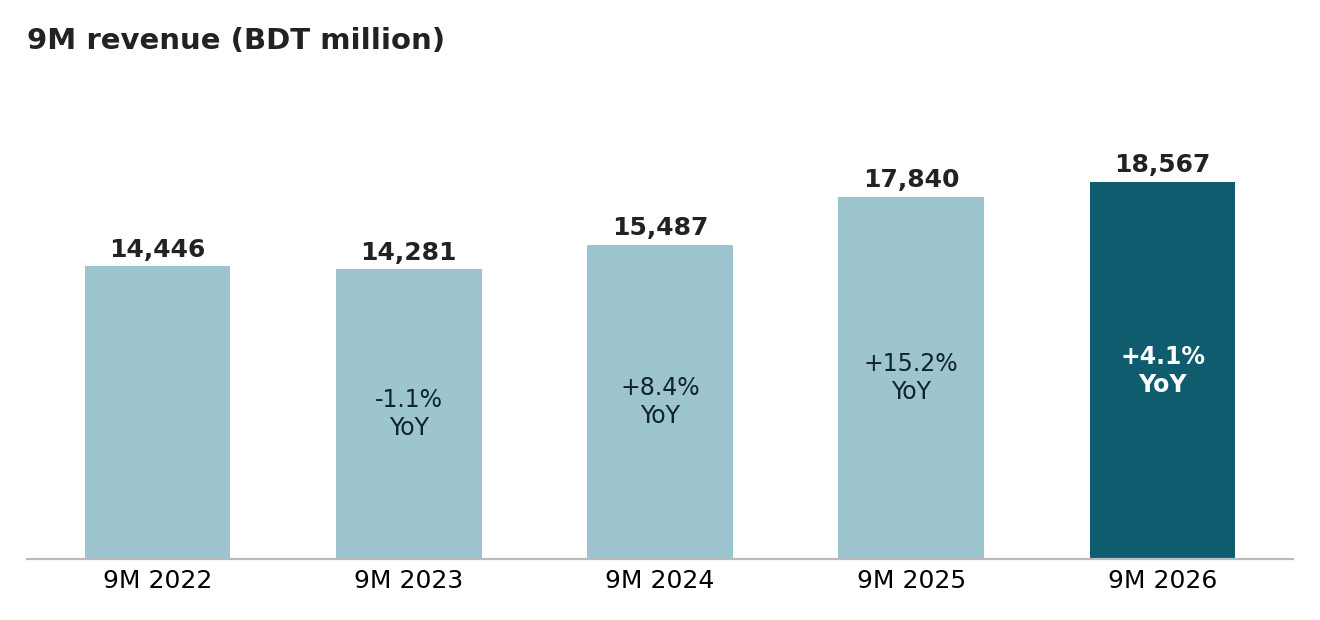
Revenue grew 4.1% to BDT 18,567.2 million, a slowdown from 15.2% growth in 9M 2025. Revenue has now recovered steadily from the 1.1% decline in 9M 2023.
Revenue by type | 9M 2026 | 9M 2025 | Growth |
|---|---|---|---|
Domestic | 18,138.7 | 17,808.8 | 1.9% |
Export | 401.6 | 0.0 | New |
Total (gross) | 18,540.3 | 17,808.8 | 4.1% |
Source: Company financials. Values in BDT million. Gross revenue by type.
Domestic sales, which make up almost the entire business, grew only 1.9% to BDT 18,138.7 million. Export sales of BDT 401.6 million were new this period and accounted for more than half of the increase in gross revenue, so the growth was driven largely by the new export business rather than by the core domestic market.
Gross Margin Edges Up
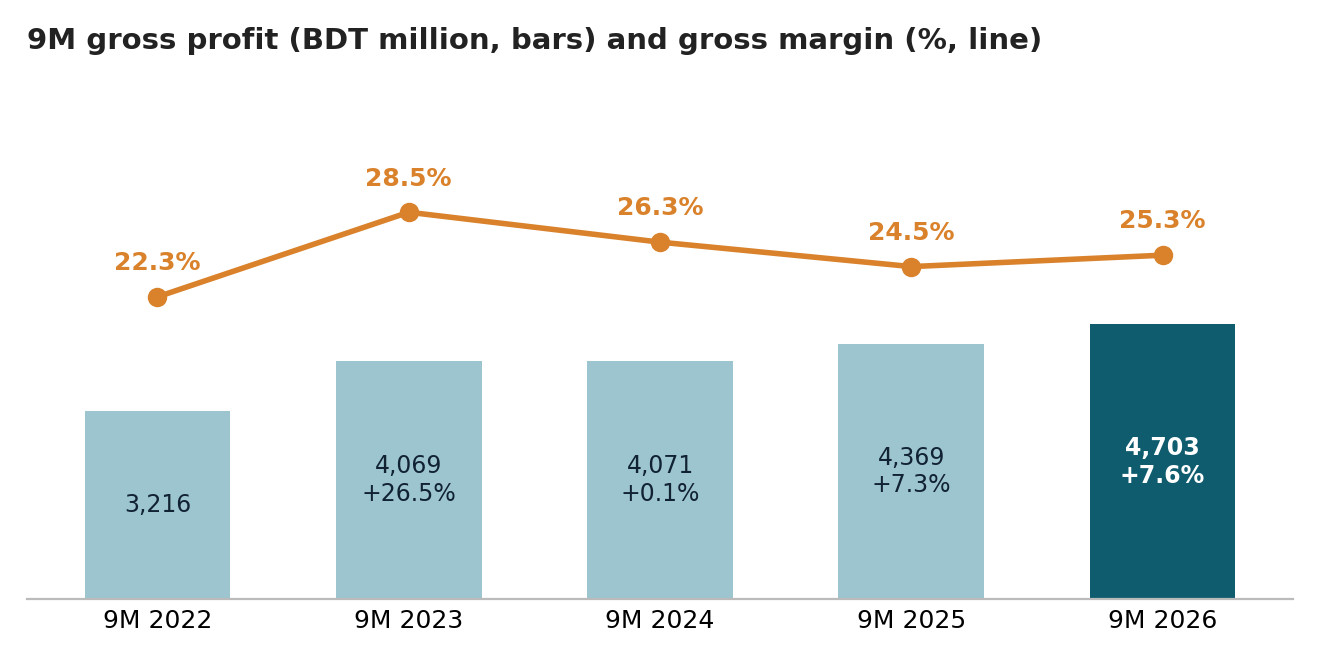
Gross profit rose 7.6% to BDT 4,702.9 million, faster than revenue, as cost of sales grew only 2.9% to BDT 13,864.3 million. The gross margin improved by 84 basis points to 25.3% from 24.5%, though it remains well below the 28.5% reached in 9M 2023.
The company says selling prices could not be raised enough to absorb the higher average cost of products, which rose due to various offers, discounts and promotional activity, and that product SKU and sales channel mix also affected the margin. This kept the margin gain marginal, as the company chose to stay price competitive.
Higher Finance Costs Deepen the Loss
Operating profit grew 6.5% to BDT 967.7 million, and the operating margin edged up to 5.2% from 5.1%. Operating expenses grew 8.5% to BDT 3,974.4 million, more than double the pace of revenue, taking them to 21.4% of revenue from 20.5% and absorbing nearly all of the gross profit improvement. Other income, up 18.1% to BDT 239.2 million, helped offset this pressure.
Operating expense item | 9M 2026 | 9M 2025 | Increase | Growth |
|---|---|---|---|---|
Salaries and allowances | 732.5 | 656.0 | 76.5 | 11.7% |
Depreciation | 176.7 | 111.3 | 65.4 | 58.7% |
Repairs and maintenance | 174.5 | 114.6 | 59.9 | 52.3% |
Total operating expenses | 3,974.4 | 3,663.1 | 311.3 | 8.5% |
Source: Company financials. Values in BDT million.
Three items drove most of the rise. Salaries and allowances grew BDT 76.5 million (11.7%) to BDT 732.5 million. Depreciation grew BDT 65.4 million (58.7%) to BDT 176.7 million, and repairs and maintenance grew BDT 59.9 million (52.3%) to BDT 174.5 million. Together, the three accounted for about 65% of the total increase in operating expenses. The company also pointed to warranty expenses, bank charges and utilities as contributors.
Finance costs were the main problem. Finance costs rose 28.9% to BDT 2,474.4 million, which the company links to heavier use of short-term borrowing. A sharp rise in finance income to BDT 426.0 million, from just BDT 1.6 million, partly offset this, but net finance costs still increased 6.8% to BDT 2,048.4 million. As a result, the loss before tax widened to BDT 1,080.7 million from BDT 1,009.6 million.
Tax expense fell 12.0% to BDT 113.7 million from BDT 129.3 million, which the company attributes to some statutory allowances, even though its new factory is a BEZA entity under a multi-year tax incentive scheme. A tax charge despite a pre-tax loss is consistent with minimum-tax provisions in Bangladesh.
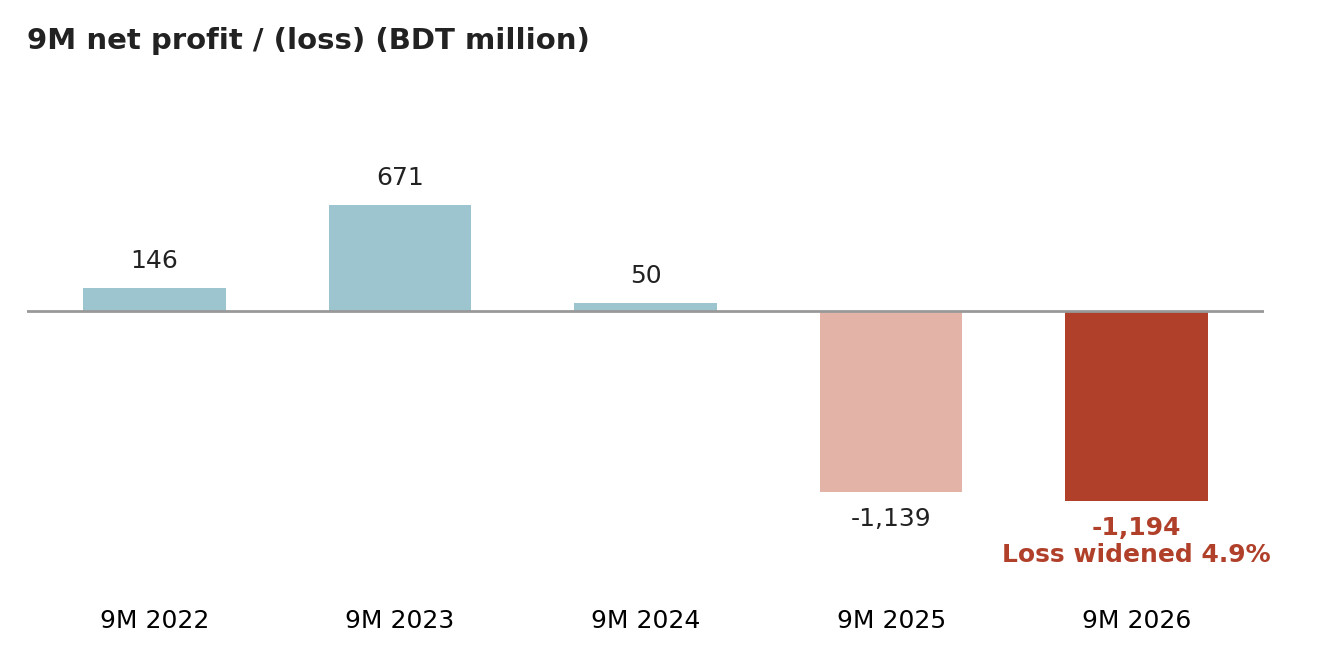
The net loss reached BDT 1,194.4 million, 4.9% more than last year, and the net margin stayed at around negative 6.4%. The company says operating cash flow per share improved to BDT 15.14 from BDT 14.48 on better collections and careful supplier payments. Still, with operating profit covering less than half of net finance costs, a lasting recovery depends on lowering borrowing costs and bringing operating expenses back in line with sales.
For more updates, be with Markedium.













Leave a comment