
























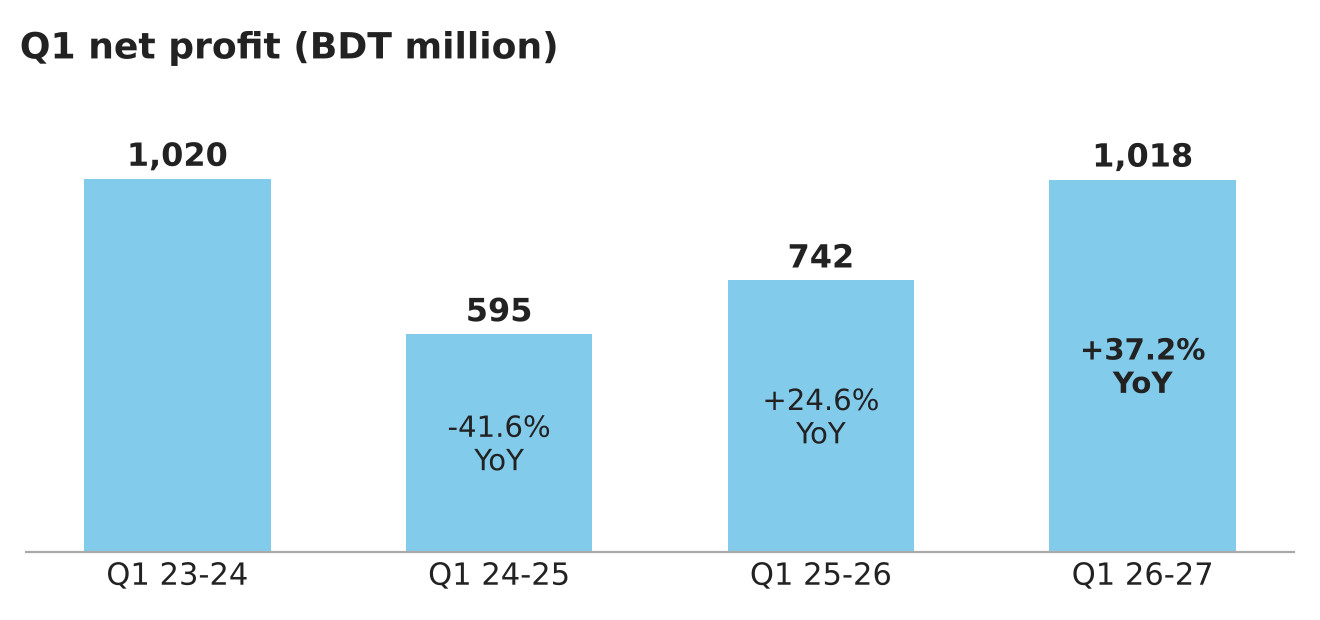
Renata PLC, one of the top five pharmaceutical companies in Bangladesh and the leader in animal health medicine, has published its consolidated financial statements for the first quarter (Q1) of FY 2026-27. Together with its subsidiaries, the company earned a net profit of BDT 1,017.6 million, up 37.2% from BDT 741.7 million in the same quarter last year. EPS (Earnings Per Share) of the company increased to BDT 8.87 from BDT 6.47.
Double-Digit Revenue Growth
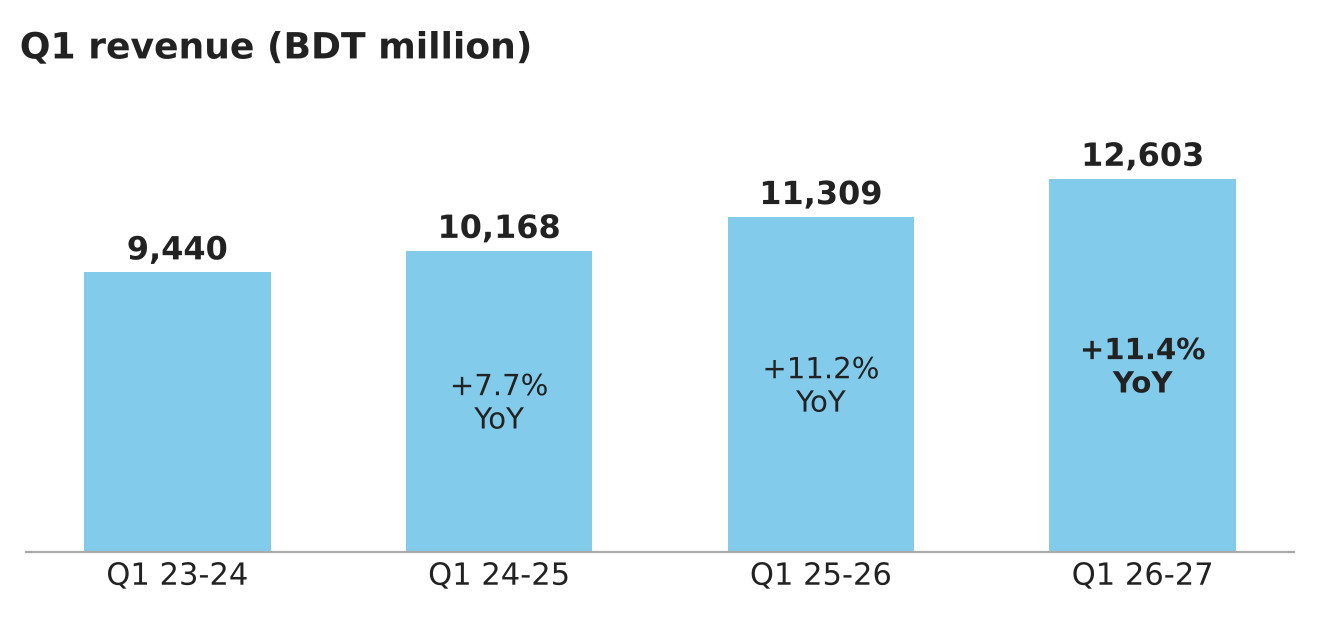
Consolidated revenue grew 11.4% to BDT 12,602.6 million from BDT 11,308.5 million, an increase of BDT 1,294.0 million. Overall, the company as grew at a compound annual rate of 11.2% since Q 1 FY 2023-24. According to the company’s Q1 commentary, the growth came mainly from higher sales volumes.
Almost all of the revenue comes from the parent company. Renata PLC earned BDT 12,496.7 million, up 11.6%, or 99.2% of consolidated revenue. Its increase of BDT 1,301.6 million was slightly larger than the group’s total gain, because revenue of Renata Pharmaceuticals (Ireland) Limited fell 17.3% to BDT 92.4 million. Renata (UK) Limited is still very small, with revenue of BDT 13.5 million against BDT 1.7 million a year earlier.
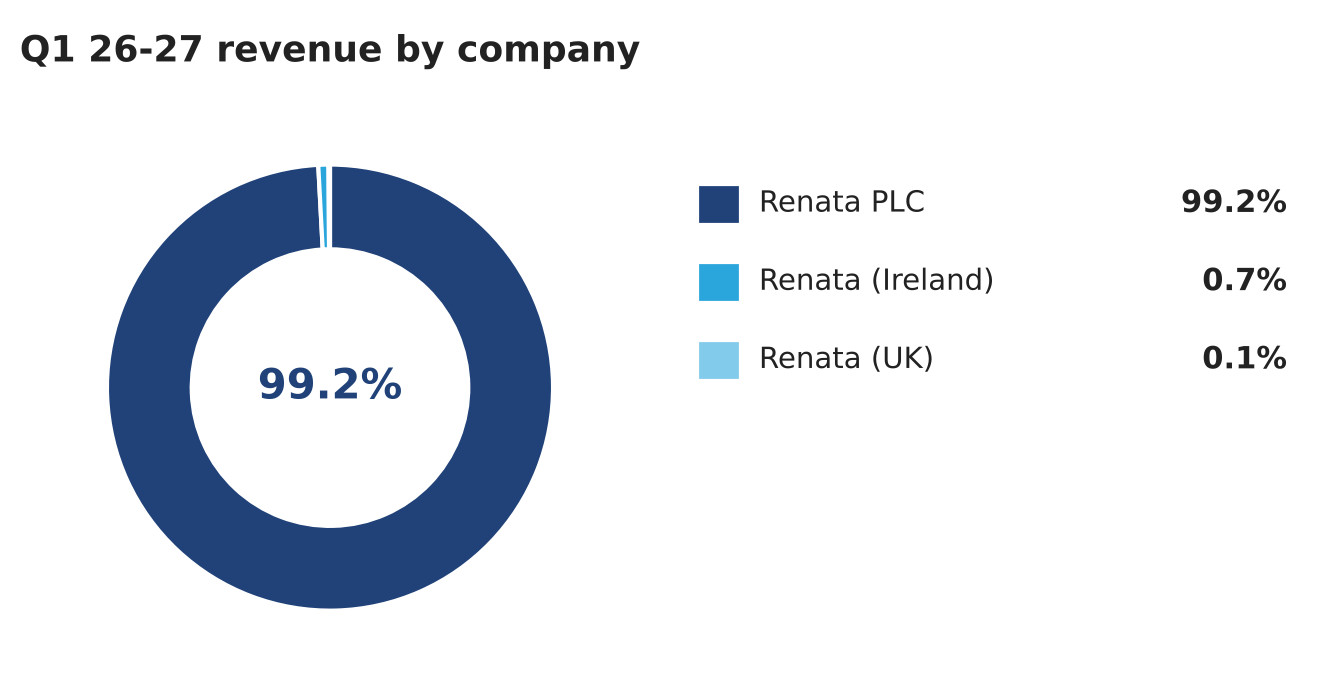
Within Renata PLC, pharmaceutical products brought in BDT 9,807.0 million, up 8.8%, and made up 78.5% of its revenue. Animal health products grew 10.4% to BDT 1,965.6 million. Contract manufacturing, where Renata makes products for other companies, doubled to BDT 646.2 million (up 101.7%) and added BDT 325.8 million, a quarter of the parent’s revenue increase. Agro-based products slipped 2.7% to BDT 77.6 million, while consumer products remain negligible.
Product (Renata PLC, BDT million) | Q1 26-27 | Q1 25-26 | Growth | Share of revenue |
|---|---|---|---|---|
Pharmaceutical products | 9,807.0 | 9,014.0 | 8.8% | 78.5% |
Animal health products | 1,965.6 | 1,780.7 | 10.4% | 15.7% |
Contract manufacturing | 646.2 | 320.4 | 101.7% | 5.2% |
Agro-based products | 77.6 | 79.7 | -2.7% | 0.6% |
Consumer products | 0.3 | 0.3 | -0.9% | 0.0% |
Source: Q1 quarterly reports.
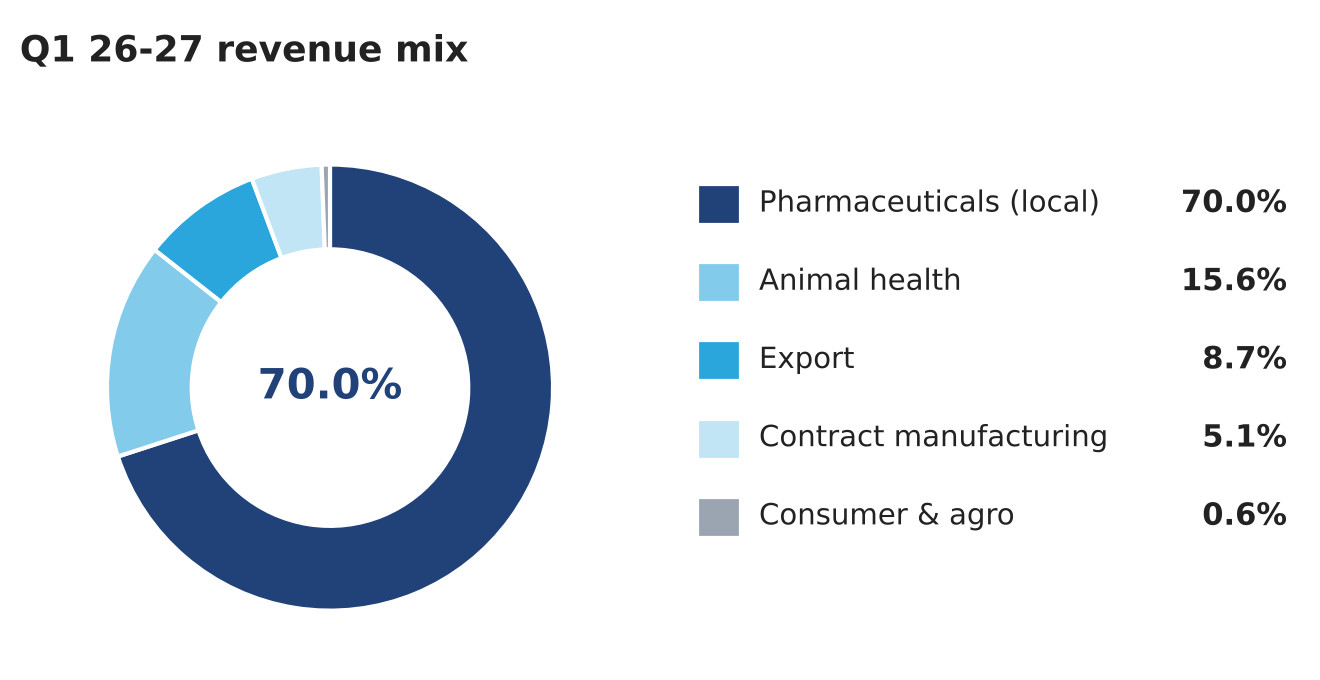
The company’s own segment split shows where the growth really came from. Local pharmaceutical sales, 70.0% of revenue, grew only 4.5% to BDT 8,821 million. Exports, including the subsidiaries, jumped 58.8% to BDT 1,092 million and added BDT 404 million, about 31% of the total growth and the largest contribution of any segment. In its Q1 presentation, the company credits new registrations from its portfolio of 100 bioequivalent products, including UK MHRA approvals for Empagliflozin and Sertraline, and its first shipment to Portugal during the quarter. It is now present in 77 international markets.
Gross Margin Edges Up
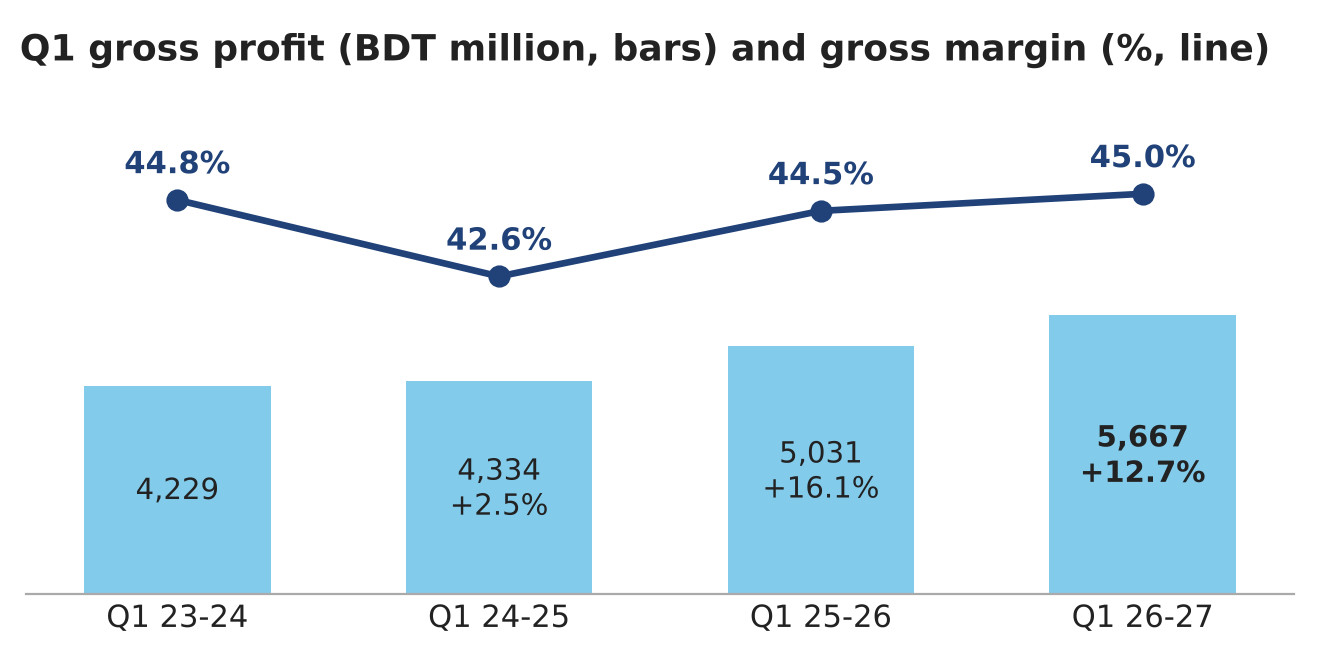
Gross profit rose 12.7% to BDT 5,667.0 million, as cost of sales grew 10.5% to BDT 6,935.6 million, slightly slower than revenue. The gross margin improved to 45.0% from 44.5%, the highest of the four years compared.
Cost of materials rose 13.0% to BDT 4,719.3 million, faster than revenue, which the company links to a sales mix with more products that need costly raw materials. Factory overhead grew only 5.4% to BDT 2,216.2 million. Factory energy costs rose 27.1% after diesel prices went up 32.4% and industrial electricity tariffs 18.6%, and toll manufacturing costs rose 64.7%. However, factory depreciation fell 31.3% after the company changed its depreciation method for plant and machinery, which kept overhead growth low.
Lower Finance Costs Drive Profit Growth
Operating profit rose 14.5% to BDT 1,587.6 million, and the operating margin improved to 12.6% from 12.3%. Administrative, selling, marketing and distribution expenses grew 11.9% to BDT 4,079.4 million, slightly faster than revenue, taking 32.4% of revenue against 32.2% a year ago. Administrative expenses rose 19.9% to BDT 660.6 million, while selling, marketing and distribution expenses rose 10.5% to BDT 3,418.8 million. The company names the following as the main drivers:
Expense driver | YoY growth | Main reason |
|---|---|---|
Energy costs | 145.4% | Higher diesel prices and electricity tariffs |
Export expenses | 88.2% | Higher export sales |
Legal and professional | 29.7% | Compliance and advisory services |
Depreciation | 11.9% | Major projects capitalised in FY 2025-26 |
Selling and marketing | 10.0% | Brand investment and market development |
Distribution | 9.4% | Higher volumes, fuel and logistics costs |
People costs | 6.8% | Annual salary increments |
Travelling and conveyance | -0.2% | Optimised field activities |
Source: Q1 quarterly reports.
Because part of the profit gain came from lower depreciation, EBITDA grew a more modest 5.1% to BDT 1,961 million, according to the company.
The biggest boost came below operating profit. Net finance costs fell 35.2% to BDT 275.2 million from BDT 424.8 million. Interest expense before capitalisation fell 38.6%, as the company replaced short-term loans with cheaper long-term funding, helped by BDT 3.25 billion of convertible preference shares. A foreign exchange loss of BDT 22.7 million last year also turned into a small gain. Other income rose 41.7% to BDT 30.3 million.
As a result, profit before WPPF grew 36.6% to BDT 1,342.6 million. After a WPPF contribution of BDT 62.3 million, profit before tax rose 36.3% to BDT 1,280.3 million. Tax expense grew 32.8% to BDT 262.7 million.
Net profit came in at BDT 1,017.6 million, up 37.2%, and the net margin improved to 8.1% from 6.6%. Net operating cash flow per share also rose 74.2% to BDT 21.98.










Leave a comment