


























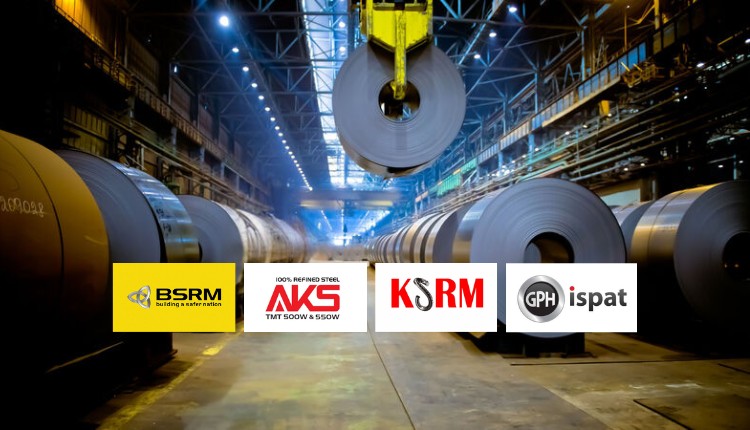
A recent study has unveiled that four steelmakers based in Chattogram currently control 53 percent of Bangladesh’s total steel demand. Despite the presence of around 40 steelmakers across the country, Bangladesh Steel Re-Rolling Mills (BSRM), Abul Khair Steel (AKS), GPH Ispat, and Kabir Steel Re-Rolling Mills (KSRM) are the key players in the market, according to industry insiders and market studies.
Data from BigMint, a platform for commodity price reporting, market intelligence, and consulting, highlights the market shares of these major players. As reported, BSRM meets approximately 25 percent of domestic demand, AKS contributes 14 percent, GPH supplies 8 percent, and KSRM covers 6 percent. The 40 steel companies in Bangladesh collectively have the capacity to produce 9 million tonnes of steel annually, against an annual requirement of around 8.5 million tonnes. Individually, BSRM can produce about 2.4 million tonnes per year, AKS 1.5 million tonnes, while both GPH and KSRM each have a production capacity of approximately 800,000 tonnes annually.
Tapan Sengupta, deputy managing director of BSRM refuted the idea of a monopoly within the steel industry, highlighting the efforts of many small units to expand their capacity. He also noted the entrance of some large companies into the market, which fosters competition. BSRM’s strong market position is attributed to its long-standing presence and experience in the industry since 1952, as well as its renowned brand. Furthermore, government steel consumption decreased to around 45 percent from 55 percent of total production in the last fiscal year, amid a slowdown in development activities.
Despite this, BigMint projects a 25 percent increase in steel consumption in Bangladesh by 2027, rising to approximately 10.6 million tonnes from the current 8.5 million tonnes. This growth is expected to be driven by expanding infrastructure development projects and individual consumption. Consequently, Bangladesh’s steel production capacity is anticipated to increase to 13 million tonnes by 2027.
BigMint also reported that Chattogram accounts for 62 percent of the country’s overall steel-melting capacity, while Dhaka contributes only 32 percent. Shahriar Jahan Rahat, deputy managing director of KSRM, highlighted the significant development of the steel industry in Chattogram over the past six decades, facilitated by the port’s accessibility for importing raw materials. He emphasized the crucial role of major steel manufacturing plants in Chattogram in supporting the country’s infrastructure development by providing essential steel products.
For more updates, follow Markedium.
















Leave a comment