





















Most good ideas do not come to life by following a brief. They begin with a question.
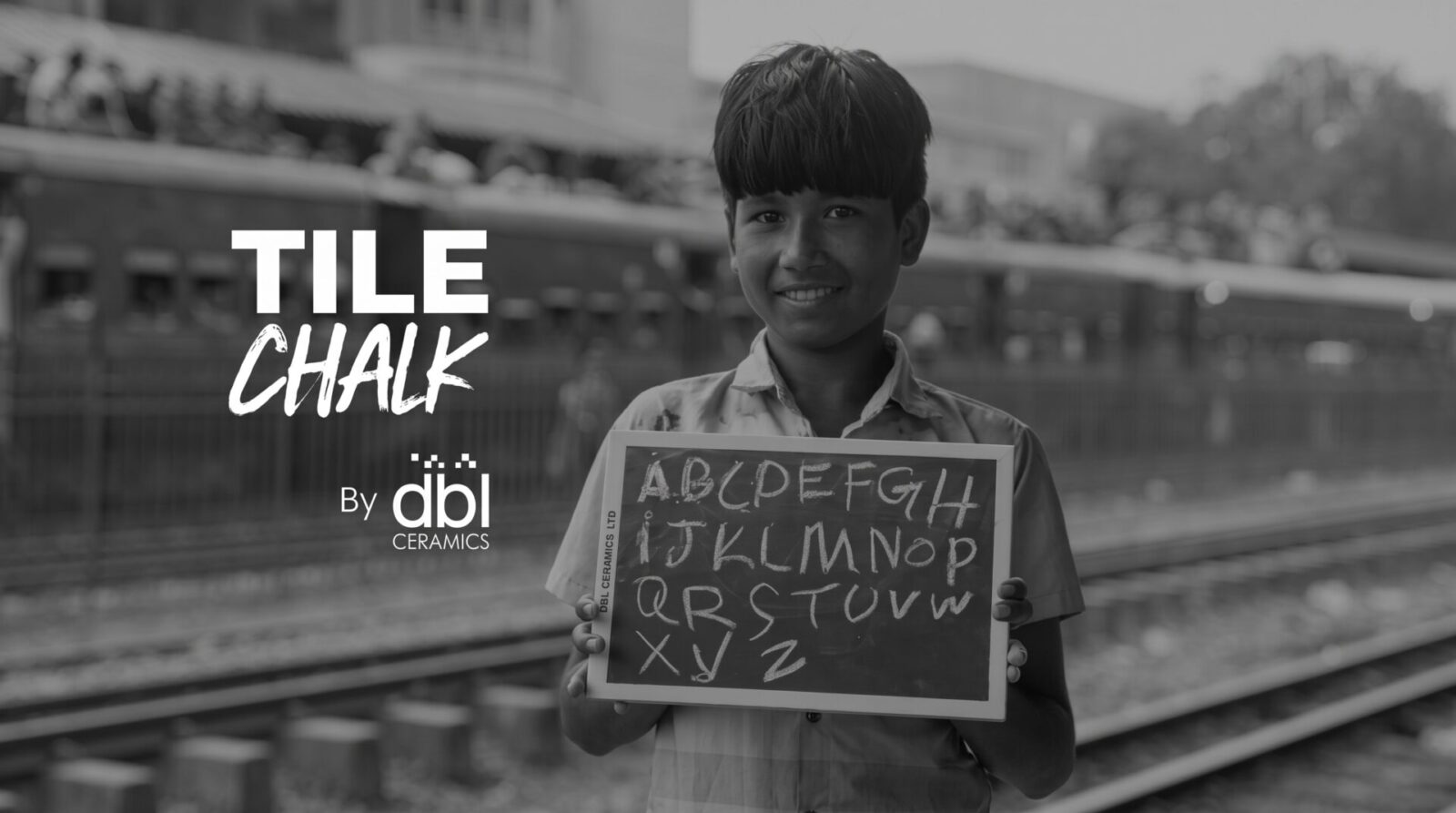
For DBL Ceramics and POP5, that question emerged not in an agency meeting or an air conditioned brainstorming room, but during a visit to DBL’s factory. What started as a look at the company’s manufacturing and sustainability practices eventually led to TileChalk, an initiative that transformed ceramic manufacturing sludge into classroom chalk.
It resulted in more than a communication campaign. It became a way of turning an industrial problem into an educational resource, while giving a local manufacturing ecosystem suffering from increased production costs.
Background
POP5 was built around the belief that communication should engage more than one way of seeing. As Chief Creative Officer Mohammad Akrum Hossain explains, the agency’s name itself comes from “pop culture” and the “five senses”, reflecting its desire to look at communication through different lenses.
That philosophy became particularly relevant when the agency visited DBL Ceramics.
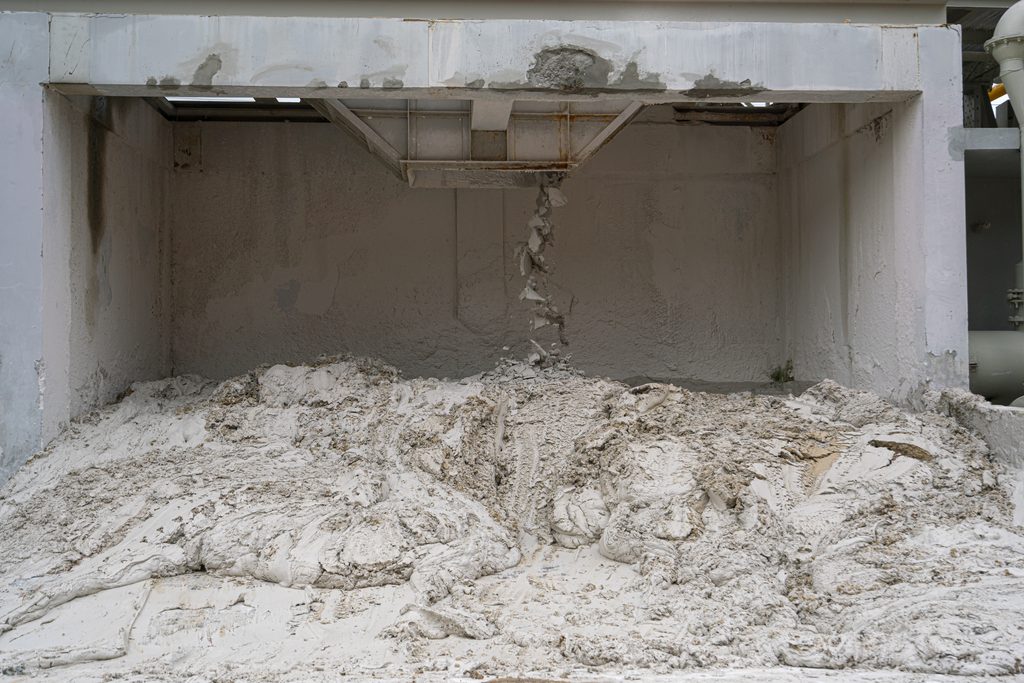
DBL was proud to show the team its manufacturing facility and the sustainability systems built into its operations. But somewhere in the middle of that tour, the team noticed something that did not quite fit the picture: a muddy, sludge like residue coming out of the production process.
The material was a problem.
According to Mr. Akrum, DBL was spending roughly Tk 10–12 crores on managing the issue, while the residue could not simply be sent to landfill because of environmental concerns.
That was the moment the brief changed.
Instead of asking, “What campaign can we make for DBL?”, POP5 began asking, “What can this material become?”
And that distinction mattered.
As Mr. Akrum puts it, “Idea সবসময় AC room থেকে আসে না.” Sometimes, to find an idea, an agency has to understand the client’s ecosystem, from production and supply to distribution, retail and the final consumer.
That factory floor became the beginning of TileChalk.
Insight
The first breakthrough came from simply taking the waste seriously.
Mr. Akrum and Group Creative Director Md Abdullah Al Rana took a sample of the sludge back with them. Rana wondered whether it could potentially be turned into something like pottery or chalk.
The team tested it rather than dismissing the thought.
Research showed that the material contained a significant amount of calcium carbonate, opening up the possibility of using it in chalk production. Subsequent research and experimentation established a viable way to re-engineer the residue into chalk.
But the insight was bigger than simply discovering that sludge could become chalk.
POP5 realised that the waste could be connected to something meaningful like education.
Mr. Akrum explains the thinking simply. Children write on chalkboards, erase what they write, and write again. Unlike disposable paper, the same surface can keep being used. So if DBL’s industrial waste could become chalk, the waste was no longer merely being disposed of. It could become part of a cycle.
Industrial waste could become a tool for learning.
That was the insight behind TileChalk.
And there were other possibilities. The material could potentially be used for pottery or even tiles. But chalk had a particular purpose. It allowed DBL to contribute directly to education while solving a manufacturing problem.
Idea
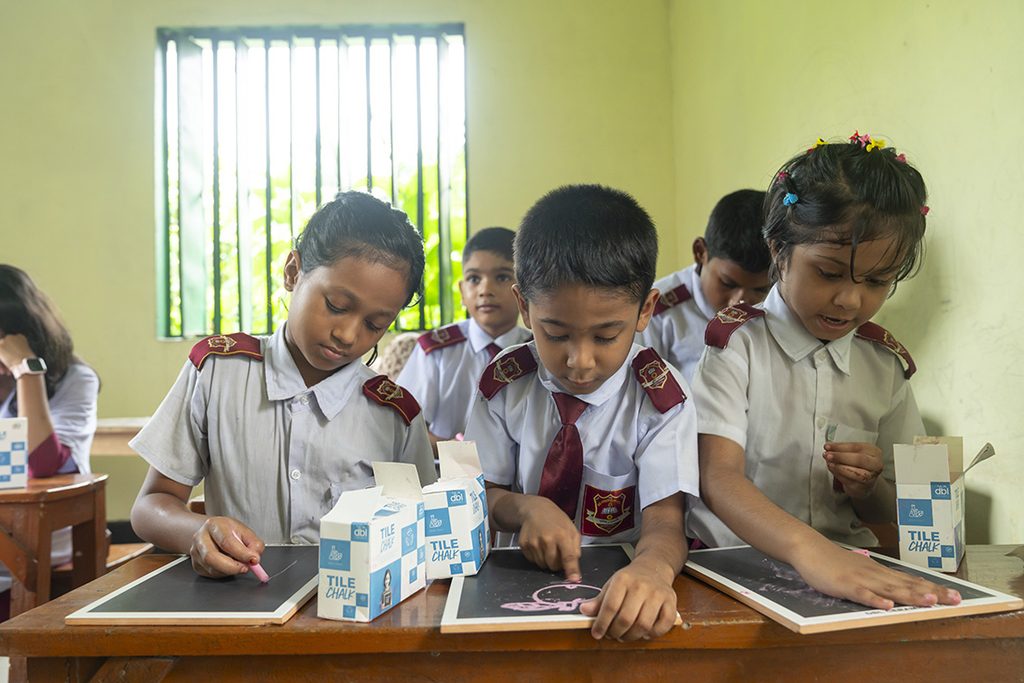
The idea was deceptively simple: turn ceramic sludge into chalk.
The team found a chalk manufacturer and handed over the material. The manufacturer developed the first version, which POP5 then tested further, including laboratory testing to ensure that the resulting chalk was suitable and safe for children.
The agency then brought the finished product back to DBL.
Initially, it was presented as a possibility. But once POP5 had completed the process and demonstrated that the chalk could actually be produced and used, DBL saw the potential.
TileChalk was born.
What made the idea powerful was the connection between seemingly unrelated worlds. A ceramic factory produces waste. A chalk manufacturer needs raw material. A school needs affordable learning tools. TileChalk connected all three.
Instead of creating another sustainability message about reducing waste, the project created a practical system in which one industry’s waste became another industry’s raw material.
Execution
The biggest challenge was no longer ideation. It was making the idea work in the real world.
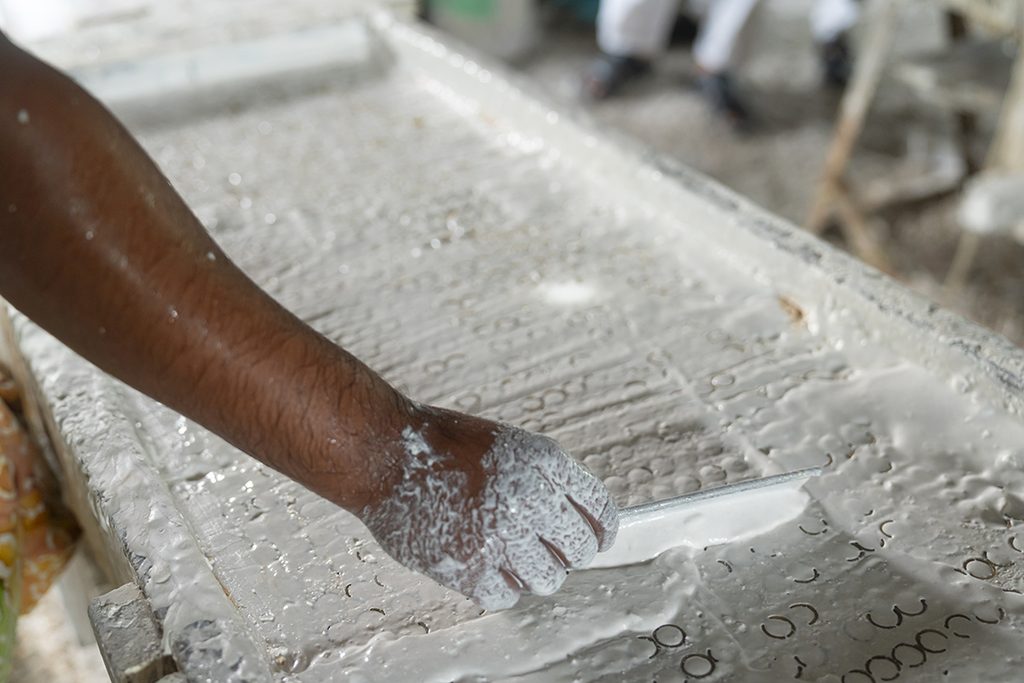
Finding the right chalk manufacturers proved difficult. DBL was not initially prepared to take full responsibility for building that new production network, so POP5 had to find and convince manufacturing partners that the process was genuinely viable.
That meant more than making a presentation.
The team had to show manufacturers an actual working product and prove that what sounded like an unusual idea could become a functioning manufacturing process.
DBL then helped take the initiative beyond a prototype.
The company worked with existing chalk manufacturers rather than building entirely new production facilities. The TileChalk formula was eventually made open source, allowing other manufacturers to adopt the process. DBL also partnered with NGOs to distribute chalk and learning tools to underserved schools.
The project also extended the circular thinking beyond chalk. Broken ceramic tiles were repurposed into lightweight, reusable slate boards, creating another educational application from material that would otherwise become waste.
The result was a campaign that did not live only in advertising channels. It lived inside factories, manufacturing partnerships, NGOs, classrooms and communities. That is perhaps the most important part of TileChalk. The communication was the documentation of an intervention that already existed.
Results
TileChalk quickly moved from an experimental idea to a functioning circular-economy model.
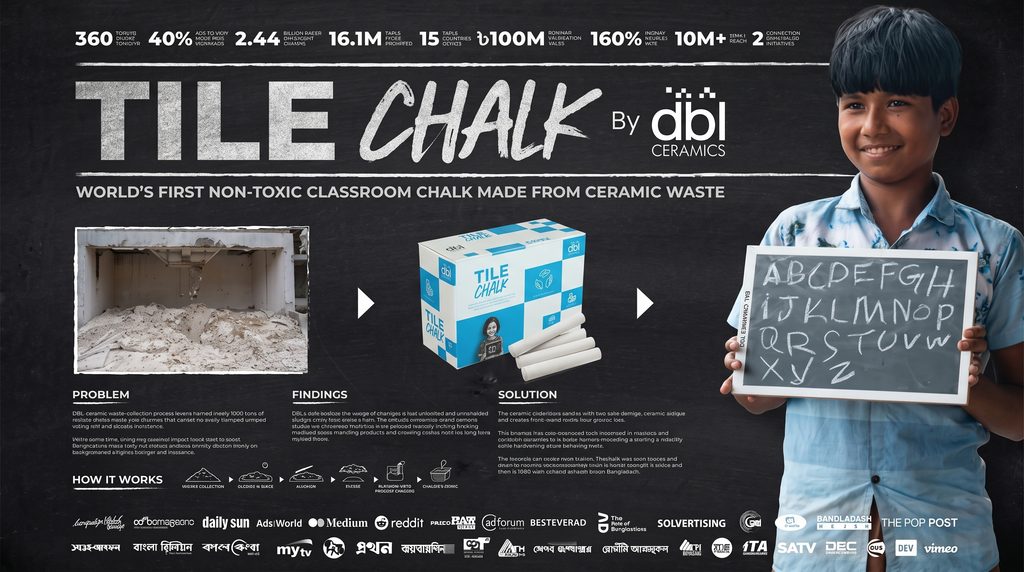
According to the published case information, the initiative recycled 360 tonnes of ceramic sludge in its first three months, with monthly recycling capacity reaching 110 tonnes. Partner chalk manufacturers saw production costs fall by around 40%, while 15 factories became part of the production ecosystem. More than 16.1 million chalk sticks were produced during the first three months.
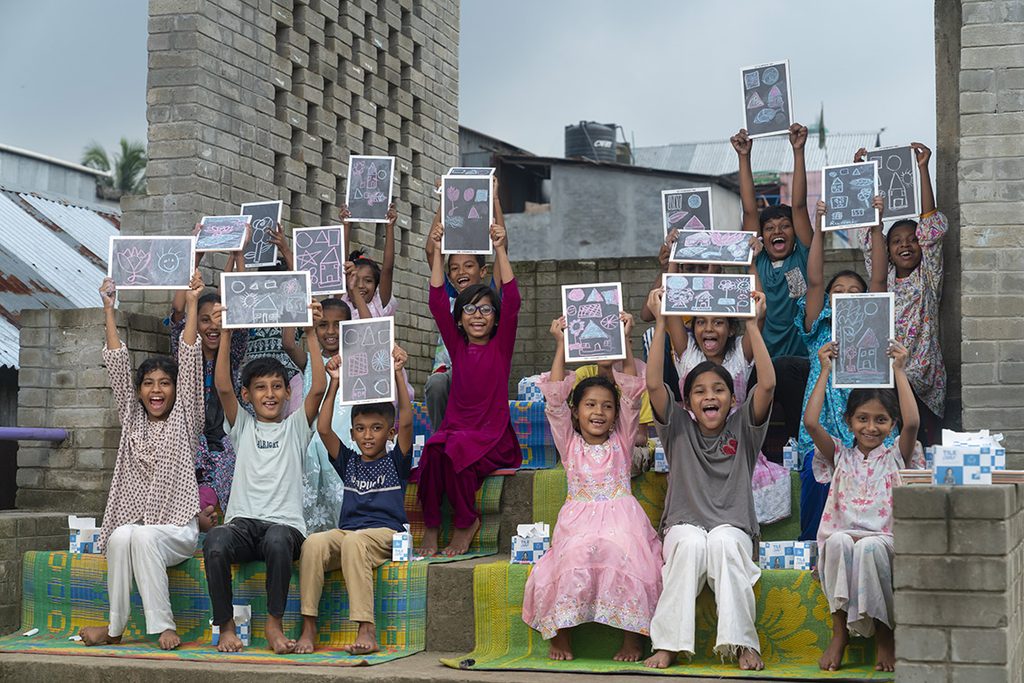
The educational impact was equally significant. TileChalk sets were distributed through NGO partners to more than 1,000 underserved schools, reaching more than 332,000 students based on the case’s cited figures.
The project also earned recognition on the international creative stage. TileChalk was recognised among the Top 5 campaigns at MAD STARS, where it was presented as an APAC innovation. The work also received Bronze at Spikes Asia, alongside recognition at The One Show, including Merit recognition in the Green Pencil and Sustainable Development Goals Pencil categories.
But perhaps the most revealing measure of success comes from Mr. Akrum himself.
He is careful not to frame TileChalk as an “award winning idea” first.
For Young Creatives from Akrum Hossain
His advice to young advertisers is almost the opposite: do not make work for awards. Make work that is useful.
For him, the test is whether a piece of communication can be good for the brand, good for people and good for the planet. He calls that “goodvertising.” If it solves a genuine business problem, it becomes “solvertising.” If it introduces meaningful innovation, it becomes “innovertising.”
TileChalk happened to contain all three. It solved a manufacturing problem. It created value for education. It created a new use for a waste stream. And it demonstrated that an industrial problem could become a useful resource.
The awards came afterwards. And perhaps that is what makes TileChalk worth remembering.
The idea did not begin with the question, “What can win?” It began with a much more ordinary question, “What is this?”
A muddy residue on a factory floor became a question. The question became a test. The test became chalk. And the chalk became a reminder that sometimes, the next big idea is sitting quietly inside the problem everyone else has learned to ignore.
About Mohammad Akrum Hossain
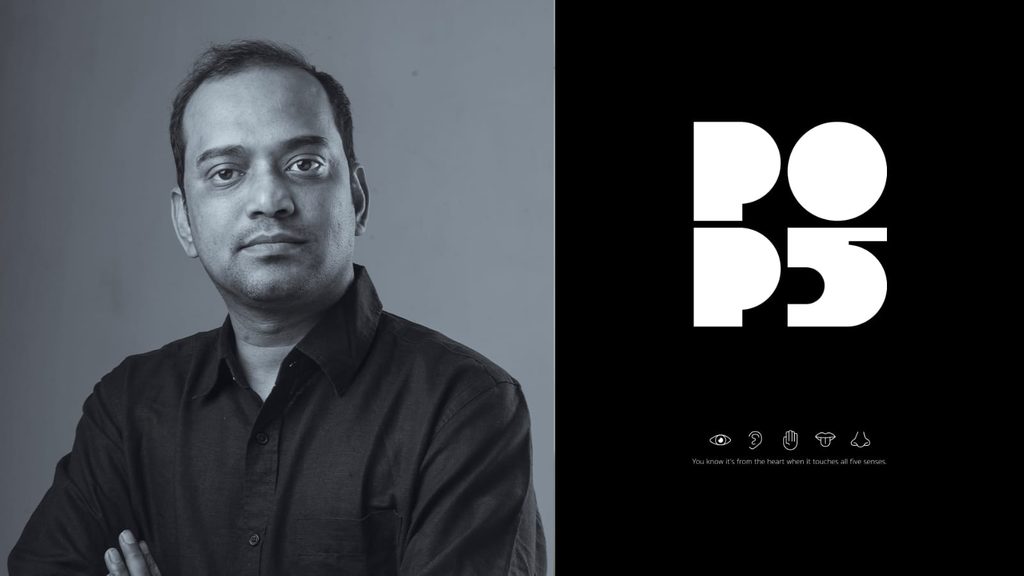
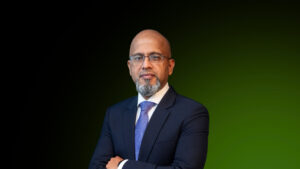
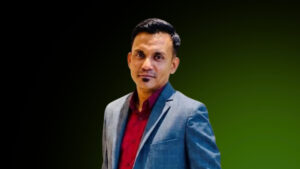
Mohammad Akrum Hossain is a Bangladeshi advertising creative leader, entrepreneur and Chief Creative Officer of POP5 Advertising, with more than 22 years of experience and over 270 local and international awards.
Known for turning local insights into ideas with global relevance, his work has been recognised by leading creative platforms including Cannes Lions, D&AD, The One Show, Spikes Asia, ADFEST, MAD STARS and the Effies.
Mr. Akrum has also represented Bangladesh as a jury member at major international creative festivals including Cannes Lions, D&AD, The One Show, Clio Awards, Spikes Asia, LIA and MAD STARS. As a speaker, he has shared his perspectives on creativity, culture, innovation and the evolving role of advertising at platforms including Cannes Lions, Magic Fest, Brand Fest, Miami Ad School and One Earth.
As CCO of POP5, Mr. Akrum is building an agency culture where creativity, strategy, technology and culture come together to create work rooted in Bangladesh and relevant to the world. His career reflects a simple belief: powerful ideas can emerge from anywhere.
For him, creativity is about finding the unexpected idea, giving it purpose, and proving that great creative work can come from anywhere.
POP5 Advertising: Pop Culture. Original Ideas. Purpose Driven.
Founded in 2024, POP5 Advertising is an independent, 360° full service agency from Bangladesh built on a simple belief: great creativity can come from anywhere, and local ideas can create global impact.
Based in Dhaka, POP5 brings together creatives, strategists, marketers, technologists and builders to turn real local challenges into creative opportunities. Its approach combines pop culture, originality, purpose, strategy, technology and storytelling to create ideas that connect with people and make a difference.
Since its launch, POP5 has earned recognition across leading global creative platforms, including D&AD, The One Show, MAD STARS, ADFEST, Spikes Asia, PHNX Awards and The ANDYs. The agency has also achieved several notable firsts for Bangladesh, including recognition at D&AD and The One Show, alongside a Double Grand Prix at MAD STARS.
Its philosophy is simple:
Start with culture. Find a real problem. Create an original idea. Make it matter.
Want to stay updated on the latest campaigns and creative ideas? Follow Markedium Campaigns for more.
Have a campaign you think deserves a closer look? Submit it to us here.
For more updates, be with Markedium.











Leave a comment