
































For millions of workers in Bangladesh, getting a job has long been less about what they can do than whom they know. Personal networks, informal brokers, and word of mouth often determine access to employment, leaving workers exposed to uncertainty, recruitment fees, and limited bargaining power.
That system also creates a problem that extends well beyond the job search: millions of workers have no formal record of their working lives.
Shomvob Technologies Ltd., founded in 2022 and based in Dhaka, is trying to change that. The company is building a digital employment infrastructure for blue-collar and entry-level workers, connecting them with verified jobs while giving employers tools to recruit, manage, and retain their workforce.
Read more: Shondhibazar: Connecting Farmers and Families Through Safe Food
The company was founded by Rifad Hossain, Co-Founder and Chief Executive Officer; Naqib Muhammad Faiyaz, Co-Founder and Chief Technology Officer; and Hasibur Rahman, Co-Founder and Chief Operating Officer. Before launching Shomvob, the three founders worked across SMEs, digital technology, and banking, each encountering a different consequence of Bangladesh’s informal labour market.

Their ambition is larger than simply putting people into jobs. Shomvob is attempting to turn informal employment histories into portable professional identities—records that could eventually help workers gain access not only to better jobs but also to financial services.
The Missing Layer in Bangladesh’s Labor Market
Bangladesh has a vast workforce, but much of its employment remains informal. For a worker paid in cash, hired without a contract, and moving between employers, years of experience can effectively disappear from the formal economy.
There may be no documented employment history, no payroll record, and no reliable way for a lender or future employer to verify earnings.
That creates a paradox. A worker may have spent years building skills and earning an income, yet still struggle to demonstrate either when applying for a formal job or seeking credit.
Shomvob emerged around this gap.
The founders, drawing on experiences across consulting, banking, and technology, encountered the problem from different sides. Workers struggled to find trustworthy opportunities, while employers faced an equally persistent challenge: finding suitable candidates and managing a workforce characterized by high turnover.
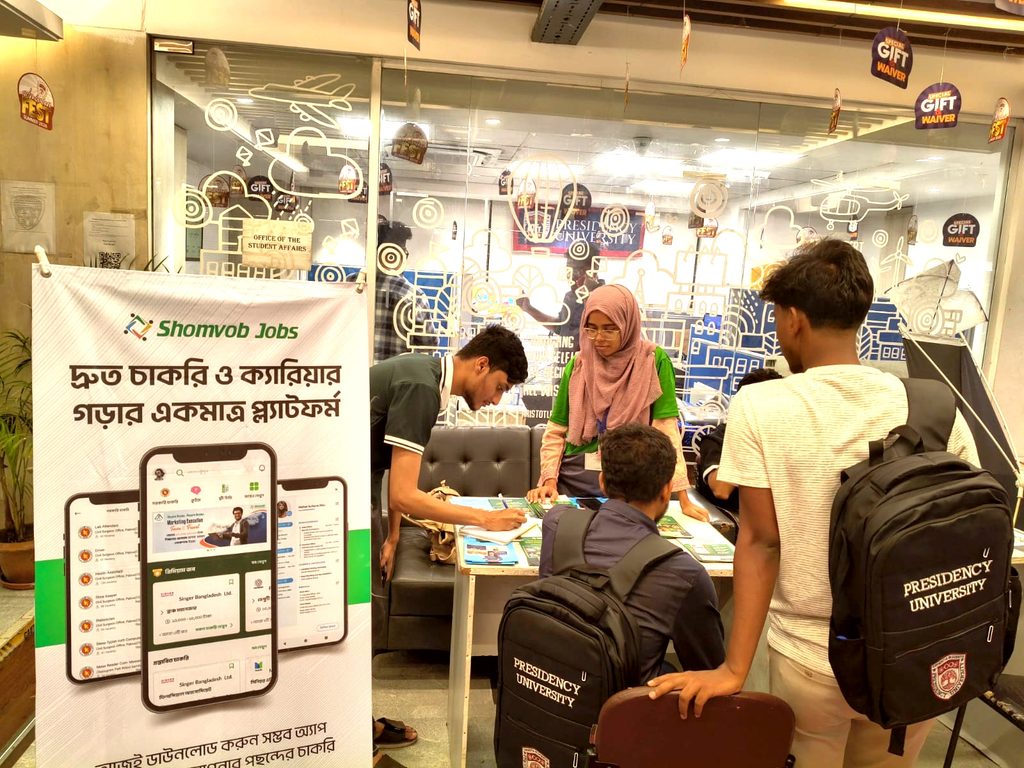
The company began building a platform around both sides of that market.
Support from the Orange Corners Bangladesh Innovation Fund (OCBIF), an initiative of the Kingdom of the Netherlands led by SAJIDA Foundation in partnership with YY Ventures, has helped Shomvob invest in technology infrastructure, strengthen employer acquisition and develop programmes focused on women and youth employment.
Today, Shomvob operates at the intersection of HR technology and fintech.
Workers can create professional profiles, apply for verified positions and accumulate employment histories. Employers, meanwhile, can use the platform for recruitment, staffing, payroll and broader workforce administration.
That distinction is important.
A conventional job platform primarily solves a matching problem: connecting vacancies with candidates. Shomvob is attempting to build something more persistent—the infrastructure surrounding the employment relationship.
More than 2.5 million job seekers have registered on the platform, resulting in approximately 40,000 successful placements.
For workers accustomed to informal brokers, the economics can be meaningful. Direct access to opportunities can reduce dependence on intermediaries and the fees associated with them. More importantly, each formal placement can create a record that did not previously exist.
Over time, those records can become economically valuable.
Employment and payroll histories can provide evidence of income and employment stability, potentially supporting access to loans and other financial products. In that sense, Shomvob’s proposition extends beyond recruitment: it is trying to make employment history a form of economic identity.
However, the opportunity is not limited to workers.
For employers, particularly those hiring large numbers of frontline employees, recruitment is only the beginning of the problem. Finding candidates, onboarding them, processing payroll, and managing turnover can become expensive operational burdens.
Shomvob’s platform seeks to consolidate those functions.
That creates a potentially powerful feedback loop. More employers bring more jobs onto the platform; more jobs attract workers; more workers generate employment data; and richer employment data can make the platform increasingly useful to both employers and financial-service providers.
If that model scales, Shomvob could occupy a position closer to employment infrastructure than a conventional recruitment marketplace.
The company has attracted recognition beyond Bangladesh, including a place on the Forbes Asia 100 to Watch list. It has also worked with organisations including UNICEF, the World Bank, Swisscontact, the Gates Foundation, and Roots of Impact.
But the path to that position was far from linear.
During its early growth phase, Shomvob faced severe cash-flow pressures that threatened the company’s survival. The founders postponed their own salaries and personally financed operations while restructuring the business.
For a young technology company operating in a market where revenue, customer acquisition, and scale rarely move in sync, that period became a test of financial discipline as much as entrepreneurial ambition.
The experience also shaped the company’s approach to growth.
Building Beyond Dhaka
Shomvob now plans to expand its presence across all 64 districts of Bangladesh while exploring international markets, with an ambition to eventually serve more than 40 million workers.
The geographic expansion matters because the problem it is addressing is not confined to Bangladesh’s major cities. Informal hiring networks are deeply embedded across the country’s labour market, particularly among workers with limited access to digital and institutional services.
Scaling, however, will require more than adding users.
The company will need to maintain trust among workers, convince employers that digital workforce management delivers measurable value, and build enough employment history to make its financial-services proposition meaningful. Its ability to translate a large registered user base into sustained employment relationships and recurring economic value will ultimately determine whether the platform becomes a durable piece of labor-market infrastructure.
At its core, Shomvob is betting on a simple but consequential idea: a person’s work history should not disappear simply because the work itself was informal.
By documenting employment, connecting workers directly with opportunities, and creating verifiable records of income and experience, the company is attempting to turn one of Bangladesh’s largest structural disadvantages—the informality of its workforce into an opportunity for greater transparency, mobility, and financial inclusion.
The end goal is therefore bigger than finding someone a job.
It is giving workers a record of the work they have already done—and using that record to open the door to what comes next.
For more updates, be with Markedium.



















Leave a comment