































Branding strategy is the documented plan that defines what a brand is, who it is for, and how it consistently communicates across every channel and touchpoint. Branding strategy connects business objectives to brand identity — it tells an organization how to show up in the market, what to say, and why customers should choose it over every alternative.
Brand strategy and branding strategy refer to the same foundational concept. Both terms describe the strategic layer of brand management: the thinking, positioning, and planning that precedes all design, messaging, and marketing execution.
This guide covers what a branding strategy includes, how to develop one from scratch, what brand strategy design means, how to build a new brand strategy for a launch or rebrand, and real-world examples of branding strategy in action.

What Is a Branding Strategy?
A branding strategy is a long-term plan that defines what a brand stands for, how it communicates, and why its target audience should choose it over competitors. Branding strategy covers every decision about brand identity, brand positioning, brand messaging, and brand experience — it is the strategic foundation that all marketing, design, and communication decisions are built on.
Sometimes a simple tagline can represent the entire brand, like Adidas.
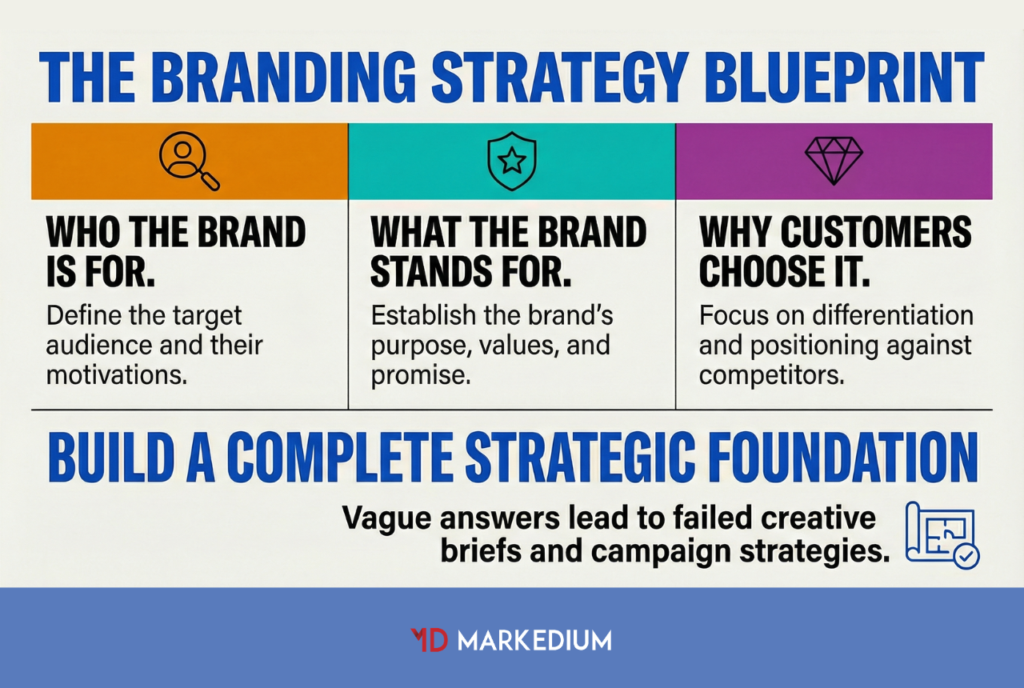
Branding strategy answers three questions every brand must resolve:
- Who is this brand for? — the target audience, their needs, and what motivates them
- What does this brand stand for? — its purpose, values, and the promise it makes to customers
- Why should customers choose this brand? — its differentiation and positioning relative to competitors
A branding strategy that cannot answer all three questions clearly is incomplete. Vague answers force every downstream decision — creative briefs, campaign strategy, product development — to rely on guesswork.
Branding Strategy vs Brand Strategy vs Marketing Strategy
| Term | Definition | Time Horizon |
|---|---|---|
| Branding Strategy | The plan defines what the brand is, who it serves, and how it communicates | 3–5+ years (long-term) |
| Brand Strategy | Same as branding strategy — the terms are used interchangeably | 3–5+ years (long-term) |
| Marketing Strategy | The plan for how to reach, attract, and convert customers executes within the brand strategy | 12–24 months (tactical) |
The key distinction: branding strategy defines what the brand IS. Marketing strategy defines how the brand REACHES customers. Marketing strategy must operate within the constraints of the branding strategy — not the other way around.
What Does a Branding Strategy Include?
A branding strategy includes 7 core components: brand purpose, brand positioning, brand values, brand personality, brand voice, brand messaging, and brand identity. Each component is a distinct attribute of the brand that must be defined before the brand can operate consistently.
| Component | Definition | What It Produces |
|---|---|---|
| Brand Purpose | The reason the brand exists beyond generating revenue | Mission statement, brand manifesto |
| Brand Positioning | The specific market space the brand occupies relative to competitors, and in the minds of its audience | Positioning statement, competitive map |
| Brand Values | The principles that guide every brand decision and action | Values list, decision framework |
| Brand Personality | The human characteristics attributed to the brand — how it would behave if it were a person | Personality traits, tone reference |
| Brand Voice | The consistent verbal style and tone used in all communications | Voice and tone guidelines, copy examples |
| Brand Messaging | The specific messages the brand uses to communicate its value proposition to each audience segment | Messaging hierarchy, tagline, elevator pitch |
| Brand Identity | The visual and verbal system that makes the brand recognizable: logo, colors, typography, imagery | Brand guidelines, visual identity system |
Brand positioning is the most strategic of the 7 components. Brand positioning determines why the brand is chosen. All other components — voice, identity, messaging — serve to express and reinforce the positioning.
Check how brand positioning is closely connected with brand development.
How to Develop a Branding Strategy: 8 Steps
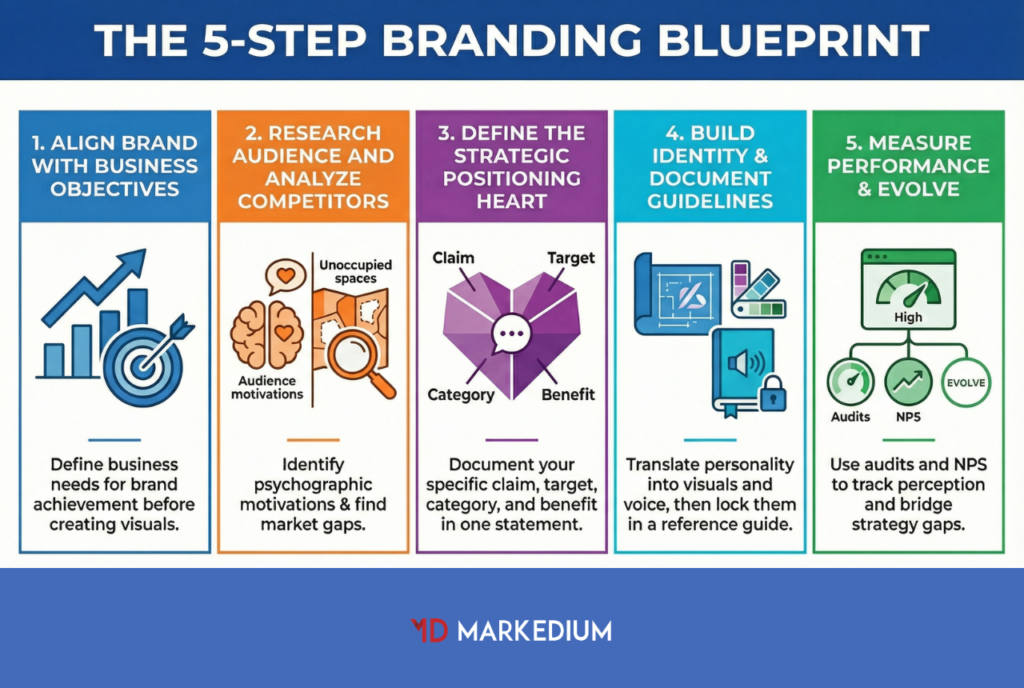
Developing a branding strategy requires 8 sequential steps. Skipping steps — particularly the research and positioning steps — results in a brand identity without a strategic foundation, requiring costly corrections later.
Step 1: Define Business Goals and Brand Objectives
Branding strategy starts with business context, not brand aesthetics. Define what the business needs the brand to achieve: enter a new market, attract a specific customer segment, command a price premium, or rebuild trust after a reputation issue. Brand objectives must connect directly to business objectives — a branding strategy that floats free of business goals produces activity without impact.
Step 2: Research the Target Audience
Target audience research defines who the brand is built for. Research must go beyond demographics (age, location, income) into psychographics: what motivates the audience, what problems they face, how they evaluate options, and what language they use. Audience research is the most frequently skipped step in brand strategy development — and the most expensive to skip. Brands built without audience insight produce positioning that resonates with no one.
Step 3: Analyze Competitors
Competitive analysis maps how competing brands position themselves, which messages they own, and which market space remains unoccupied. Competitive analysis answers: What position is defensible for this brand that a competitor does not already own? A branding strategy that does not examine the competitive landscape risks landing in an already-crowded position or failing to differentiate on dimensions that matter to the audience.
Step 4: Define Brand Positioning
Brand positioning is the strategic heart of the branding strategy. Positioning defines the specific claim the brand makes: for which audience, in which category, offering which benefit, supported by which proof. A positioning statement documents this claim in a single paragraph. Every subsequent brand decision — name, logo, voice, campaigns — must reinforce the positioning or it weakens it.
Positioning Statement Formula:
For [target audience], [brand name] is the [category] that [key benefit] because [reason to believe].Example: For independent business owners who find enterprise software overwhelming, Notion is the productivity platform that scales with the business because it replaces five tools with one flexible workspace.
Step 5: Define Brand Personality, Values, and Voice
Brand personality gives the brand human characteristics that inform every communication decision. Brand values set the principles that guide behaviour. Brand voice defines the specific verbal tone — formal or conversational, expert or accessible, bold or understated — applied consistently across all channels. These three attributes together prevent brand communication from drifting based on whoever wrote the last piece of content.
Step 6: Develop Brand Identity
Brand identity development translates the positioning and personality into the visual and verbal elements that make the brand recognizable: logo system, color palette, typography, photography style, iconography, and design principles. Brand identity design must be guided by the positioning, not by aesthetic trends. A brand positioned on trust communicates differently visually than one positioned on disruption.
Step 7: Document Brand Guidelines
Brand guidelines capture all 7 components of the branding strategy in a single reference document. Brand guidelines define how to use the logo, which colors apply in which contexts, how to write in the brand voice, and which messages lead in which situations. Without documented guidelines, brand consistency degrades as the organization grows and more people create content.
Step 8: Measure and Evolve
Branding strategy is not a one-time deliverable. Brand awareness, brand consideration, share of voice, Net Promoter Score (NPS), and brand equity scores measure whether the strategy is working. Quarterly brand audits compare how the brand is perceived against how it intends to be perceived. Gaps in this comparison define the next iteration of the strategy.

What Is Brand Strategy Design?
Brand strategy design is the process of translating a completed branding strategy into its visual and verbal expressions — the logo, color palette, typography, tone of voice, and all identity elements that make the strategy tangible and recognizable.
Brand strategy design is the bridge between strategic thinking and visual output. It is not decoration applied to a business — it is the visual encoding of the brand’s positioning, personality, and values into forms an audience can immediately recognize and respond to.
Brand Strategy Design vs Visual Identity Design
| Brand Strategy Design | Visual Identity Design Only | |
|---|---|---|
| Starting point | Brand strategy: positioning, purpose, personality | Brief or aesthetic preference |
| Decision criteria | Does this visual choice reinforce the positioning? | Does this look good? |
| Output | Identity system that expresses a defined brand position | Visuals that may or may not communicate anything specific |
| Result | A brand that communicates consistently and strategically | A brand with attractive assets that lacks strategic coherence |
Brand strategy design requires a completed branding strategy before design work begins. A design brief without a strategy brief produces visual output that cannot be evaluated against any standard other than personal taste. When brand identity is built on strategy, every design decision — color, typeface, layout principle — can be tested against the positioning.
Types of Branding Strategy
Branding strategy takes different forms depending on the audience, market context, and organizational goals. The 7 most common types of branding strategy each apply the same core framework — positioning, identity, voice, messaging — with specific emphasis based on context.
1. Corporate Branding Strategy
Corporate branding strategy positions the organization as a whole, not individual products or services. Corporate brands like Samsung, Google, and Tata use a single brand identity that carries across every business unit, product line, and market. Corporate branding strategy is most valuable when the organization’s reputation is itself the differentiator — when customers choose a product because of who makes it.
2. Personal Branding Strategy
Personal branding strategy applies the same framework to an individual. A personal branding strategy defines what a person stands for professionally, who they serve, and how they communicate their expertise. Personal branding strategy is used by executives, consultants, content creators, and any professional whose individual reputation directly drives business outcomes. The components — positioning, voice, messaging — apply identically, with the person as the brand entity.
3. Employer Branding Strategy
Employer branding strategy positions an organization as a place to work rather than a provider of products or services. Employer branding strategy targets potential employees and addresses their decision-making criteria: culture, growth, leadership, and purpose. Organizations with strong employer branding strategies — such as Shopify or Patagonia — attract talent pools that their competitors cannot access at the same cost.
4. B2B Branding Strategy
B2B branding strategy positions a brand for business buyers rather than individual consumers. B2B branding strategy emphasizes expertise, reliability, and trust because B2B purchase decisions involve multiple stakeholders, longer sales cycles, and higher risk tolerance requirements. B2B brands that invest in branding strategy convert more pipeline at higher values because buyers enter with established trust before the first sales conversation.
5. Digital Branding Strategy
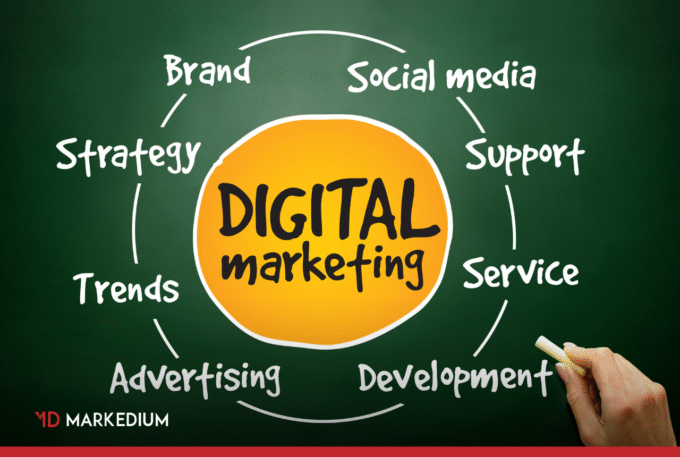
Digital branding strategy is the application of branding strategy across digital platforms: website, social media, content marketing, email, and search. Digital branding strategy does not replace the core branding strategy — it translates the positioning and identity into the formats, channels, and interaction patterns of digital environments. A brand with a strong offline identity needs a digital branding strategy to ensure that identity survives translation to social media, mobile, and search.
6. Startup Branding Strategy
Startup branding strategy prioritizes positioning clarity over visual polish. Startups with limited resources should resolve the positioning question — who is this for, what does it offer, why does it win — before investing in visual identity design. A startup with clear positioning and a minimal identity outperforms a startup with an expensive logo and no coherent position. Startup branding strategy also plans for iteration: positions will sharpen as market feedback arrives.
7. Product Branding Strategy
Product branding strategy positions a specific product rather than the organization behind it. Product branding strategy is used when an organization sells multiple products targeting different audiences or occupying different market positions. Procter & Gamble applies separate product branding strategies to Tide, Pampers, and Gillette — distinct brands targeting distinct audiences — within a single corporate architecture.
New Brand Strategy: Building From Scratch vs Rebranding
A new brand strategy is required in two distinct situations: launching a brand for the first time, or rebranding an existing brand that has outgrown, misaligned with, or damaged its original identity. Both situations use the same 8-step process, but each applies different constraints and priorities.
New Brand Strategy for a New Business
A new brand strategy for a new business has one structural advantage and one structural challenge. The advantage is a blank slate: no legacy positioning, no existing audience expectations, no accumulated inconsistencies to correct. The challenge is the same blank slate: no brand equity, no recognition, no baseline. Every element of the branding strategy — purpose, positioning, voice, identity — must be created from scratch and validated against real audience research rather than existing brand data.
A new brand strategy for a new business should prioritize positioning before everything else. The positioning question — who is this brand for, and why does it win — is the only question that cannot be changed cheaply once the brand is in market. Name, logo, and visual identity can evolve. Positioning that must change after launch is an expensive correction.
New Brand Strategy for a Rebrand
Rebranding applies a new brand strategy to an existing organization. Rebranding is warranted when: the business model changes, the target audience shifts, the brand is associated with outdated values, the organization merges with or acquires another brand, or competitive repositioning has made the existing position untenable.
Rebrand strategy must answer a question that the new brand strategy does not: what existing brand equity is worth preserving? A rebrand that destroys recognized brand assets — an established name, a trusted visual identity, a well-understood positioning — destroys equity that took years to build. Successful rebrand strategies identify the core equity worth protecting and rebuild everything else around it.
| Factor | New Business Brand Strategy | Rebrand Strategy |
|---|---|---|
| Starting point | No existing brand equity | Audit of existing brand equity |
| First priority | Get positioning right | Identify what equity to protect |
| Audience relationship | Build from zero | Transition existing audience |
| Biggest risk | Positioning that does not resonate | Destroying equity the audience valued |
Branding Strategy Examples
The following 5 branding strategy examples illustrate how the framework — positioning, identity, voice, consistency — produces competitive advantage across different industries and market contexts.
Nike: Purpose-Led Brand Positioning
Nike’s branding strategy is built on a single positioning insight: athletic potential exists in everyone, not just professional athletes. This positioning — expressed through “Just Do It” — repositioned Nike from a performance-shoe company to an aspirational brand accessible to anyone who wants to push their limits. Nike’s brand strategy design translates this positioning into visual language: athletes in motion, minimal product focus, maximum human emotion. Every campaign, regardless of channel or medium, reinforces the same positioning.
Brand strategy lesson: Positioning connected to a human truth — rather than a product attribute — compounds into brand equity over decades, not just campaigns.
Apple: Brand Strategy Design as Competitive Advantage
Apple’s branding strategy positioned the brand not on technology specifications but on simplicity and the belief that well-designed tools change how people think and work. Apple’s brand strategy design — the clean white spaces, minimal typography, uncluttered packaging — visually encodes this positioning in every touchpoint. Apple’s brand guidelines enforce this positioning so consistently that any deviation feels off-brand to consumers who have internalized the Apple identity. This is brand strategy design working at its highest level: design that communicates a specific competitive position, not just aesthetics.
Brand strategy lesson: Brand strategy design is a competitive signal. Consistent visual language tells the market what the brand stands for before a single word is read.
Patagonia: Values-Driven Branding Strategy
Patagonia’s branding strategy places brand values at the center of the positioning: environmental responsibility is not a CSR add-on; it is the brand’s primary competitive differentiator. Patagonia’s decision to run a “Don’t Buy This Jacket” campaign — urging customers to consider the environmental cost of consumption — is an example of a brand acting entirely from its brand strategy. The campaign increased brand preference among Patagonia’s target audience because it demonstrated that the values in the brand strategy were genuine constraints on business decisions, not marketing language.
Brand strategy lesson: Brand values in a branding strategy must function as real decision constraints. Values that disappear under commercial pressure are not brand values — they are brand claims, and audiences learn the difference quickly.
Grameenphone: Branding Strategy in an Emerging Market
Grameenphone’s branding strategy in Bangladesh demonstrates how brand positioning works in price-sensitive, high-growth emerging markets. Grameenphone built brand equity not only on network quality — a rational differentiator — but on national relevance and accessibility, communicating in Bangla, connecting to local culture, and positioning the brand as a partner in Bangladesh’s development. This branding strategy created loyalty that competitors with comparable network quality could not replicate, because the differentiation was not technical — it was relational. Grameenphone’s brand strategy design consistently reflected this through locally resonant imagery, colours, and messaging that signalled cultural belonging rather than corporate distance.
Brand strategy lesson: In emerging markets, cultural positioning is a durable competitive advantage. A brand that earns relevance through genuine cultural integration is harder to displace than one competing on price or product alone.
Warby Parker: New Brand Strategy Disrupting a Category
Warby Parker launched with a new brand strategy that addressed two constraints simultaneously: high prices and limited accessibility in prescription eyewear. The positioning — premium eyewear at accessible prices, sold directly — required a brand strategy design that communicated quality without signals of exclusivity. Warby Parker used a literary aesthetic, warm copy, and direct-to-consumer touchpoints to build a brand that felt considered without feeling expensive. The brand’s “Buy a Pair, Give a Pair” program embedded purpose into the brand strategy, giving customers an additional reason to choose Warby Parker beyond product quality or price alone.
Brand strategy lesson: A new brand strategy for a new business succeeds when it identifies a genuine gap — in price, access, experience, or values — and builds every brand attribute around solving it.

Branding Strategy Framework: A One-Page Reference
A branding strategy framework organises the 7 components of a branding strategy into a structured template that guides development. Every complete branding strategy should be documentable in one concise reference. If it takes more than 2–3 pages to summarise, the strategy has not been sufficiently sharpened.
| Framework Element | Question It Answers | Output Format |
|---|---|---|
| Brand Purpose | Why does this brand exist beyond making money? | One sentence, active voice |
| Target Audience | Exactly who is this brand built for? (go narrow) | Audience persona, 1–2 paragraphs |
| Brand Positioning | What specific position does the brand occupy in its market? | Positioning statement (1 paragraph) |
| Brand Values | What principles guide every brand decision? | 3–5 values with 1-sentence definitions |
| Brand Personality | If this brand were a person, how would it behave? | 5 adjectives + short description |
| Brand Voice | How does the brand sound in writing and speech? | Voice attributes + examples of what to say / not say |
| Brand Messaging | What is the core message the brand owns? | Tagline + messaging hierarchy (3 levels) |
| Brand Identity | What does the brand look and feel like visually? | Visual identity system (logo, colors, type) |
How to Measure a Branding Strategy
Branding strategy is measured through brand health metrics, which track how the brand is perceived by its target audience over time. Brand health metrics differ from marketing performance metrics: marketing metrics measure acquisition and conversion; brand metrics measure identity, awareness, and preference.
| Metric | What It Measures | How to Track |
|---|---|---|
| Unaided Brand Awareness | % of audience who name the brand without prompting | Brand surveys (quarterly) |
| Aided Brand Awareness | % of the audience who recognise the brand when shown it | Brand surveys (quarterly) |
| Brand Consideration | % of aware audience who would consider buying | Brand surveys + intent data |
| Share of Voice | Brand’s presence vs competitors across all channels | Social listening tools |
| Net Promoter Score (NPS) | Customer loyalty and likelihood to recommend | Post-purchase surveys (monthly) |
| Branded Search Volume | Growth in searches for the brand name | Google Search Console (monthly) |
| Brand Sentiment | Positive vs negative brand mentions online | Social listening + review monitoring |
Brand metrics move slowly. Branding strategy should be measured over 12-month periods, minimum, not monthly sprints. Short-term measurement of brand metrics produces noise, not signal. Set baseline measurements at strategy launch, track quarterly, and evaluate annual trajectory.
Frequently Asked Questions: Branding Strategy
What is the difference between a branding strategy and a marketing strategy?
Branding strategy defines what the brand IS. Marketing strategy defines how the brand REACHES customers. The branding strategy has a 3–5-year horizon and covers identity, positioning, values, and voice. Marketing strategy has a 12–24 month horizon and covers channels, campaigns, and acquisition tactics. Marketing strategy must operate within the brand strategy — not independently of it.
How long does it take to develop a branding strategy?
Developing a complete branding strategy typically takes 6–12 weeks for a new brand, including audience research, competitive analysis, positioning workshops, identity development, and brand guidelines. Rebranding with existing audience research and brand equity data can take 4–8 weeks. Implementing the strategy in market — building awareness and establishing the brand position — takes 12–24 months of consistent execution.
Can a small business develop a branding strategy without an agency?
Yes. Small businesses can develop a branding strategy internally using the 8-step process. The brand positioning and audience research steps are the most critical and the easiest to do poorly — they benefit from an external perspective. The visual identity step typically requires professional design support even for small businesses. A small business with a clear brand strategy and a simple visual identity outperforms a business with no strategy and an expensive logo.
What is a brand strategy framework?
A brand strategy framework is a structured template that organises the components of a branding strategy — purpose, positioning, values, personality, voice, messaging, and identity — into a format that guides development and keeps the strategy navigable. A branding strategy framework prevents brand strategy from becoming a 40-page document nobody reads. The most useful frameworks fit on one to two pages and answer the eight questions in the framework table above.
What makes a branding strategy fail?
Branding strategies fail for 4 predictable reasons:
- No clear positioning. A brand that does not own a specific position in the market communicates nothing distinctive — it blends into category noise.
- Targeting everyone. A branding strategy built for a broad, undefined audience produces messaging that resonates with no one deeply enough to create preference.
- No internal alignment. A branding strategy that lives in a document but is not understood by the people delivering the brand experience is not a strategy — it is a file.
- Treating strategy as a one-time project. Branding strategy requires iteration. Markets shift, audiences change, competitors reposition. Brands that stop evolving their strategy become stale.









Leave a comment