



























Bangladesh is setting its sights on Pakistan as an emerging sourcing destination, with local traders eager to tap into competitive pricing and a wider range of raw material supplies reportedly.
Currently, Pakistan enjoys a trade surplus, as Bangladesh imports cotton, yarn, fabrics, and essential commodities from the country. However, these imports still lag significantly behind those from China and India – Bangladesh’s two largest trading partners.
Bangladesh and Pakistan share a trade relationship that has remained stagnant for years, preventing Pakistan from becoming a major sourcing hub.
In July–December FY25, Bangladesh exported goods worth $39.77 million to Pakistan.
In FY24, total exports to Pakistan reached $61.98 million, marking a 31.78% drop from $83.59 million in FY23.
Meanwhile, Bangladesh’s imports from Pakistan stood at $372.1 million in the first half of FY25, down from $627.8 million in FY24 and $698.7 million in FY23.
Despite the absence of formal trade restrictions, weak trade relations have kept Pakistan from becoming a key supplier.
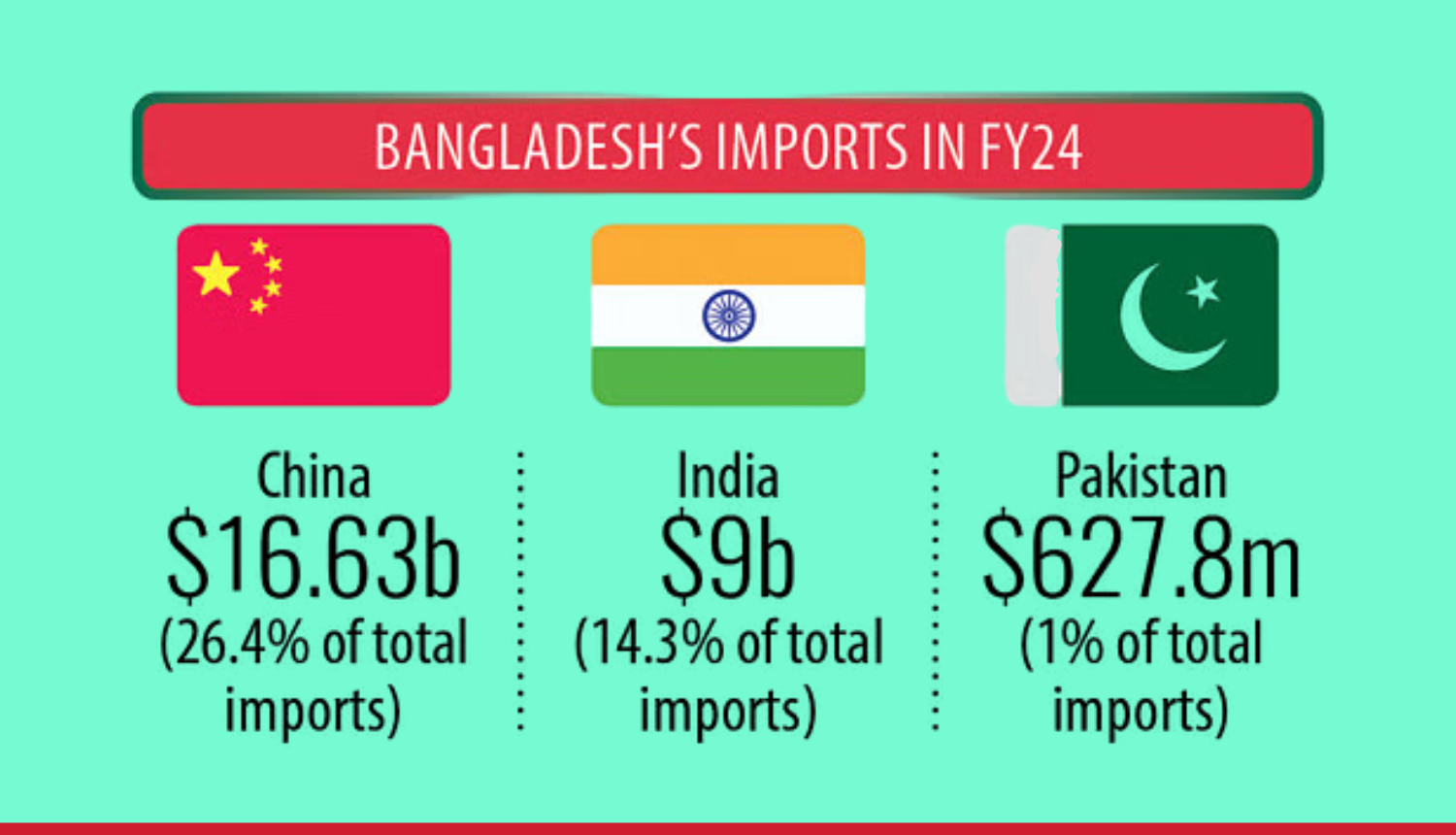
Pakistan remains a minor player in Bangladesh’s import landscape:
✅ China: $16.63 billion in FY24 (26.4% of total imports)
✅ India: $9 billion in FY24 (14.3% of total imports)
✅ Pakistan: Just $627.8 million (1% of total imports, ranking 20th)
A majority of imports from Pakistan—$476.3 million—came from cotton alone.
Experts believe Pakistan could play a key role in diversifying Bangladesh’s sourcing options, making the supply chain more competitive and resilient.
Mohammad Abdur Razzaque, Chairman of Research and Policy Integration for Development, emphasized the need for a reliable and cost-effective supply of essential goods, including food and energy. He believes Pakistan could be a strong alternative, creating more competition among supplying nations.
While Bangladesh already benefits from trade privileges under the South Asian Free Trade Agreement (SAFTA), exports remain low, limiting the advantages.
Tariff and non-tariff barriers between the two countries must be addressed to enhance trade flows, he added.
The idea of an FTA (Free Trade Agreement) between Bangladesh and Pakistan has been floating since 2002, with discussions resurfacing at the 2004 SAARC summit. However, Pakistan refused to grant Bangladesh unilateral and unconditional market access, halting progress.
Razzaque believes a bilateral FTA isn’t an immediate priority, as Bangladesh would benefit more from deals with bigger trading partners. However, he acknowledges that a stronger trade relationship with Pakistan could boost overall intra-regional commerce in South Asia.
Currently, less than 5% of South Asia’s total trade happens within the region—an issue partly attributed to the ineffectiveness of SAARC, established in 1985 to foster economic collaboration.
Industry leaders see great potential in sourcing from Pakistan, particularly in textiles.
Abul Kasem Khan, former president of DCCI, believes Bangladesh could benefit from lower-priced Pakistani cotton and denim fabrics.
Mir Nasir Hossain, former FBCCI president, agrees, saying expanding trade with Pakistan could help Bangladesh diversify its supply chain.
Bangladesh could also increase exports of jute and tea to Pakistan, strengthening bilateral trade ties.
A 2022 study by The Pakistan Business Council (PBC) estimated that Pakistan has an export potential of $2.95 billion in Bangladesh, mainly in:
✅ Textiles
✅ Agriculture & foodstuffs
✅ Chemicals
✅ Base metals
✅ Plastics & cement products
However, in 2020, Pakistan exported only $435.78 million worth of these top 25 commodities, despite their estimated $1.24 billion potential.
A major step forward came on January 13, 2025, when the Federation of Pakistan Chambers of Commerce & Industry (FPCCI) and the FBCCI signed an MoU to establish the Pakistan – Bangladesh Joint Business Council (PBJBC).
FBCCI Administrator Md Hafizur Rahman, who led the Bangladeshi delegation at the joint meeting, acknowledged that trade potential remains underutilized, possibly due to political factors.
One of the biggest obstacles to boosting trade with Pakistan has been poor connectivity. However, recent changes indicate positive momentum:
Direct Shipping Line: Now in place, facilitating smoother trade.
Visa Process Simplified: Pakistan has eased its visa process for Bangladeshis, now offering approval within 24 hours.
For years, Bangladesh’s textile industry heavily relied on Indian cotton. However, in recent years, spinners and traders have diversified, sourcing from:
Argentina
Australia
Brazil
United States
Several African nations
Pakistan
According to Showkat Aziz Russell, President of the Bangladesh Textile Mills Association, Pakistan’s competitive pricing has made it an increasingly attractive option for cotton imports.
With bilateral relations improving, he expects higher import volumes in the near future.
Read more: Bangladesh Becomes Fastest-Growing Apparel Exporter to the US in January
While Pakistan remains a small player in Bangladesh’s overall trade, recent developments indicate that the dynamics are changing, With:
✔️ Improved connectivity
✔️ Lower trade barriers
✔️ Competitive pricing on essential imports
✔️ Increasing collaboration between business chambers
Pakistan could emerge as a more significant sourcing destination for Bangladesh, offering new opportunities for both nations in the coming years.
For more updates, be with Markedium.













Leave a comment