



























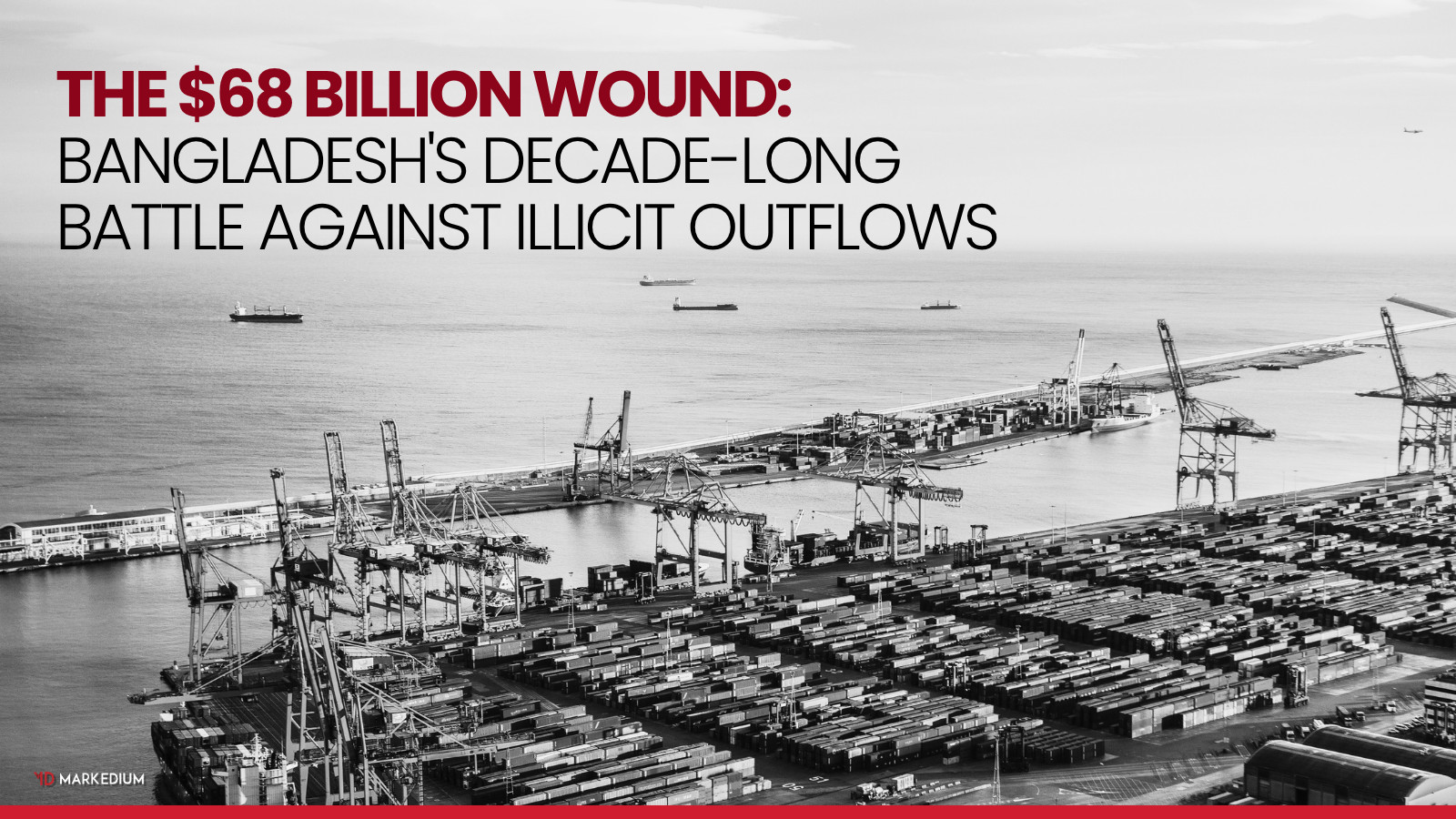
Bangladesh hemorrhaged an estimated $68 billion in illicit financial outflows over the ten year period between 2013 and 2022, placing the country among the top ten developing Asian nations for trade discrepancies with advanced economies. The findings come from a report titled “Trade-related Illicit Financial Flows in Developing Asia 2013–2022,” published on March 27 by the Washington based think tank Global Financial Integrity (GFI).
On an annual basis, the losses amount to approximately $6.8 billion, representing 16 percent of Bangladesh’s total trade with the world. The primary driver is trade misinvoicing, a practice in which import or export values are deliberately falsified. The report specifically flagged Bangladesh’s vulnerability to trade based money laundering, particularly through over invoiced imports of capital machinery that benefit from subsidised loans. Of the total outflows, around $32.8 billion was traced to transactions with advanced economies.

The GFI study, which analysed data from 24 developing Asian countries across South, East, and Southeast Asia, noted that larger economies naturally record higher illicit outflows. China alone accumulated $6.96 trillion in cumulative trade gaps over the decade, followed by Thailand at $1.18 trillion and India at $1.06 trillion.
These findings align with a December 2024 white paper by Bangladesh’s interim government, which estimated that an average of $16 billion was siphoned off annually during the 15 years of Awami League governance.
Professor Selim Raihan of Dhaka University cautioned that figures may vary across studies due to differing methodologies, adding that Bangladesh’s delayed reporting of official trade data complicates cross verification efforts. He urged institutions to establish systems that compare import prices against global market rates and ensure export earnings are repatriated through official channels.
The GFI report warned that illicit flows deprive governments of critical revenues, weaken domestic resource mobilisation, and undermine poverty reduction efforts. It called for strengthened customs enforcement, greater transparency in free trade zones, and enhanced international data sharing as essential steps toward curbing what it described as a profound and persistent threat to Asia’s development.
For more updates, be with Markedium.











Leave a comment