





























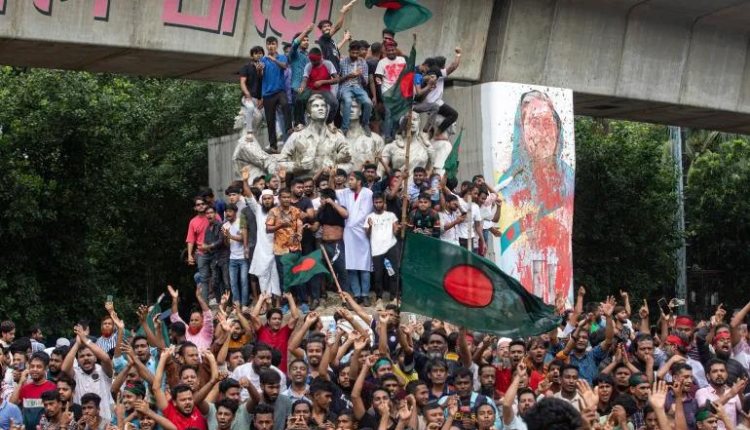
The recent political turmoil in Bangladesh, marked by Prime Minister Sheikh Hasina’s resignation and the ensuing unrest, has ignited a media frenzy across the border in India. The Indian media’s portrayal of these events has been nothing short of sensational, with narratives that paint a picture of foreign conspiracies and Islamist takeovers.

However, a closer look reveals a more complex reality that warrants a nuanced understanding, especially for Indian readers who might be swayed by such alarmist rhetoric.
Sensationalism vs. Responsibility
Indian news outlets (not all, but some major ones), traditionally known for their sensationalist tendencies, have turned the political upheaval in Bangladesh into a story of intrigue and conspiracy. Reports have accused Pakistan’s ISI, China’s intelligence networks, and even the United States of orchestrating Hasina’s downfall. This narrative, amplified by prime-time anchors, serves not only to stoke nationalist sentiments but also to divert attention from internal issues by presenting a foreign crisis as a security threat to India.

Numerous news reports have made exaggerated claims about attacks on Hindus, including one by the Times of India quoting Suvendu Adhikari, a senior leader of Prime Minister Narendra Modi’s Bharatiya Janata Party (BJP), suggesting that “more than one crore [10 million] refugees are likely to enter West Bengal soon.” Additionally, the ANI news agency quoted an Indian student leader asserting that the mass uprising was “orchestrated by the enemies of Bangladesh.” In a particularly bizarre report, the Times of India stated that Jamaat-e-Islami, Bangladesh’s largest Islamist party, was responsible for “bringing down Sheikh Hasina’s government in Bangladesh.”
Such reporting risks misinforming the public, creating unnecessary hysteria, and straining diplomatic relations. The emphasis on sensational stories over factual reporting undermines the media’s responsibility to inform rather than incite.
Contrary to some of the Indian media’s depiction, the situation in Bangladesh is more of a political and economic struggle than an orchestrated coup. The student-led protests that catalyzed Hasina’s resignation reflect widespread dissatisfaction with governance and economic conditions, not a clandestine plan by Islamist forces or foreign powers.

Reports from the ground, including those by global media giant Al Jazeera, highlight that attacks on Hindu minorities were largely politically motivated, targeting those affiliated with the Awami League rather than indiscriminately attacking based on religious identity.
The narrative of a mass exodus of Hindus into India and an impending refugee crisis is largely exaggerated. Historical grievances and fears are being manipulated to probably fit a narrative that resonates with Indian political interests.
The Indian media’s approach, as seen in the coverage by outlets like Republic TV, Times Now, and others, appears to be driven by an agenda that conflates political unrest with religious extremism. This not only distorts the situation in Bangladesh but also fuels Islamophobic sentiments within India, potentially leading to communal discord.
It is crucial for Indian readers to critically assess the media’s narrative and seek diverse sources of information. The portrayal of Bangladesh’s crisis as an Islamist conspiracy fits too neatly into a broader narrative used by right-wing elements in India to bolster their ideological stance against Muslims. This approach not only misrepresents the situation but also ignores the broader socio-political dynamics at play in Bangladesh.
For the global audience, the situation in Bangladesh should be viewed through the lens of its internal dynamics and a new hope of democracy in Bangladesh rather than external manipulation. The real story is one of a nation grappling with change and seeking a path forward amid complex challenges.
A Call for Balanced Reporting
As the media continues to cover the unfolding events in Bangladesh, it is imperative that the narrative is shaped by facts and context rather than conjecture and sensationalism. Indian media, in particular, must move beyond fear-mongering headlines and provide a balanced perspective that respects the nuances of the situation. By doing so, they not only serve the truth but also contribute to a more informed and harmonious regional discourse.
For more updates, be with Markedium.
















Leave a comment