






























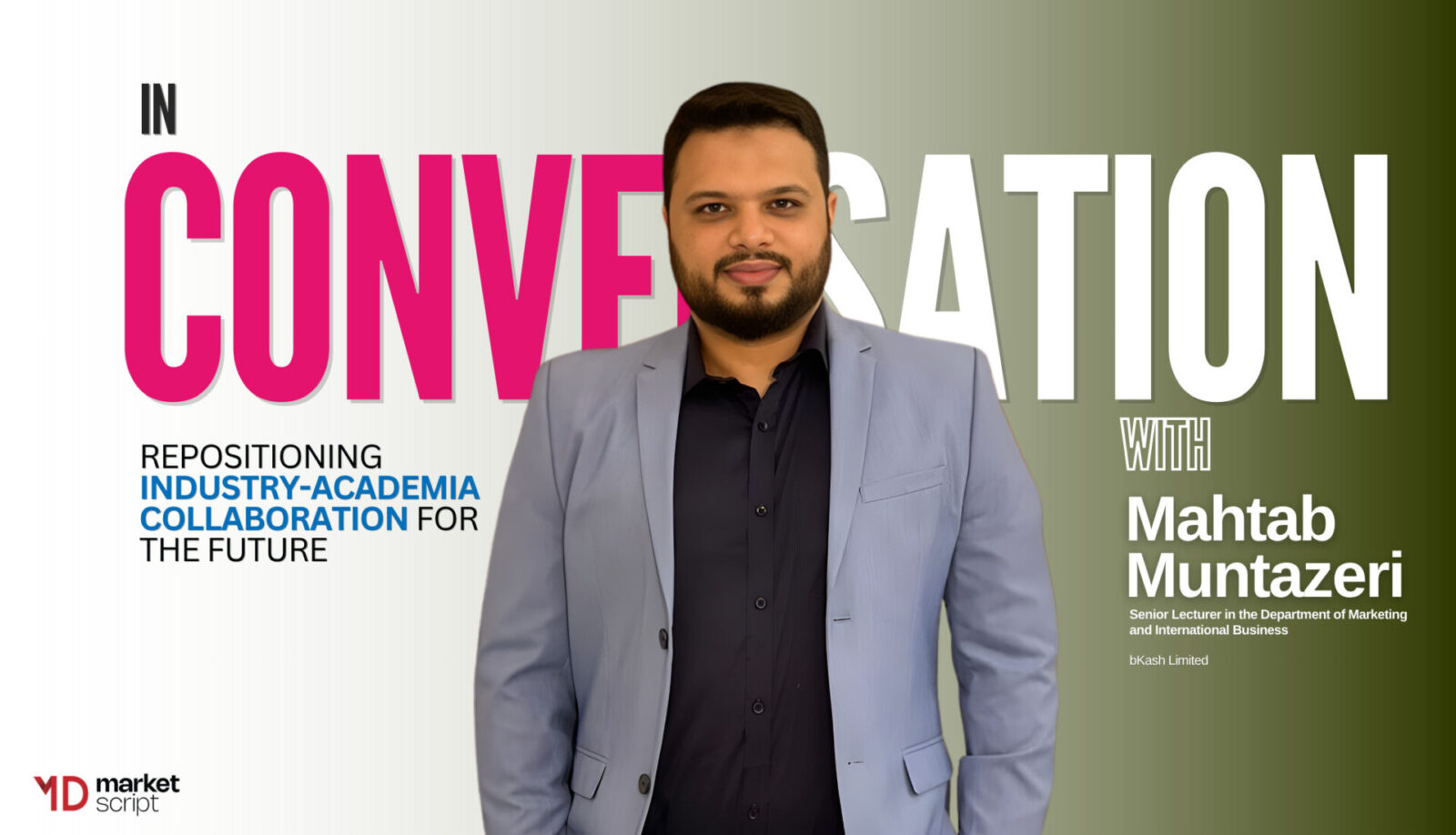
The relationship between higher education and industry is at a critical juncture in the global economy. As economies rapidly evolve, the traditional model of theoretical knowledge transfer is proving insufficient to meet the dynamic needs of the job market. To explore this vital intersection, we spoke with Mr. Mahtab Muntazeri, Senior Lecturer in the Department of Marketing and International Business at North South University (NSU), who shared his expert assessment on the current state, challenges, and necessary philosophical shifts required for effective industry-academia collaboration.
Assessing the Current State: A Phase of Development
Mr. Mahtab characterizes the current landscape of industry-academia collaboration as being in a “development phase.” While leading institutions—including NSU, Dhaka University, and Brac University—are engaging in significant efforts, much of the collaboration remains transactional, often occurring through short-term events or on a one-on-one basis.
“Where we lack is structured development of industry-academia,” Mr. Mahtab notes. He stresses that the most immediate and critical area where collaboration is falling short is in co-creation. This involves the joint development of knowledge, particularly industry-specific content and local learning requirements.
The lack of co-creation impacts core academic materials: “If we want to create, for example, let’s say case studies, which is Bangladeshi-specific and industry-specific, it requires industry-academia collaboration,” he says. Similarly, adapting curricula—often adopted from foreign systems—to the local needs of corporates, recruiting companies, and entrepreneurs demands a far deeper partnership.
Defining and benchmarking the ‘Quality Graduate’
In a fast-changing economic environment, the definition of a “quality graduate” must evolve beyond simple academic achievement. For business graduates specifically, Mr. Mahtab highlights a combination of core competencies:
- Domain Knowledge
- Analytical Thinking
- Adaptability: Specifically, “be able to adapt to new challenges [and] the dynamic business environment.”
- Quick Learning: The ability to learn swiftly from corporate and work environments.
- Soft Skills: The essential interpersonal skills required in industry.
The collective possession of these attributes, Mr. Mahtab suggests, is what truly defines a graduate who can add value in the modern workplace.
Effective Mechanisms for Bridging the Practical Skills Gap
While credit-bearing internships are a proven method for bridging skill gaps, Mr. Mahtab argues that the timing and structure of practical exposure need significant reform.
He advocates for integrating project works that involve direct field experience with industry. For instance, a marketing student should engage in projects working with agencies or sales teams.
Crucially, he challenges the current standard of placing the compulsory internship as the last course: “If they could do it maybe early on, like middle of their graduation or even earlier, that could have been even more helpful… they could have been able to relate [practical experience] to certain concepts on classes.”
This earlier exposure would allow students to bring real-life outlooks back into the classroom, enriching discussions and significantly reducing the skill gaps upon graduation. He suggests that developing a culture of short, mid-program placements—similar to summer programs in other systems—is essential, though it requires corporate participation and a restructuring of academic calendars.
Establishing Mutual, Quantifiable Value
The major impediment to sustained collaboration is the difference in motivation, often leading to short-term, event-based partnerships. To overcome this, both academia and industry must adopt a long-term perspective and establish a clear shared value.
For the industry, the gain is far beyond mere recruitment. Industry can use collaboration as an opportunity for:
- Knowledge Creation: Not just for the university, but for the industry itself, by developing best practices and solving unique, complex problems.
- Efficient Problem-Solving: Gaining the intellectual resources of the faculty to tackle issues in a more efficient way.
For the university, the gain extends past “a good story” or public relations:
- Better Curriculum: Designing and refining programs that are directly responsive to the needs of the job market.
- Faculty Development: Providing faculty members with exposure and real-world data to enrich their research and teaching.
“We need to set up or find a way where there would be a shared value, where we would know that what both parties are gaining in the long run,” Mr. Mahtab asserts.
The Faculty-Industry Link and SME Collaboration
To prevent the curriculum from becoming theoretically outdated, academic staff must possess and maintain current industry experience. Mr. Mahtab suggests an embedded program or a Faculty-in-Industry Fellowship where professors could be part of industrial programs.
While admitting the difficulty of implementing this on a large scale due to the sheer volume of faculty and students, he highlights the necessity of in-hand experience for faculty to:
- Teach better and with greater context.
- Design a superior curriculum and assessment criteria.
- Ensure project works are industry-aligned.
Regarding Small and Medium Enterprises (SMEs), Mr. Mahtab notes that while large corporations have the resources for collaboration, SMEs are often more flexible. Since SMEs represent a significant and growing portion of the job sector, universities must assess their specific requirements and create accessible platforms for SMEs to collaborate with academia.
Measuring Long-Term Success and the Philosophical Shift
Measuring the true, long-term success of collaborative initiatives requires going beyond initial job placement. Mr. Mahtab proposes the following Key Performance Indicators (KPIs):
- Career Progression of Graduates
- Retention Rate (in their first few jobs)
- Entrepreneurship Outcomes
- Project Outcomes (the real-world impact of student/faculty projects)
- Curriculum Development (quantifying alignment changes over time)
- Innovation (metrics related to novel solutions or patents)
Ultimately, maximizing industry input requires a fundamental shift in the philosophy of higher education: moving from a focus on purely theoretical knowledge transfer to one centered on applied problem-solving and entrepreneurial thinking.
This shift, Mr. Mahtab concludes, circles back to the concept of co-creation, involving students, faculty, and industry partners alike. He suggests that universities must create structured institutions—like NSU’s “Start Up Next” incubation program—that are dedicated to training specific skill sets, complementing classroom theory, and fostering an environment of innovation.
“If we invest more on these type of institutions, programs like this… that would help create an environment where students can learn problem-solving capabilities, entrepreneurial thinking.”
This interview was first published in Market Script Issue 1, where we delved deep into the ‘Mobile Financial Service’ industry of Bangladesh.
For more updates, be with Markedium.














Leave a comment