






















The 2026 Winter Olympics did not just produce medals. It produced one of the clearest brand strategy case studies of the decade. Milano Cortina 2026 ran from February 6 to 22 in Italy, co-hosted by Milan and Cortina d’Ampezzo, and Milan’s selection as a co-host city changed the commercial dynamics of the entire event.
This was not a sponsorship play from 10 years ago. Brands that treated it like one largely underperformed. The brands that won did something structurally different: they built platforms, not placements for brand development.
Here is what actually happened, and what it means for how brands think about major event marketing going forward.
Milan Changed Who Shows Up to the Olympics
The city selection for an Olympic host is typically a logistics decision. For Milano Cortina 2026, it was also a brand positioning decision — one that paid dividends for a category of brands that had never engaged with a Winter Games before.
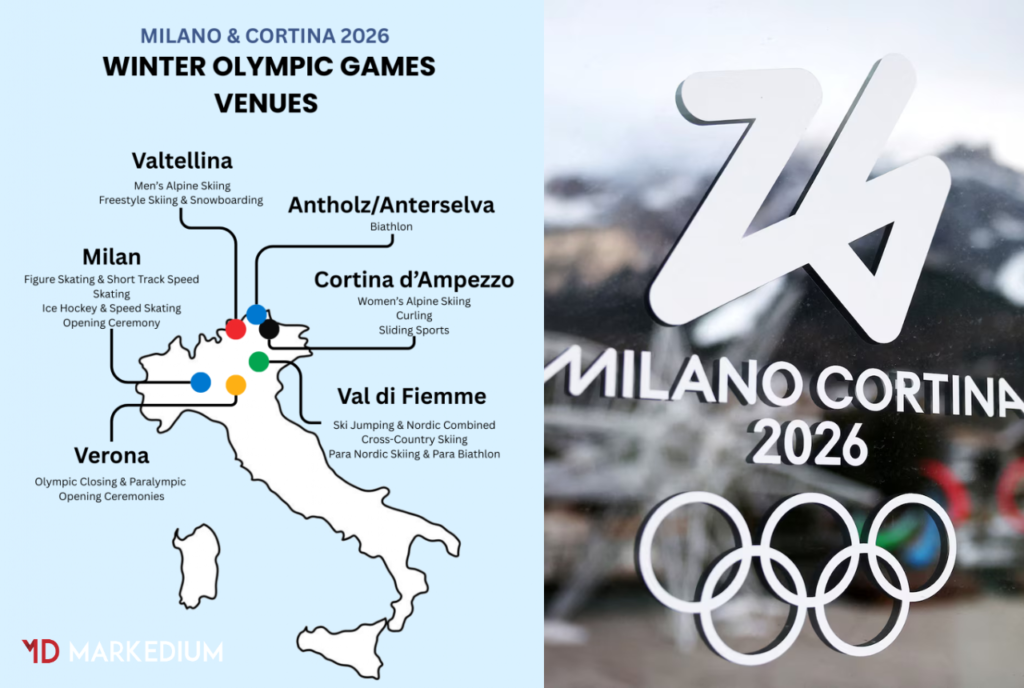
Milan is the global capital of fashion and design. That single fact brought haute couture houses, luxury lifestyle brands, and premium apparel labels into a commercial arena traditionally dominated by telcos, sportswear giants, and consumer electronics companies. The 2026 Games attracted an unusually broad commercial coalition: traditional sporting goods manufacturers, luxury fashion houses making strategic moves into performance apparel, and lifestyle brands positioning themselves at the intersection of athleticism and aspiration.

The result: team kits were described as couture-level designs. Fashion and luxury accounted for 18 of the 52 brand categories associated with medal-winning athletes. Brands that would never sponsor a competition in Salt Lake City or Sochi found a culturally legible entry point in Milan.
The lesson: host city identity is not just a tourism variable. It is a brand-positioning decision that reshapes the event’s entire commercial ecosystem.
The Broadcast Sponsorship Model Is No Longer Enough
The dominant brand activation model at Milano Cortina 2026 was the owned physical space, not the broadcast logo placement. Sponsors built what the industry now calls “brand houses” — dedicated venues in Milan where they controlled the audience, the content, the data, and the narrative.
Samsung opened Samsung House near the city center. The space blends product showcases and areas for athlete appearances and content production. Visitors tested Galaxy devices in performance and creativity scenarios. Samsung also revived its “Victory Selfie” initiative, distributing roughly 3,800 special-edition phones to Olympic and Paralympic athletes so medalists could capture their own celebratory moments — a single activation that product-seeded, ecosystem-locked, and culturally built.
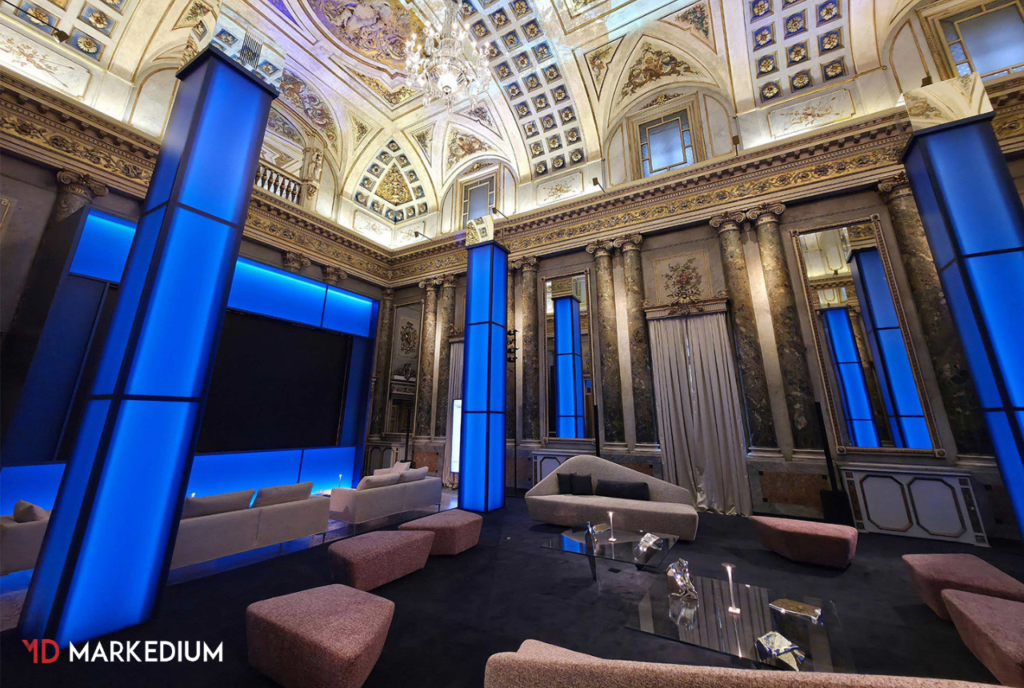
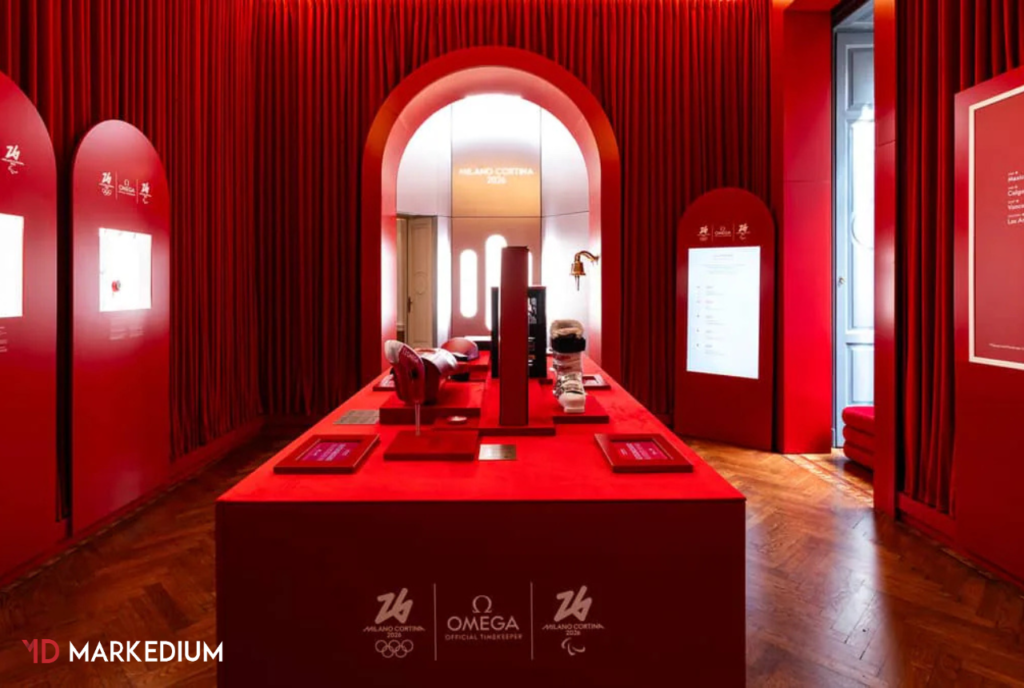
Omega opened Omega House Milano, its first dedicated Winter Games house in a host city, using the venue to demonstrate how competition timing systems work across disciplines like alpine skiing and speed skating. Archival installations traced decades of Olympic involvement. The space connected product function to brand legacy in one physical experience.
Airbnb launched 26 bookable Olympian and Paralympian Experiences tied to the Games — athlete-led sessions ranging from training workshops to cultural outings, integrated directly into Airbnb’s booking system with live pricing and scheduling. Those experiences continued after the competition window closed. Airbnb did not just sponsor the Games; it built a new product line out of the partnership.
The strategic logic behind this shift is direct: a brand house is programmable. You decide who enters, what happens inside, and how success is defined. You link activations to pipeline development. You capture first-party data. You generate owned content that extends far beyond the 16-day Games window. A logo on a broadcast feed does none of that.
Brands that built physical presence reported measurable engagement, earned media, and brand recall long after medals were packed away. Brands that bought broadcast placement had two weeks of visibility and nothing after.
Athletes Generated More Value Than Official Channels in the 2026 Winter Olympics
The most commercially significant data point from Milano Cortina 2026 was not viewership. It was Earned Media Value (EMV) generated by individual athletes.
EMV measures the estimated cost of achieving equivalent reach through paid advertising. The athlete with the highest EMV at the entire Games was figure skater Ilia Malinin — the “Quad God” — who generated $1,941,251 in earned media value for his sponsors through organic content and social engagement. Amber Glenn, the American figure skater with 1.3 million Instagram followers, ranked second. Both outperformed most official broadcast activations in terms of raw attention generated.
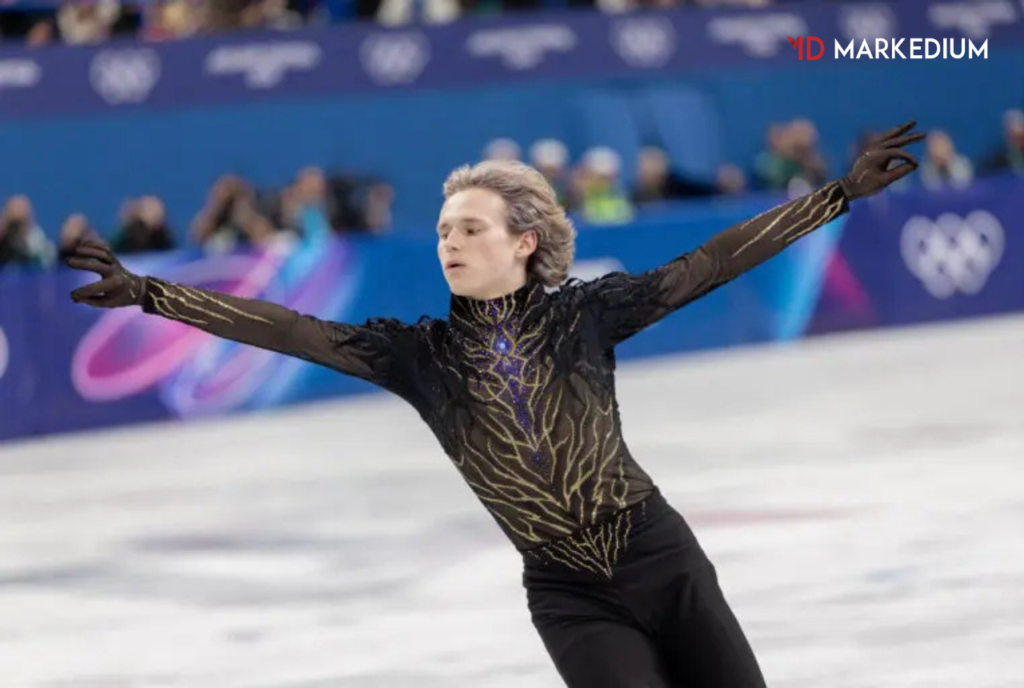
Google and Samsung recorded the highest overall EMV among brands associated with medal-winning athletes. Google’s numbers were driven almost entirely by Malinin and Glenn — two athletes in a non-traditional Olympic discipline, generating brand exposure that no paid placement could have bought at equivalent cost.
Italian athletes added a local dimension. Italy won 30 medals — an all-time national record — and the social media consequences were immediate. Giovanni Franzoni, silver medalist in downhill skiing, and Stefania Constantini, bronze medalist in mixed doubles curling, recorded the highest Instagram growth percentage among Italian athletes. They outperformed established names like Federica Brignone and Arianna Fontana in EMV rankings, despite having smaller existing followings before the Games.
This is the athlete-as-media-channel dynamic operating at scale. An athlete who wins a medal at a major event is not just a brand ambassador — they are a media property that generates earned coverage across every platform simultaneously, often for multiple brand partners at once.
For brands that had seeded athlete partnerships before the Games, the return on that investment was compounded when medals arrived. For brands that had not, there was no equivalent path to that kind of organic reach in two weeks.

Rule 40 Changed the Calculus for Non-Official Sponsors
Rule 40 of the Olympic Charter has historically been the mechanism that protects official TOP (The Olympic Partner) sponsors by creating a “blackout period” during which non-official brands cannot run campaigns featuring Olympic athletes.
Milano Cortina 2026 operated under a materially different version of that rule. The IOC and national committees adopted a “continuity principle” — personal sponsors of athletes can maintain their presence during the Games, provided the campaigns reflect pre-existing relationships and are not materially escalated during the competition window. Athletes were allowed to post up to seven “thank you” messages acknowledging personal sponsors on social media during the Games.
This change restructures the commercial math of Olympic sponsorship. A brand that builds a genuine athlete partnership before the Games can now maintain a visible presence during the Games without paying TOP sponsor fees, which can run into tens of millions of dollars per cycle. The path to Olympic-adjacent brand equity no longer requires the full official sponsorship investment.
The tradeoff is real: non-sponsors still cannot use Olympic intellectual property — the rings, the official mascots, or phrases like “Road to Milano Cortina.” The Italian Competition Authority launched enforcement actions against at least three Italian retail brands for attempting to associate with the Olympic Games without official status. Ambush marketing was monitored more closely at these Games than at any previous Winter Olympics.
The rule change rewards brands that invest in genuine athlete relationships early. It penalizes brands that try to manufacture an Olympic association at the last minute. The playbook is long-lead, not reactive.
The Emerging Market Angle: What Brands Can Learn from a Telco
The commercial dynamics of Milano Cortina 2026 were shaped by the specific conditions of Milan and Europe. But the underlying brand strategy lessons translate directly to emerging market contexts — and Bangladeshi brands and marketers should read them through that lens.
The core lesson is not “spend like Samsung.” It is: identify the platform where your brand can build a genuine, culturally relevant presence, and build that presence before the window opens — not during it.
Grameenphone’s long-run brand strategy in Bangladesh operates on the same logic. The brand did not win by matching competitors on network quality alone. It built cultural positioning — communicating in Bangla, connecting to national development narratives, and showing up as a local partner rather than a corporate outsider. That positioning is not replicable by a competitor in a sponsorship window. It compounds over time.
The brands that won at Milano Cortina 2026 did not win because they had larger budgets. Samsung, Omega, and Airbnb won because they built genuine platforms — owned spaces, authentic athlete relationships, products embedded in the Olympic experience — that could not be matched by a late-entry check.
The Olympic brand lesson for any market, including Bangladesh: platform-building beats placement-buying, every time.
What Changed at These Games, Summarized
| Old Olympic Brand Model | Milano Cortina 2026 Model |
|---|---|
| Broadcast logo placement | Brand as a spectator of athlete performance |
| Official TOP sponsorship only | Athlete partnerships (Rule 40 evolution) + official tiers |
| Luxury fashion, lifestyle, and tech are all competing equally | Platform extends before and after the Games |
| Host city as a brand positioning signal | Brand embedded in athlete content and earned media |
| Sportswear and consumer tech dominated | Luxury fashion, lifestyle, and tech all competing equally |
| Host city as logistics decision | Host city as a logistics decision |
The One Number That Matters
The IOC redistributes 90% of its revenues to athletes and sports organisations worldwide — equivalent to over $4 million per day. Official Olympic sponsorship funds the global sports ecosystem, not just the host city event.
That context matters for how brands evaluate the sponsorship investment. Paying TOP sponsor fees is not just a marketing expense. It is participation in a global distribution system that funds athletes from countries that could not otherwise send competitors to the Games. Brands that communicate that story — rather than just the logo placement — build a different kind of audience relationship.
Patagonia-style values-driven brand strategy works in sport sponsorship the same way it works in product marketing. The brands at Milano Cortina 2026 that embedded genuine purpose into their activation — Airbnb’s athlete experiences, Samsung’s phone distribution to Paralympic athletes, Visa’s athlete support program — generated stronger audience response than brands that showed up with signage and a hospitality tent.
Purpose embedded in activation is not soft marketing. At Milano Cortina 2026, it was measurably the highest-performing activation type.
Milano Cortina 2026 closed on February 22. The Winter Paralympics run from March 6 to 15, 2026. The next Winter Olympics will take place in the French Alps in 2030.





Leave a comment