

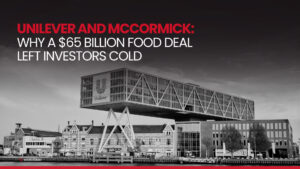






















When two companies announce a merger and both their share prices fall, the market is sending a message. That is precisely what happened on Tuesday when Unilever confirmed it would merge its food division with American spice maker McCormick in a transaction valuing the combined entity at $65 billion, the second largest food deal in history.
Unilever’s shares fell 7% on the announcement, wiping $7 billion from its market value. McCormick shares dropped approximately 5%. The reaction was not irrational. Investors had three specific grievances: the deal’s structure, its timeline and the spectre of regulatory scrutiny.

A tax efficient structure that satisfies nobody
The transaction will be structured as a Reverse Morris Trust, a mechanism that delivers tax advantages by having Unilever spin off its food division before merging it with McCormick. On paper, that is efficient. In practice, it creates an ownership problem. Analysts at RBC Capital Markets noted that Unilever shareholders would retain 55.1% of the combined business, with Unilever itself holding a further 9.9% stake, describing the arrangement as hardly a clean exit. That residual concentration is not a footnote. It represents a sustained overhang on the new company’s stock, constraining price discovery and limiting the strategic freedom McCormick’s management would otherwise enjoy.
A 15 month window of regulatory exposure
The deal is not expected to close until mid-2027. In the current environment, that is a long time to leave a transaction exposed. Bill Kovacic, a former chair of the Federal Trade Commission, said the deal would likely receive close scrutiny given the agency’s focus on mergers affecting consumer prices. The packaged food sector has already drawn regulatory attention, and a transaction of this scale, combining Hellmann’s and Knorr with McCormick’s spice and condiment portfolio, offers antitrust examiners considerable material to work with.
Activist pressure finally bears fruit, at a cost
The deal did not emerge in a vacuum. Investor pressure to shed food brands intensified after activist shareholder Nelson Peltz built a stake in Unilever in 2022, and has been linked to the departure of two CEOs who were seen as too slow to streamline the portfolio. Unilever’s food unit, while profitable, has seen sales growth lag its personal care and beauty divisions, weighing on the company’s ambition to grow group sales by 4% to 6%.
The strategic logic is sound. The execution risk is substantial. Markets, for now, are focused on the latter.
For more updates, follow us on










Leave a comment