





























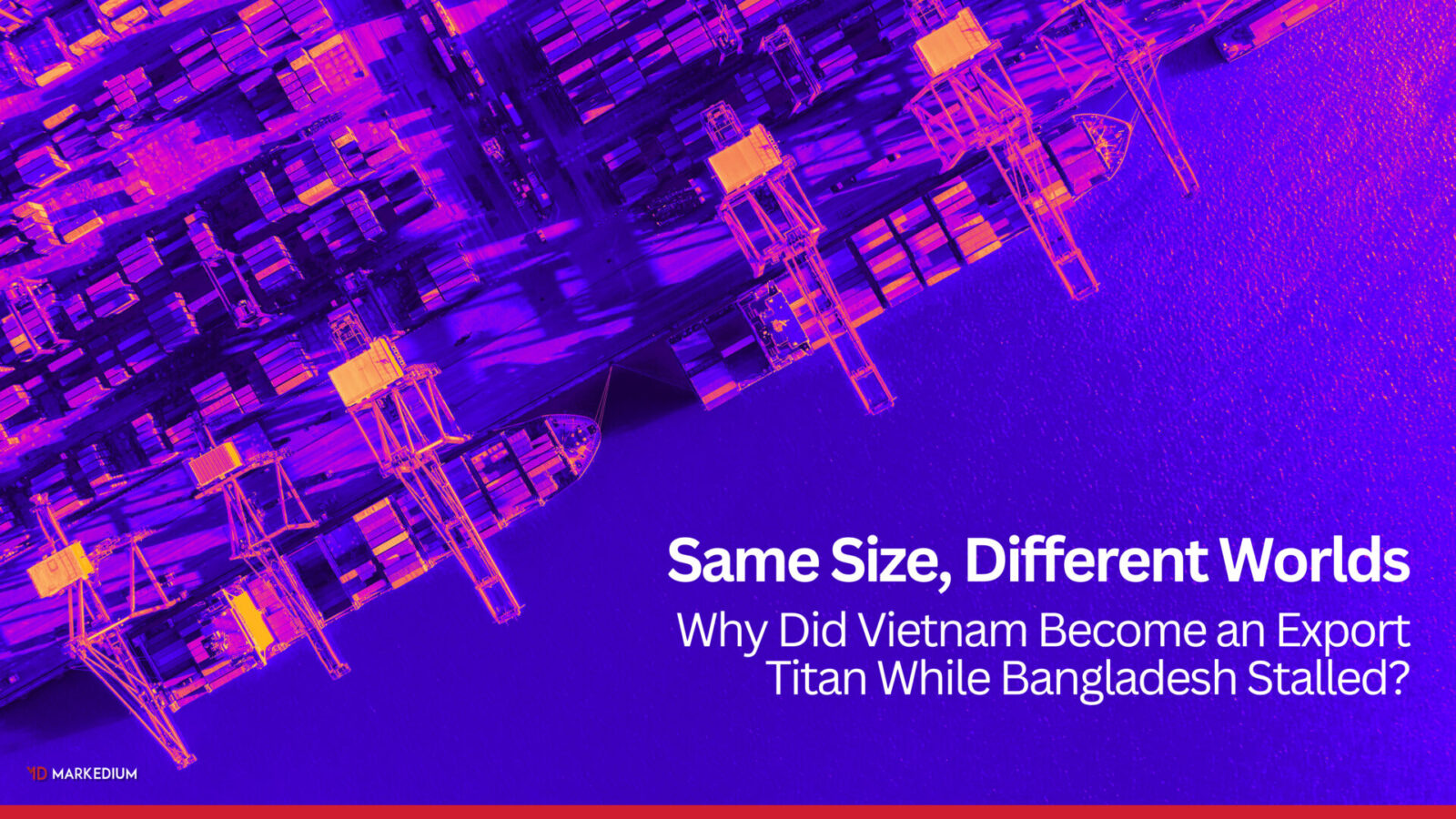
Two economies of nearly identical size have taken vastly different paths. One has built a $475 billion export machine and attracted more foreign capital last year than the other has in its entire history as a nation.
On paper, Vietnam and Bangladesh look like twins. Vietnam’s economy was worth roughly $514 billion in 2025; Bangladesh’s, about $456 billion, according to the World Bank. Both are Asian, both built their modern growth stories on cheap, disciplined labor, and both turned to export manufacturing in the 1980s after emerging from war and upheaval. Any visitor comparing only the GDP line would assume the economies were peers on similar trajectories.
But they are not.
Vietnam exported $475 billion worth of goods in 2025, a 17% jump from the year before, with 36 separate product categories each clearing $1 billion in shipments. Whereas Bangladesh has exported only $48.28 Billion. This disparity is further underscored by global capital flows: in 2024, UNCTAD data revealed that Vietnam secured $20.17 billion in foreign direct investment (FDI), dwarfing Bangladesh’s $1.27 billion. This trajectory has only intensified; by 2025, Vietnam’s Ministry of Planning and Investment reported that FDI inflows surged to $27.62 billion, while Bangladesh struggled to break the $2 billion threshold. One country has become one of the most trade-dependent economies on earth, with trade equivalent to nearly 170% of GDP, and the other is watching its signature industry run up against a wall.
The gap between these two economies is not really a story about GDP. It is a story about what each government built, or failed to build, around its labor force.

The machine Hanoi built:
Vietnam’s transformation was not an accident of geography, though geography helped. It was the product of a three-decade campaign to make the country the path of least resistance for any multinational looking to relocate a factory out of China.
The first pillar was trade access. By 2026, Vietnam had signed or was implementing somewhere between 16 and 18 free trade agreements, including the Comprehensive and Progressive Agreement for Trans-Pacific Partnership, the EU-Vietnam Free Trade Agreement, and the Regional Comprehensive Economic Partnership. Vietnam’s own planning ministry has estimated the EU-Vietnam Free Trade Agreement (EVFTA) alone could lift GDP by as much as 15% over time. A factory built in Bac Ninh or Hai Phong can ship its products, mostly without tariffs, to the EU, Japan, South Korea, Australia, Canada, and most other Asian countries all at once. This capability is a significant advantage that few other low-cost manufacturing centers can claim.
The second pillar was anchor investment. Samsung is the case study every economist in the region now cites. What began as a single television factory in 1995 grew into a $24 billion cumulative investment, and by the end of 2025, Samsung’s Vietnamese operations alone generated $64.9 billion in revenue and $57.1 billion in exports, a figure larger than Bangladesh’s entire export economy. Korean investments, spearheaded by Samsung and LG, now represent approximately 30% of Vietnam’s total exports. This particular partnership has pulled along an entire supply chain of component suppliers from Taiwan, Japan, and China. Since then, Hanoi has applied the same strategy with companies such as Intel, Foxconn, Pegatron, and, increasingly, semiconductor packaging firms, aiming for a share of the projected 9% of the global chip-assembly market by 2032.
| Country | 2024 Registered FDI | Cumulative FDI | Key Sectors & Projects |
| Singapore | $10.2 billion (confirmed) – #1 rank, ~27% share of FDI | ~$84 billion (≈3,950 projects) | High-tech manufacturing (electronics), industrial parks (VSIP network), real estate (smart cities), logistics, renewable energy (solar farms) |
| South Korea | $7.06 billion (confirmed) – #2 rank, 18.5% share | ~$92 billion (10,128 projects) | Electronics (Samsung’s ~$22 billion, 112k jobs), displays (LG’s $5.65 billion complex), semiconductors (Amkor $1.6 billion), steel, autos, energy (wind power) |
| China | $4.73 billion (confirmed) – #3 rank (by projects #1) | ~$30.8 billion (≈2,300 projects) | Electronics (PCB factory $520 million, phone assemblers), textiles ($300 million garment park), infrastructure (rail projects), solar panel manufacturing |
| Japan | ~$3 billion (estimated) – #5 rank in 2024 | ~$74 billion (≈5,300 projects) | Manufacturing (auto parts, electronics), energy (Nghi Sơn refinery $9 billion), smart infrastructure (metro lines via ODA), real estate (urban developments), retail (AEON malls) |
| Taiwan | ~$2.8 billion (estimated) – top 6 investors | ~$39 billion (≈3,200 projects) | Electronics & PCs (Foxconn, Pegatron $400 million+, Compal), textiles (Formosa $200 million synthetic textiles), steel (Formosa Hà Tĩnh $10.5 billion), semiconductors (ASE, others in chip packaging) |
Table data Source: https://vietnam.incorp.asia/fdi-companies-in-vietnam/
The third pillar was timing. Since roughly 2018, U.S. tariffs on Chinese goods have pushed multinational manufacturers to diversify their supply chains, and Vietnam has become the default beneficiary of what analysts call the “China+1” strategy. Samsung shifted the bulk of its electronics assembly out of China and into Vietnam; Nike and Adidas made Vietnam their primary footwear production base and Nike is particularly significant because Vietnam is currently Nike’s largest global supplier, with 180 factories employing nearly 500,000 workers as of January 2026. Vietnam did not simply wait for this shift — it actively courted it with tax holidays, industrial zones, and streamlined customs.
The result compounds. Vietnam posted 8.02% GDP growth in 2025, among the fastest in Asia, even after absorbing a 20% U.S. tariff that was originally threatened at 46%. Hanoi is now targeting 10% annual growth through 2030.
The wall Dhaka is hitting:
Bangladesh’s growth story is, in its own right, remarkable — the country built the world’s second-largest garment export industry, after China, from almost nothing, lifting millions out of poverty and driving major gains in female labor-force participation along the way.[17] But that single success has calcified into a dependency that now works against the country on several fronts at once.
Start with concentration. Ready-made garments generated roughly $39.35 billion of Bangladesh’s $48.28 billion in exports in the fiscal year through June 2025 — about 81% of the total. Where Vietnam has 36 billion-dollar export categories, Bangladesh functionally has one. Policy analysts in Dhaka have warned publicly that this concentration leaves the economy dangerously exposed just as preferential market access is set to shrink.
Then there is the investment gap, which is not a rounding error but a chasm. In per capita terms, Bangladesh’s FDI inflow stands at just $9, $175 in Vietnam, $284 across ASEAN economies, $187 in RCEP countries, and $26 within the LDC group. Bangladesh thus falls below even the LDC average, a significant competitiveness gap. Vietnam’s FDI-to-GDP ratio runs near 4.2%; Bangladesh’s sits around 0.3%. Put in cumulative terms: Vietnam attracted more foreign investment in the two years from 2024 to 2025 alone than Bangladesh has drawn in its entire history since independence in 1971.
Layered on top of that is an energy crisis that is actively strangling the garment sector as this article is being written. Gas shortages tied to a malfunctioning LNG import terminal have left close to 1,200 factories have been completely shut down across major industrial hubs, including 525 in Gazipur, 450 in Narayanganj, 171 in Habiganj, and numerous others belonging to major conglomerates like Meghna Group and BSRM, the crisis is severely stalling the economy, with sectors like textile and dyeing in Narsingdi alone facing daily estimated losses of Tk 400-500 crore, threatening overall exports, employment, and market stability.
Then there is the deadline hanging over all of it: Bangladesh graduates from United Nations Least Developed Country status in November 2026, a milestone that sounds like progress but will strip away the preferential trade access, cheap or duty-free entry into the EU and other markets, that much of the garment industry has relied on for decades. Goods exports had already fallen year-over-year for eight consecutive months through March 2026, heading into that transition.
Neither story is as clean,
as its headline number suggests.
Vietnam’s export boom is, in large part, a foreign-capital boom passing through Vietnamese territory rather than a story of Vietnamese firms climbing the value chain on their own. Vietnam’s own analysts note that labor productivity remains only about 27% of South Korea’s level, and that a mere 14% to 15% of local firms are actually integrated into the supply chains of the foreign investors driving the export numbers. Much of the country’s celebrated electronics sector is still concentrated in final assembly rather than design, chip fabrication or higher-margin components. And Vietnam’s dependence on the U.S. market — which absorbed a record $153.2 billion trade surplus in 2025 — has made it a direct target of Washington’s tariff policy, including a threatened 40% levy on goods deemed to be transshipped through Vietnam from China.
Bangladesh, for its part, is not without a case for cautious optimism. The Asian Development Bank has pointed to political stabilization after elections and continuing reform implementation as reasons its 2027 growth forecast has improved, and remittance inflows have pushed the country’s foreign reserves to their highest level since Bangladesh Bank adopted its current accounting method in 2023. Net FDI, while still minuscule next to Vietnam’s, did rise nearly 40% in 2025 from a depressed 2024 base
The takeaway
Strip away the headline GDP comparison and a simpler story emerges. Vietnam converted political continuity, an aggressive and deliberately built trade-agreement network, and a small number of deep anchor-investor relationships into a diversified, self-reinforcing export economy. Bangladesh’s one great strength, garments, became, in the absence of a comparable diversification strategy, a ceiling rather than a foundation, and it is now bumping against that ceiling at precisely the moment its energy infrastructure and political institutions are under the most strain in a generation.
The two countries started, four decades ago, from strikingly similar positions. The distance between them today is not really about the size of their economies. It is about what each government chose to build on top of the other.
For more updates, be with Markedium.













Leave a comment