





























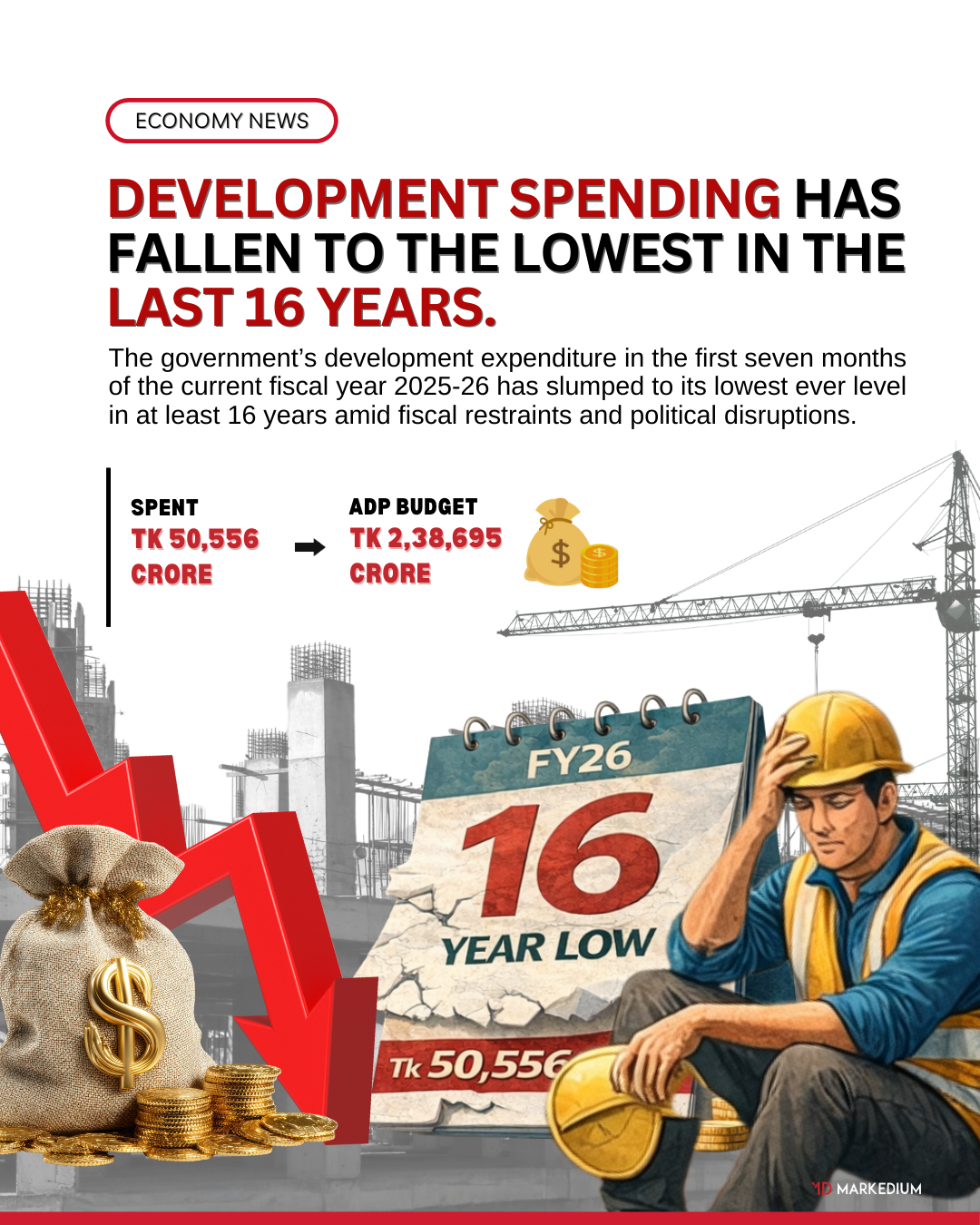
Bangladesh’s development expenditure has hit its lowest implementation rate in at least 16 years, raising serious concerns about public service delivery and healthcare accessibility across the country.
Official data from the Implementation Monitoring and Evaluation Division (IMED) reveals that ministries and divisions disbursed Tk 50,556 crore during the July–January period of fiscal year 2025-26, equivalent to a mere 21.18% of the total Annual Development Programme (ADP) allocation. The figure represents a sharp deterioration from 27.11% recorded in FY2024 and 28.16% in FY2023, and falls marginally below even the 21.52% logged in FY2025, a year defined by mass political upheaval and administrative paralysis.
No sector reflects this failure more acutely than healthcare. The Medical Education and Family Welfare Division has utilised only 2.98% of its allocated budget, while the Health Services Division has managed just 6.59% — figures that experts describe as alarming, given Bangladesh’s already severe out-of-pocket health expenditure burden, one of the highest anywhere in the world.

Md Deen Islam, Research Director at RAPID, attributed the underperformance to governance weaknesses and institutional hesitancy. “In many cases, those in charge hesitate to take bold decisions, particularly when procurement-related scrutiny creates a climate of fear,” he said. He warned that without immediate increases in health investment, a single chronic illness could push a non-poor family into poverty, a structural vulnerability he described as demanding urgent policy attention.
The spending slowdown reflects broader headwinds. Several contractors abandoned ongoing projects following the mid-2024 political transition, while an austerity-focused ADP has deferred or scaled back initiatives from the previous administration. Infrastructure sectors have fared comparatively better, with the Ministry of Water Resources achieving the highest implementation rate at 41.10%.
There are tentative grounds for cautious optimism. January recorded a marginal improvement, with 3.64% of the revised ADP implemented, edging above the 3.55% recorded in January 2024. The formation of a new elected government has also raised expectations. Ashikur Rahman, Principal Economist at the Policy Research Institute of Bangladesh, noted that a fully empowered political administration would be better positioned to drive nationwide development activity with greater urgency and accountability.
Yet the scale of the challenge remains considerable. With the health sector still operating at a fraction of its allocated capacity and out-of-pocket costs continuing to rise, the gap between policy ambition and on-the-ground delivery has rarely looked wider. Whether the incoming administration can close that gap — and do so before the costs become irreversible — will define one of the most consequential tests of governance Bangladesh faces in the years ahead.
For more updates, follow Markedium.











Leave a comment