





























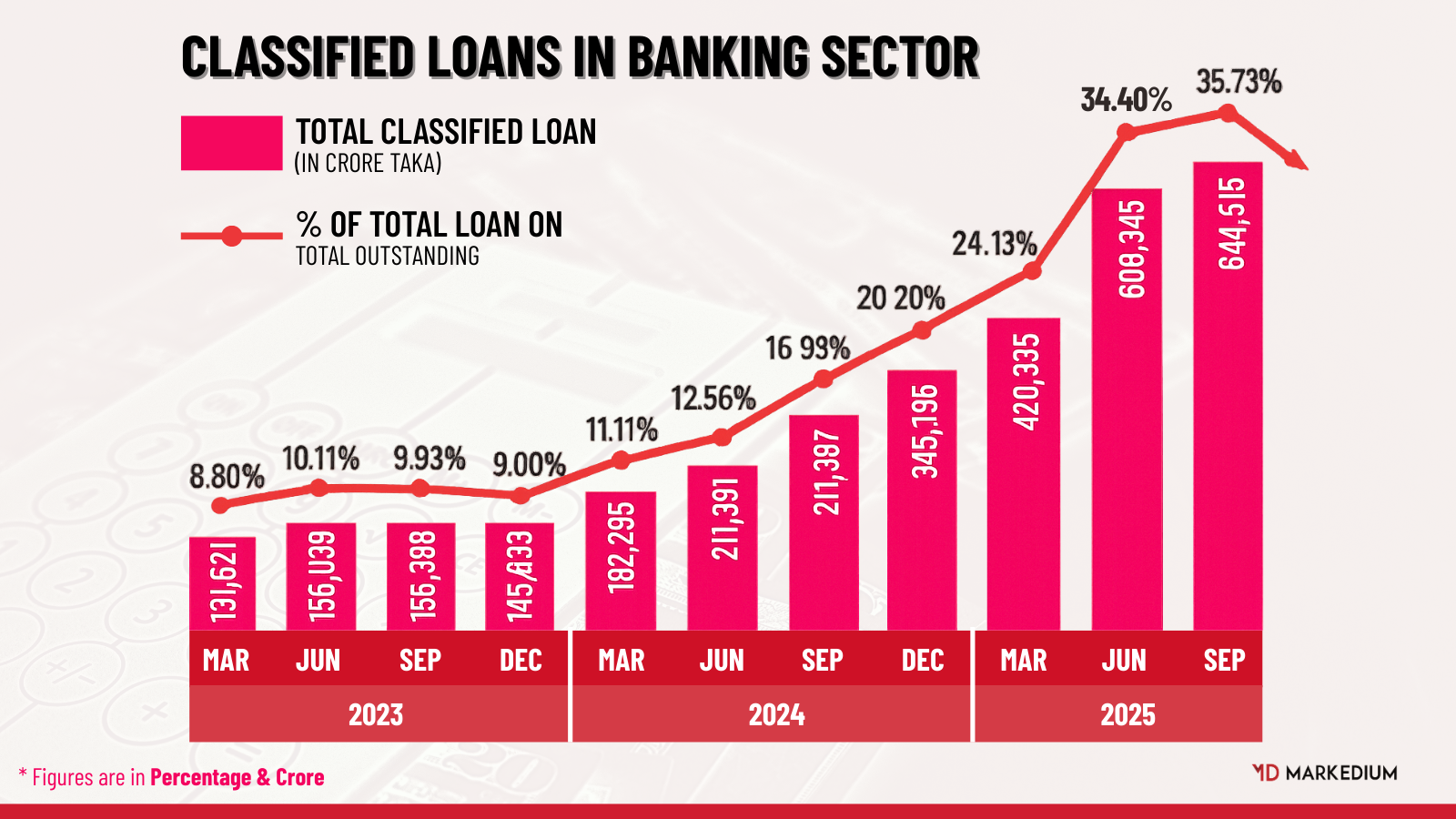
Non-performing loans (NPLs) in Bangladesh’s banking sector experienced a substantial reduction of Tk87,298 crore during the final quarter of 2025, a shift primarily facilitated by an aggressive debt rescheduling campaign under relaxed central bank policies. According to a report by the central bank, NPLs stood at Tk5.57 lakh crore at the end of December 2025, accounting for 30.60% of total outstanding loans. This reflects a notable decrease from the Tk6.44 lakh crore, or 35.73%, recorded at the end of September 2025. Despite this decline, analysts warn that the situation remains precarious, as banks maintained provisions of only Tk2.49 lakh crore against defaulted loans, leaving a massive provision shortfall of Tk1.91 lakh crore that poses significant risks to depositors.
Rescheduling Policy and Sector Performance
The recent reduction followed a special policy introduced in September 2024, which allowed affected borrowers to reschedule classified loans for up to 10 years with a mere 2% down payment and a grace period of up to two years. Recently, the Bangladesh Bank further relaxed these terms, permitting rescheduling with just a 1% down payment. Consequently, nearly 1,300 firms and business groups have regularized their debts under these schemes. This improvement was visible across various banking segments: private commercial banks saw defaulted loans decline by Tk73,606 crore to Tk3.89 lakh crore, while state-owned commercial banks recorded a drop to Tk1.46 lakh crore, bringing their default rate to 44.44%. Specialised banks also saw a modest reduction to Tk18,546 crore.
Hidden Defaults and Structural Risks
The sharp rise in NPLs earlier in 2025 climbing from Tk3.45 lakh crore in December 2024 to its September peak was driven by the disclosure of previously concealed “bad loans” following a political transition. Stricter supervision and audits conducted by foreign firms revealed an additional Tk4.33 lakh crore in hidden defaults accumulated over the previous decade due to widespread irregularities and fraud involving major business groups like S Alam, Beximco, and Hallmark.

While policy support has allowed some banks to significantly lower their NPL ratios, industry experts warn that the improvement may be temporary. Many rescheduled loans generate limited actual recovery and could turn non-performing again in the coming years, potentially creating a “chaotic” surge in defaults and renewed instability by 2027.
For more updates, follow Markedium.










Leave a comment