
























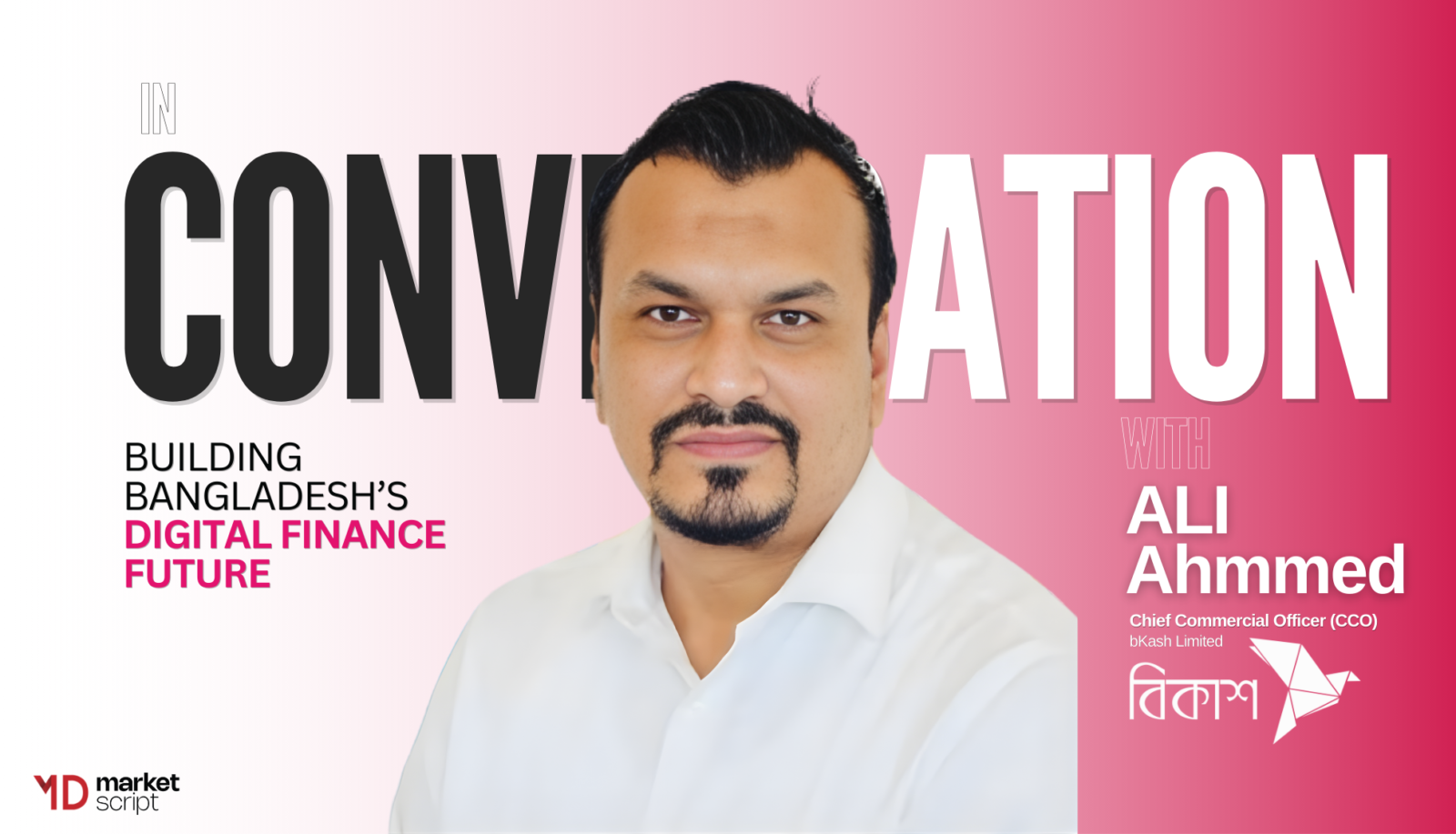
As bKash marks its 14th year, we sat down with Ali Ahmmed, Chief Commercial Officer of bKash Limited, to discuss how the company and the broader Mobile Financial Services (MFS) industry have transformed Bangladesh’s financial landscape, what consumer behavior shifts mean for the future, and where digital finance is heading next.
Here’s a refined version of the interview.
Markedium: Over the last 14 years, how would you describe the transformation that bKash and the MFS industry have driven?
Mr. Ahmmed: Over the last 14 years, the MFS industry has transformed financial access by reaching millions of households and solving a fundamental problem—sending money quickly, safely, and affordably. Back then, people relied on unreliable methods like couriers or bus services, which were costly and time-consuming.
“bKash identified this gap and drew inspiration from global examples like Kenya’s M-Pesa, adapting similar USSD-based solutions for Bangladesh.”
We recognized that many workers in cities needed to send money home to their families in villages, and technology offered the most efficient solution. By partnering with mobile operators and working closely with Bangladesh Bank—whose progressive, pro-people policies were instrumental—we built a reliable, secure platform that reshaped how money moves across the country.
Markedium: Have you noticed a shift in how consumers view and use cash versus digital payments?
Mr. Ahmmed: Absolutely. One of the biggest shifts has been in utility bill payments. Not long ago, paying a 500 taka electricity bill meant standing in line at a bank for hours, going through multiple layers of verification. Today, MFS platforms process over 30 million bills every month, saving customers time while ensuring billers receive funds instantly—no more waiting weeks for settlement.
The impact goes further: banks can repurpose idle funds productively, billers get money on time, and customers enjoy convenience. The same trend is visible in digital payments for ride-sharing, food delivery, and e-commerce. Offline too, we now process around a million transactions a day.
Consumer behavior is changing rapidly in cities—young people at superstores or pharmacies already prefer mobile wallets—but the next big frontier is rural markets and wet markets. Once payments there go digital, we’ll truly see all walks of life embracing a cashless ecosystem.
Markedium: Beyond customers, merchants play a critical role in the digital payment ecosystem. How is bKash creating value for them and encouraging wider acceptance of digital payments?
Mr. Ahmmed: Our role as digital players is twofold: bringing new users onto the platform and creating compelling reasons for merchants to accept digital payments. Merchants are crucial stakeholders, so we focus on solving their pain points with simple, practical solutions.
For example, we introduced the payment speaker, a small device that announces when a transaction is complete—saving busy shop owners the hassle of checking their phones. Solutions like this make digital acceptance easier and more attractive for small traders.
Globally, we see even deeper integration. In China, restaurants use QR codes not just for payments but for browsing menus, placing orders, and settling bills—all through self-service. Digitization in Bangladesh must move in that direction: from payment tools to digital menus, POS systems, and cash counters.
Only then can the entire merchant ecosystem become more efficient, allowing businesses to focus on what they do best while customers enjoy a seamless digital experience.
Markedium: What are the current growth drivers for the MFS industry?
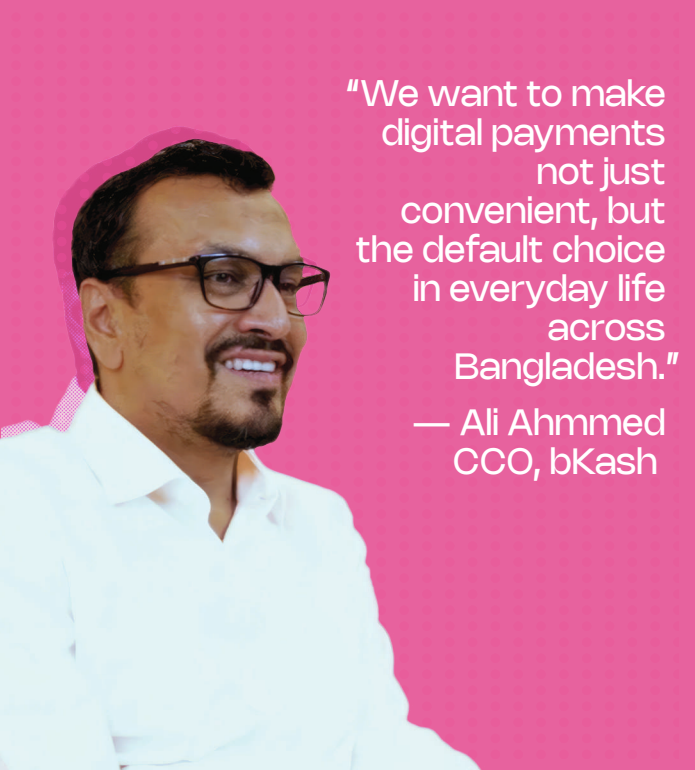
Mr. Ahmmed: We are working closely with the central bank to introduce Bangla QR at a national level. Once implemented, any customer—whether using bKash, a bank app, or another MFS provider—will be able to scan any QR and make payments seamlessly. This interoperability will bring all digital payment users under one unified ecosystem.
Another priority is cross-border remittance. By partnering with banks, we enable rural customers to receive remittances directly on their phones and withdraw from the nearest MFS agent. This makes the process faster, safer, and more inclusive.
We are also focusing on digital savings solutions like DPS and micro-savings. Millions of customers are now saving as little as 250 taka a week, building habits that lead to financial independence. Over time, these small deposits accumulate into meaningful amounts, allowing people to invest in education, business, or creative pursuits.
Markedium: Every bKash product—from remittance to savings and loans—has solved real problems over time. What is the core product philosophy at bKash, and what key questions must every new product answer before launch?
Mr. Ahmmed: Our product philosophy begins with a simple question: “What customer problem are we solving?”
Fourteen years ago, the challenge was financial inclusion—millions lacked access to formal banking. We addressed that with services like sending money home.
Today, the bigger gap is access to credit. Informal loans are expensive and unreliable, while banks require documentation and collateral that many customers don’t have. That’s why we partnered with City Bank on nano loans. City Bank handles credit assessment and policy approval, while bKash disburses loans and enables repayment through our platform.
So far, 5.6 million customers have been offered credit, with over 1 million already taking loans. Every day, around 27,000 new customers are accessing credit. Repayment rates are strong, showing customers understand the value of building a credit history.
“This is just the beginning—we expect millions more to gain access to affordable credit in the coming years.”
Markedium: How do bKash’s financial products contribute to deeper platform engagement? Do you see evidence that these offerings increase customer activity and loyalty?
Mr. Ahmmed: Yes, absolutely. Some products are highly “sticky” and drive repeat engagement. For example, mobile recharge is our most used feature—around 4 million transactions daily, with the average customer making more than five recharges a month.
Utility bill payments show similar behavior: once customers save their credentials, they prefer the convenience of staying on our platform rather than switching elsewhere.
The same goes for merchant payments—whether at a coffee shop or superstore customers increasingly prefer paying digitally. Together, these products not only deepen engagement but also build long-term loyalty while reducing churn.
Markedium: Remittance is vital for Bangladesh. How is bKash shaping that sector?
Mr. Ahmmed: We currently work with 29 local commercial banks and over 114 international money transfer companies, enabling instant credit of remittances into bKash accounts. For families in Bangladesh, this means receiving money from abroad in a way that is fast, reliable, affordable, and completely hassle-free—no paperwork or physical visits required.
“Our ambition is to connect with all major money transfer companies worldwide and drive down remittance costs through digitization.”
By lowering sending fees, we can pass the benefits to both senders and receivers. As more banks and partners join the ecosystem, we believe transaction volumes will continue to grow, making remittances more accessible and efficient for millions.
Markedium: bKash’s agent network is a critical part of its ecosystem. How has this network evolved over time, and what role do agents play in driving financial inclusion and customer engagement?
Mr. Ahmmed: We have 350,000 agents, supported by 300 distributors and 12,000 field officers—our “frontline warriors.” They ensure agents have liquidity, follow security protocols, and receive daily support. We also partner with banks for safe cash management.
The network itself has evolved: 95% of agents now use smartphones, not bar phones, reducing errors. Many agents now hold bank accounts, offer savings products, and assist with customer registrations. Their incomes and lifestyles have grown alongside bKash.
Markedium: What lessons has bKash learned over 14 years serving in Bangladesh shaping the industry?
Mr. Ahmmed: Engagement with regulators is key. For example, the central bank’s eKYC policy—developed through close collaboration—transformed MFS account opening from a cumbersome, paper-based process into a 24/7 digital experience. Such innovations wouldn’t be possible without regulatory alignment.
Beyond regulators, cross-industry collaboration has been critical. From working with mobile operators on USSD in the early days to partnering with banks, utilities, and microfinance institutions, we’ve co-created solutions that extend financial services, simplify bill payments, and support loan and savings collections. Together, these partnerships help build a stronger digital ecosystem.
Markedium: Trust is everything in financial services. How has bKash earned it?
Mr. Ahmmed: Trust is the foundation of any financial company, and for bKash it has been the most critical element over the past 14 years. Our promise has always been that customer money is safe.
Deposits are backed by government securities and kept only with top-rated banks, ensuring funds are always available whenever a customer wants to transact. On top of that, both the government and regulators have shown strong confidence in bKash, entrusting us with social safety net disbursements and broader financial inclusion efforts.
Altogether, these elements—secure funds, reliable access, and institutional trust—have created a rewarding and trusted experience for our customers.
Markedium: Looking ahead, what can customers expect from bKash in its 15th year?
Mr. Ahmmed: The future is payment innovation. Customers won’t need leather wallets—tap-and-pay and speaker-verified transactions will be mainstream. Expect enhanced rewards programs, new savings products, and expanded credit access.
This interview was first published in Market Script Issue 1, where we delved deep into the ‘Mobile Financial Service’ industry of Bangladesh.
For more updates, be with Markedium.









Leave a comment