





























Bangladesh’s real GDP growth is projected to slow significantly in fiscal year 2025, dropping to 4.5% from 5.8% in FY24, according to recent forecasts. This downturn is a consequence of a combination of factors, including rising inflation, political instability, and deteriorating economic conditions, which have adversely impacted the banking sector. Moody’s Ratings has downgraded Bangladesh’s banking system outlook from “stable” to “negative,” citing increasing asset risks and a challenging economic environment.
The credit rating agency highlighted key concerns, including worsening asset quality, high inflation, and weakening economic growth, all of which are expected to erode bank profitability and threaten financial stability. Moody’s warned that structural risks in the banking sector, such as lax regulatory oversight and poor corporate governance, will persist, further complicating efforts to stabilize the financial system.
Liquidity across the banking system is expected to remain stable but tight, with the loan-to-deposit ratio standing at 81% as of September 2024. Moody’s acknowledged that the government would likely continue to support the banking sector through regulatory forbearance and liquidity measures aimed at reducing the risks of contagion. However, these interventions may mask underlying asset risks and hinder the recovery of loans, according to the agency’s analysis. As of June 2024, the systemwide non-performing loan (NPL) provision ratio remained at a concerningly low 42%, and the situation is expected to worsen as loans with modified payment terms are included.
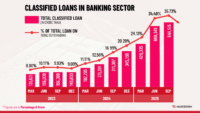
The negative outlook also reflects the government’s diminishing capacity to provide effective support to banks in times of crisis. The country’s banking sector is grappling with rising asset risks, particularly as the NPL ratio surged to 17% in September 2024, up from 9% just nine months earlier. Moody’s anticipates that asset quality will continue to deteriorate as the broader economic environment worsens, exacerbated by ongoing social unrest, which has disrupted supply chains, reduced demand, and created labor shortages in several industries.
Read more: Bank Deposits See 8% Growth in January After Months of Sluggish Performance
The banking sector is facing further pressure due to newly introduced, stricter NPL classification rules that will take effect in April 2025. These changes are expected to deepen the challenges facing banks, pushing up loan-loss provisions and dampening profitability. As a result, banks with strong fundamentals may see improvements in net interest margins (NIMs) due to higher lending rates following the central bank’s removal of the interest rate cap, while banks grappling with deteriorating asset quality will experience a decline in NIMs as the proportion of interest-yielding loans shrinks.
The country’s real GDP growth slowdown is being driven by several factors, including political and social instability, disruptions in the garment sector, and weakening domestic and international demand. Additionally, inflation is expected to remain high at 9.8% in 2025, further complicating efforts to stabilize the economy. In response to these inflationary pressures, Bangladesh’s central bank raised policy rates from 6% to 10% over the past 15 months, a move that has strained the financial system and further limited the government’s capacity to enact significant reforms. The interim government’s fiscal position remains constrained, and its ability to provide substantial support to the economy is increasingly limited.
Despite these challenges, Moody’s noted that overall capitalization in the banking sector is expected to remain stable, albeit at a slower pace of credit growth. However, state-owned banks remain particularly vulnerable, with an average capital-to-risk-weighted-assets ratio of -2.5% as of September 2024, well below the private sector average of 9.4%. This significant shortfall is attributed to weak profitability, high NPLs, and a lack of capital infusions from the government. According to Moody’s, state-owned banks will remain undercapitalized, further exacerbating the strain on the sector.
In conclusion, Bangladesh’s banking sector is facing an increasingly challenging environment, with rising asset risks, high inflation, and political instability dampening economic prospects. The government’s capacity to stabilize the situation remains uncertain, and the outlook for the country’s banking system and broader economy remains fraught with challenges.
For more updates, be with Markedium.











Leave a comment