


























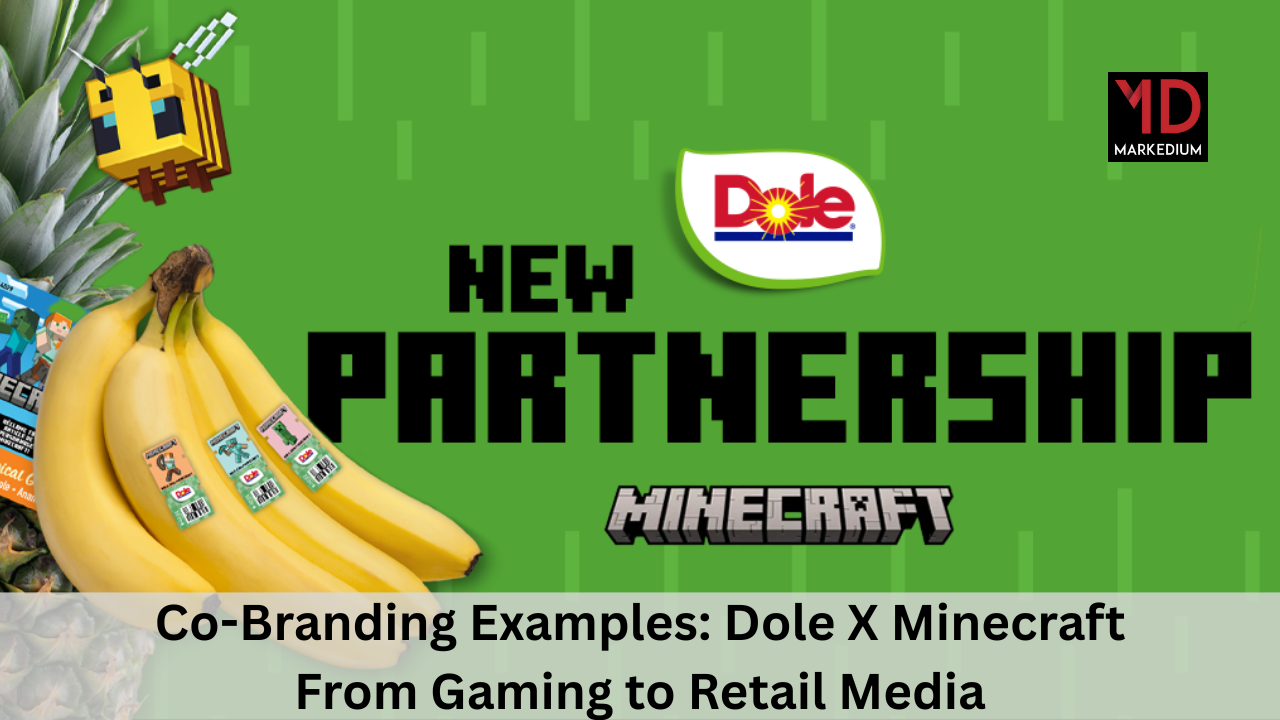
Dole just turned Minecraft players into banana buyers. The produce giant’s “Make the World a Healthier Place” campaign proves that smart co-branding creates value neither brand could deliver alone—and drives measurable business results in the process.
Co-branding isn’t new. But the way leading brands structure partnerships has evolved dramatically. You’re no longer just slapping two logos together. You’re building integrated ecosystems where each brand’s strengths multiply the other’s reach, credibility, and commercial impact.
Here’s how modern co-branding works, why it matters, and what you can learn from two very different partnership models: Dole x Minecraft in gaming and Macy’s x Amazon in retail media infrastructure.

The Dole x Minecraft Co Branding Examples Blueprint
Dole Food Company partnered with Minecraft on a six-month global campaign running from October 2025 through March 2026 across the U.S., Canada, Germany, Italy, Greece, and the Netherlands. This marks the first time Dole launched a marketing initiative simultaneously in North America and Europe—a signal of strategic priority.
The mechanics reveal sophisticated thinking. Players unlock an exclusive Dole Banana Hoodie for their Minecraft avatar by visiting a microsite and uploading a photo of Dole banana stickers or pineapple tags purchased in real stores. Meanwhile, Dole products feature Minecraft characters—Steve, Alex, Creeper, Enderman, and others—on actual produce stickers and tags in grocery aisles.
This creates a closed-loop engagement system. Digital engagement drives physical retail purchases. Physical purchases unlock digital rewards. Neither brand could create this loop alone. Minecraft delivers 300 million players and cultural cachet among families. Dole delivers retail distribution and nutrition credibility.
The campaign includes Minecraft-inspired recipes like Golden Banana Ingots and Creeper Crusher Smoothies, in-store displays, and social media activations—extending the partnership across every consumer touchpoint. The result? Dole reported 14.3% year-over-year revenue growth to $2.4 billion in Q2, with this campaign positioned to sustain momentum through Q1 2026.
Why Cross-Industry Co-Branding Works
The Dole x Minecraft partnership exemplifies cross-industry co-branding—when brands from different categories collaborate to reach each other’s audiences and leverage each other’s capabilities. Gaming meets nutrition. Entertainment meets healthy eating. Digital meets physical retail.
Compare this to traditional celebrity endorsements, where payment flows in one direction and promotion feels transactional. True co-branding requires mutual investment, shared risk, and integrated execution, with both brands visibly participating in each other’s domains.
Dole didn’t just license Minecraft characters. They built a campaign in which Minecraft’s digital world drives behavior in Dole’s physical retail world, while Dole’s nutrition messaging appears within Minecraft’s entertainment environment. Each brand strengthens the other’s positioning.
This matters because modern consumers—especially families making health decisions—respond to brands that show up authentically in spaces they already occupy. Kids play Minecraft. Parents buy bananas. The partnership bridges both contexts without feeling forced or purely commercial.
The Macy’s x Amazon Retail Media Partnership
Cross-industry partnerships like Dole x Minecraft get attention, but same-industry strategic alliances can be equally transformative. Consider Macy’s partnership with Amazon Retail Ads for third-party ad serving—a completely different co-branding model that addresses distinct business needs.
As we covered in our analysis of the Macy’s x Amazon retail media partnership, this collaboration allows advertisers to buy Macy’s sponsored placements through Amazon’s advertising console and APIs. Amazon provides the ad-serving technology infrastructure while Macy’s maintains control over customer experience and first-party data.
This isn’t about cute crossover content or shared marketing campaigns. It’s infrastructure co-branding—pooling operational capabilities to deliver better service to mutual customers (advertisers). Macy’s gains sophisticated ad tech without building it internally. Amazon expands its retail media network beyond its own properties. Advertisers get unified dashboards for multi-retailer campaign management.
The strategic parallel to Dole x Minecraft is clear: both partnerships create closed-loop systems that neither brand could build independently. Dole x Minecraft closes the loop between digital engagement and physical purchase. Macy’s x Amazon closes the loop between retail media inventory and advertiser buying platforms.

Five Co-Branding Models You Should Know
Cross-industry partnerships (Dole x Minecraft)
Brands from different categories collaborate to reach complementary audiences and leverage complementary capabilities. Works best when both brands target similar demographics through different channels.
Infrastructure alliances (Macy’s x Amazon)
Operational partnerships where one brand provides technology or capabilities to another. Less visible to end consumers but critical for competitive positioning and service delivery.
Ingredient co-branding (Intel Inside, Dolby)
One brand becomes a valued component of another’s product, with both brands promoted to end customers. Creates quality signals and shared marketing investment.
Licensing partnerships
One brand pays to use another’s intellectual property. Less integrated than true co-branding, but lower risk and easier execution. Examples include fashion brands licensing sports team logos.
Strategic joint ventures
Brands create entirely new entities together. Highest commitment level, but enables long-term value creation that neither brand could achieve independently.
What Makes Co-Branding Succeed
The best co-branding examples share three characteristics that separate successful partnerships from failed experiments.
Complementary strengths, not competing assets
Dole brings retail distribution and nutrition expertise. Minecraft brings digital engagement and credibility in youth culture. Neither competes in the other’s core business. Macy’s brings retail media inventory. Amazon brings ad-serving technology. No direct competition enables true collaboration.
Measurable value exchange
Strong partnerships quantify what each brand contributes and receives. Dole gains access to 300 million players. Minecraft gains retail visibility and real-world product integration. Both can measure success through sales lift, engagement metrics, and brand awareness.
Integrated execution across both brand worlds
Weak co-branding slaps logos together without meaningful integration. Strong co-branding embeds each brand authentically in the other’s environment. Minecraft characters appear on bananas in grocery stores. Dole nutrition messaging appears inside Minecraft gameplay. The partnership feels native to both worlds.

Your Co-Branding Evaluation Framework
Before pursuing partnerships, ask four questions: Does this brand reach audiences we can’t access independently? Do our strengths complement rather than compete with theirs? Can we measure success objectively? Will customers find our collaboration authentic in both brand environments?
Dole x Minecraft and Macy’s x Amazon prove that smart co-branding isn’t about borrowing another brand’s equity. It’s about creating new value that neither brand could deliver alone—then splitting the rewards proportionally to contribution.








Leave a comment