




























The world’s largest sovereign wealth fund has reduced its investment exposure in Bangladesh by 17% in 2025, extending a multi-year trend of declining holdings amid economic and political uncertainties that weigh on investor confidence in Bangladesh’s capital markets.
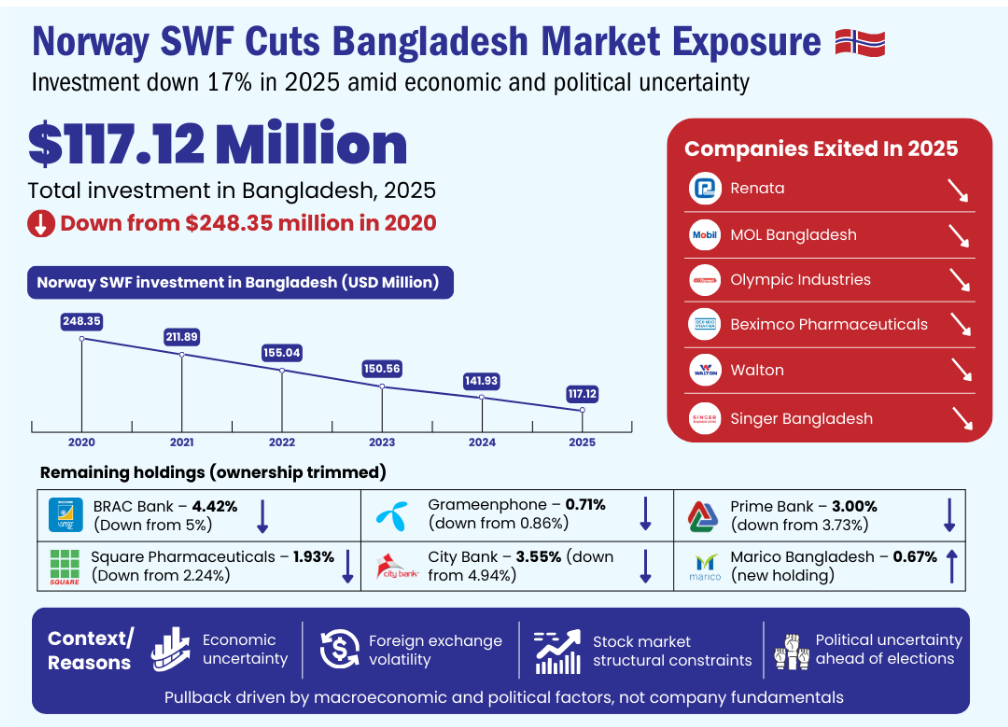
Norges Bank Investment Management, which oversees Norway’s sovereign wealth fund, disclosed that total investments in Bangladesh decreased to $117.12 million in 2025 from $141.93 million in 2024. The reduction represents a continuation of steady divestment since holdings peaked at $248.35 million in 2020, reflecting growing caution toward Bangladesh’s equity market despite the country’s underlying growth potential.

The Norwegian fund has completely exited positions in several prominent publicly traded companies, including Beximco Pharmaceuticals, Walton, MJL Bangladesh, Renata, Olympic Industries, and Singer Bangladesh. These withdrawals signal a strategic reassessment of the fund’s portfolio composition in the country.
Despite the overall reduction, the sovereign wealth fund maintains significant stakes in select major corporations. BRAC Bank represents its largest holding with a 4.42% ownership stake valued at $45.45 million. Other substantial investments include Square Pharmaceuticals with a 1.93% stake worth $27.81 million, Grameenphone at 0.71% valued at $20.35 million, City Bank with a 3.55% position worth $10.73 million, Prime Bank at 3% valued at $8.16 million, and Marico Bangladesh with 0.67% ownership worth $4.59 million.
Ownership percentages in most retained companies declined from 2024 levels, indicating a partial portfolio liquidation rather than fresh capital deployment. Market analysts attribute the reduced exposure primarily to macroeconomic and structural challenges rather than company-specific performance issues.
A senior analyst at Brummer & Partners Bangladesh, speaking anonymously, identified multiple factors contributing to the investment slowdown since 2020. These include the economic impact of the Covid-19 pandemic, the prolonged implementation of stock market floor price mechanisms, concerns about taxation policy, foreign exchange rate volatility, and heightened economic and political uncertainty.
The analyst noted that Norway’s sovereign wealth fund continues holding shares in fundamentally sound and well-governed companies such as BRAC Bank, City Bank, Grameenphone, and Square Pharmaceuticals, consistent with its long-term investment approach and preference for market-leading firms with relatively stable earnings trajectories.

Salim Afzal Shawon, head of research at BRAC EPL Stock Brokerage, observed that 2025 witnessed broader reductions in foreign portfolio investment across Bangladesh’s market. Many international investors opted to liquidate or partially exit positions as foreign exchange conditions improved, facilitating smoother fund repatriation.
Shawon indicated that increasing caution ahead of the upcoming national election prompted investors to limit exposure pending greater clarity on political stability and policy direction. If the political transition delivers confidence and predictability, foreign investors are likely to return. Bangladesh continues to offer attractive long-term opportunities given its substantial domestic market and growth-oriented industries.
Norway’s sovereign wealth fund initiated investments in Bangladesh in 2015 and has emerged as the country’s largest foreign portfolio investor, with cumulative investments estimated at approximately 1,800 crore taka. Globally, the fund manages assets valued at approximately $2.11 trillion across 68 countries.
For more updates, follow Markedium.










Leave a comment