





























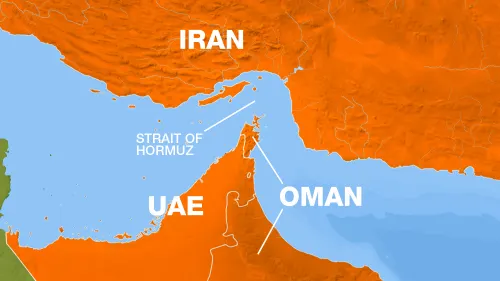
The Strait of Hormuz is a narrow waterway between Iran and Oman, at its narrowest point only 33 kilometres wide. Despite its modest geography, it carries approximately 20% of the world’s entire oil supply making it the single most consequential maritime chokepoint in the global energy system. Every major Gulf producer Saudi Arabia, Iraq, Kuwait, UAE, and Qatar depends on it as their primary or sole export route. There is no viable large-scale alternative.
What makes it uniquely dangerous is the combination of irreplaceability and fragility. A single hostile act of mining, missile strikes on tankers, or an Iranian naval blockade can freeze a corridor the entire world depends upon simultaneously. Insurance markets react within hours, shipping halts within days, and prices spike before a single barrel is actually lost. For import-dependent nations like Bangladesh, the Strait is where international conflict becomes domestic inflation and power shortages immediately and without warning.
Bangladesh’s Energy Dependency Trap: Supply Security Risks Amid Potential Disruption of Strait of Hormuz
Bangladesh’s 90% import dependency through the Strait of Hormuz is not an accident of policy; it is the accumulated result of decades of underinvestment in domestic energy production, delayed renewable transition, and an over-reliance on Gulf bilateral relationships for preferential supply terms.
The critical distinction analysts must make here is between price risk and availability risk. Most commentary focuses on the former, that oil will become more expensive. But for Bangladesh, availability risk is the more existential threat. If the Strait experiences even a partial disruption or if war-risk insurance premiums make shipping economically unviable for smaller buyers, Bangladesh as a non-priority buyer without long-term take-or-pay LNG contracts of significant scale could face actual supply shortfalls, not merely expensive supply.
From Crude to Consumer: How Global Oil Price Rise May Feed Inflationary Pressure in Bangladesh
Crude rising over 10% in under two weeks signals what is coming domestically. Higher fuel costs raise electricity generation expenses, which elevate industrial production costs, which compress export margins particularly in RMG. Transport costs follow, pushing food and essential goods prices upward. For households already weathering persistent inflation, this arrives as a compounding burden, not an isolated event. Bangladesh has limited price stabilization mechanisms to smooth the adjustment. The shock moves fast; the policy response historically moves slowly.
Rising Oil, Potential Reserve Pressure: Bangladesh May Face Dollar Strain Amid Escalating Iran–Israel conflict
Bangladesh’s foreign exchange reserve position transforms what might be a manageable price shock for a reserve-rich economy into a potentially destabilizing one. The reserve buffer, which has been under sustained pressure since the post-pandemic import surge of 2022, provides limited room to absorb a structural increase in the import bill.
The transmission mechanism works rapidly and visibly. Higher oil prices expand the import bill in dollar terms. This pressures the taka, which Bangladesh Bank must defend through reserve drawdown or allow to depreciate. Depreciation then feeds back into import costs, creating a second-round inflation effect that compounds the original fuel price shock. Bangladesh has lived through this cycle once already in 2022-2023, and its institutions have limited new tools to respond differently this time.
How a Gulf War increases industrial and export competitiveness for Bangladesh
The RMG sector, which accounts for over 80% of Bangladesh’s export earnings, is exposed through two channels simultaneously. Higher energy costs raise factory-level production costs, compressing already thin margins. Simultaneously, if the conflict disrupts global shipping lanes more broadly, freight costs and delivery timelines become unpredictable, a serious problem for an industry built on just-in-time supply chain commitments to Western buyers.
At the same time, Bangladesh’s competitors Vietnam, Cambodia, India are exposed to varying degrees. If the shock is broadly distributed, relative competitiveness may hold. But if Bangladesh’s energy cost pass-through is sharper or its currency adjustment more pronounced, it could lose ground on price competitiveness precisely when global buyers are already diversifying sourcing amid broader geopolitical uncertainty.
Bangladesh’s Energy Sector: No Strategic Reserves, Borrowed Power, and No Safety Net
Bangladesh enters this crisis with its domestic energy foundation already compromised. Indigenous gas production historically the backbone of the power sector is in structural decline as mature fields deplete faster than new exploration replaces them. The country has responded not with long-term investment but with short-term dependency on expensive rental and quick-rental power plants, which run on imported furnace oil and diesel, directly exposing generation costs to every global fuel price movement.
Compounding this is the complete absence of a strategic petroleum reserve. When global oil prices spike or supply routes face disruption, Bangladesh has no buffer, no stored inventory to buy adjustment time while markets stabilize or diplomatic solutions emerge. Where other nations measure their reserve cover in days or weeks, Bangladesh effectively has none. Every price shock, every geopolitical disruption, every shipping delay hits the economy in real time with nothing standing between the external event and its domestic consequence.

The Fiscal Balancing Act: Bangladesh’s Energy Subsidy Challenge Amid External Price Uncertainty
The government faces a structurally unpleasant choice that has no clean resolution. BPC, the state petroleum corporation, is the institutional shock absorber of first resort. If crude climbs from the current $67 toward $85-90 per barrel, a plausible scenario under moderate escalation, the incremental subsidy burden becomes fiscally significant at a time when Bangladesh is simultaneously managing IMF program conditionalities that emphasize fiscal consolidation.
Passing costs to consumers through domestic fuel price increases is the textbook response, but it carries serious political economic risks in the current environment and would directly feed into headline inflation, affecting the cost of living for lower-income households who spend a disproportionate share of income on transportation and utilities.
Neither path is without consequence. What Bangladesh lacks is a price stabilization mechanism , a reserve fund or hedging instrument that would allow it to smooth the adjustment over time rather than absorbing it in a single sharp movement.
The Structural Vulnerability That Cannot Be Fixed Quickly. Perhaps the most professionally honest observation is this:
Bangladesh has known about its Strait of Hormuz dependency for years. The strategic documents exist. The renewable energy targets exist. The aspiration toward LNG supply diversification exists. What has been consistently absent is the investment velocity and institutional coordination needed to convert strategic awareness into structural resilience.
Expanding renewable energy capacity, building even a modest strategic petroleum reserve, diversifying LNG procurement toward long-term contracts with multiple counterparties, and developing regional energy interconnects with India all of these reduce the Strait of Hormuz exposure over time. But they require 5 to 10 years at minimum to become meaningful hedges, and they require fiscal space and institutional capacity that are both currently constrained.
Bangladesh’s Energy Supply Chain: A Single Corridor, A Single Port, No Alternative
Bangladesh’s energy architecture is built on dangerous linearity. Nearly 90% of its crude oil, refined petroleum, and LNG imports travel through the Strait of Hormuz now effectively a high-risk military zone following US-Israel strikes on Iran. Every cargo originates from the same narrow supplier base: Saudi Arabia, Qatar, and the UAE. There is no alternative procurement channel, no diversified routing, and no long-term contracts with non-Gulf counterparties that could redirect supply if the Strait becomes impassable.
That cargo then arrives at a second structural weakness Chittagong port, Bangladesh’s single major energy import terminal. Any surge in vessel traffic, war-risk insurance-driven shipping delays, or port-level congestion compounds what began as a geopolitical disruption into a domestic supply crisis. Bangladesh has no redundancy at either end of this chain. When both chokepoints face simultaneous pressure, the country’s energy security does not bend and it breaks.
For more updates, follow Markedium.














Leave a comment