






























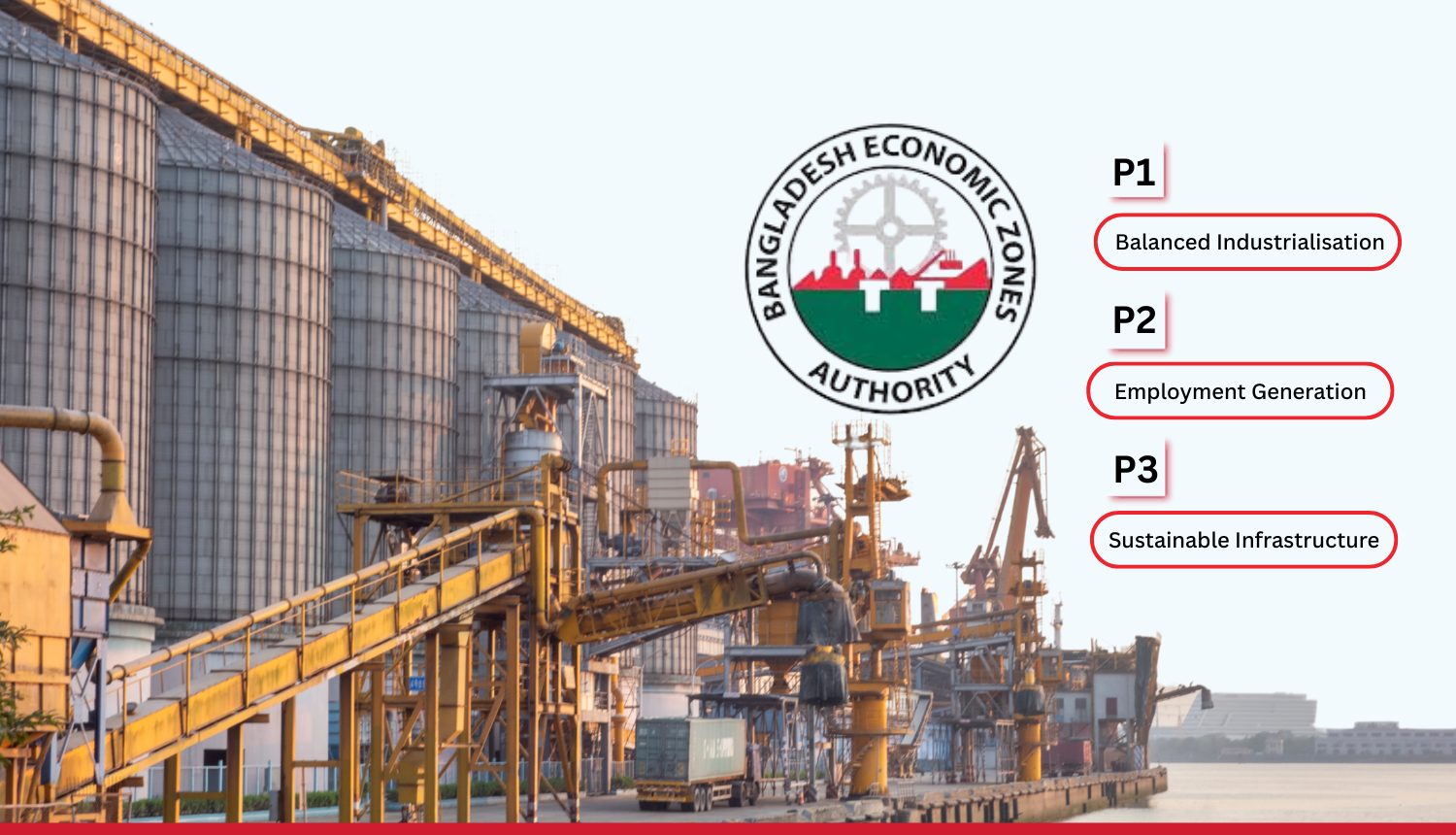
The Bangladesh Economic Zones Authority (BEZA) has outlined a strategic three-phase master plan to establish economic zones nationwide, fostering balanced industrialization, employment generation, and sustainable infrastructure development reportedly.
As part of its draft “National Master Plan of Economic Zones,” BEZA aims to set up 20 economic zones by 2046, implementing the initiative in carefully planned phases to optimize resources and attract both local and foreign investment.
The announcement came during a workshop titled “Economic Zone Prioritization and Phasing, Offsite Infrastructure Planning, and Development Mechanism” held at BEZA’s Biniyog Bhaban office in Agargaon, Dhaka, yesterday.
The master plan, currently being developed with World Bank funding, emphasizes a phased approach to mitigate challenges such as land acquisition, infrastructure preparedness, and investor confidence. This structured strategy ensures the systematic and sustainable development of economic zones.
Since launching its industrialization drive in 2015, BEZA has made 10 economic zones operational. Of these, two – National Economic Zone in Chattogram and Sreehatta Economic Zone in Sylhet – are government-managed, while eight are privately operated.
The privately managed zones include City Economic Zone, Meghna Industrial Economic Zone, Meghna Economic Zone, Hoshendi Economic Zone, Abdul Monem Economic Zone, Bay Economic Zone, Aman Economic Zone, and East West Economic Zone.
According to BEZA, these 10 economic zones currently employ approximately 60,000 people, with 7,000 working in government-run zones and 53,000 in private zones. In the fiscal year 2022-23, these zones produced goods valued at $14.47 billion.
At the workshop, BEZA Executive Chairman Ashik Chowdhury reaffirmed his commitment to transforming the master plan into a roadmap for success, driving growth, innovation, and sustainable industrialization. “BEZA is not just building economic zones; it is shaping the future of Bangladesh,” he stated.
World Bank Country Director Gayle Martin underscored the importance of rationalizing economic policies for sustainable growth. A well-functioning private sector is crucial for fostering innovation, entrepreneurship, job creation, and sustainable resource management was stated by her. She also highlighted that Bangladesh’s tax-to-GDP ratio remains among the lowest in the world, with tax exemptions accounting for 6% to 7% of GDP. Rationalizing these policies, she emphasized, is critical for long-term fiscal sustainability.
Read more: Uber’s Economic Impact In Bangladesh: BDT 55 Billion Contribution In 2024
According to a presentation on the master plan, the development will proceed in three phases:
Phase 1 (FY25-FY30): This phase prioritizes economic zones already in development or at advanced planning stages. BEZA will focus on building essential infrastructure, including roads, power supply, water management, and telecommunications, to attract investors.
To create a favorable business environment, the authority will emphasize industries with high employment potential and low capital requirements, such as agro-processing, textiles, and light engineering. By 2030, these zones are projected to generate over 300,000 jobs and significantly contribute to Bangladesh’s export earnings.
Phase 2 (FY31-FY35): This stage will introduce large-scale industries, including automobile manufacturing, pharmaceuticals, and heavy engineering. Infrastructure development will be strengthened with expanded railway and expressway connectivity. Public-private partnerships (PPP) and government-to-government (G2G) collaborations will be actively promoted.
Legal and environmental clearances for these zones are currently in progress, and by 2035, they are expected to house major industrial parks that will boost Bangladesh’s manufacturing and export sectors.
Phase 3 (FY36-FY46): The final phase aims to transform Bangladesh into a global industrial hub, integrating AI-driven logistics, automated factories, and IoT-based infrastructure.
It will introduce green economic zones featuring eco-friendly policies, renewable energy solutions, and circular economies. Specialized industrial clusters will be developed to enhance competitiveness with global economic zones in Vietnam, India, and China.
Despite a structured rollout plan, BEZA acknowledges that land acquisition complexities, environmental regulations, and policy inconsistencies remain key challenges. However, through successful implementation, the master plan aspires to transform Bangladesh into a regional industrial powerhouse, generating millions of jobs and diversifying economic growth beyond Dhaka and Chattogram.
For more updates, be with Markedium.












Leave a comment