
























A $72B power play that reshapes attention, ads, and the future of local OTTs from New York to Dhaka.
For a decade, the story was simple: Netflix vs. Disney vs. everyone else.
We called it the streaming wars, imagined like a battlefield of apps fighting for the same few hours of your evening. More platforms, more shows, more passwords.
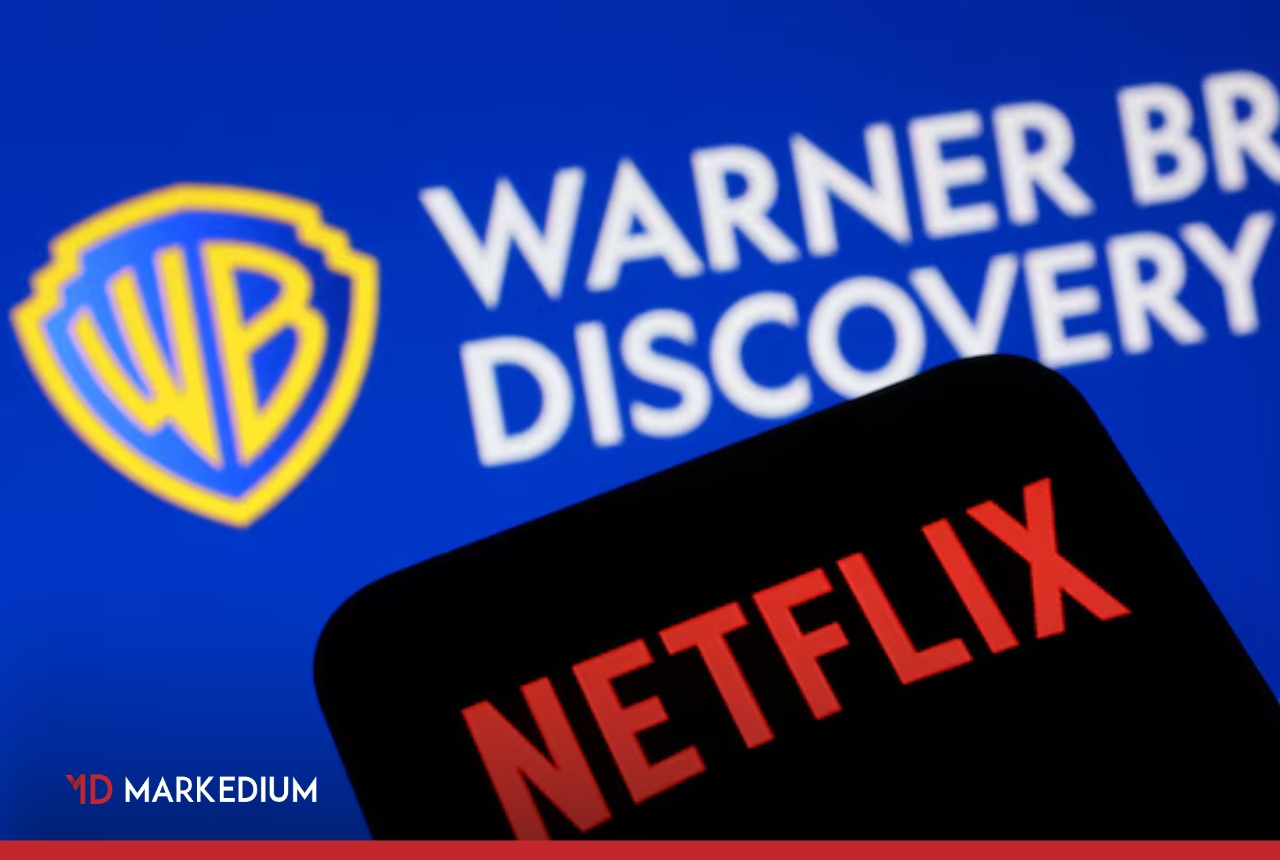
Then, in December 2025, Netflix buy Warner Bros and flipped the script.
The company signed a $72 billion deal to acquire Warner Bros.’ studios and streaming assets, including HBO Max and tentpole IP like DC, Harry Potter, and Game of Thrones.
If regulators approve it, the combined Netflix Warner Bros giant is expected to command around 10% of all U.S. TV viewing and roughly $2.3 billion in U.S. ad revenue—and that’s just one market.
This isn’t just “another deal.” It’s the moment the streaming wars start looking less like a free-for-all and more like the formation of streaming empires. And if you work in marketing, media or OTT—whether in New York or Dhaka—that changes your planning maths.
Netflix Buy Warner Bros – The deal in one breath
Netflix is buying Warner Bros’ studio and streaming business in a cash-and-stock transaction valued at $72B, with an enterprise value around $82.7B, after Warner Bros. Discovery spins off its legacy cable networks into a separate company (Discovery Global).
What Netflix gets if the deal closes:
- Warner Bros. studios (film, TV, games)
- HBO / HBO Max and their libraries
- DC Entertainment / DC Studios
- A deep bench of IP: Harry Potter, Game of Thrones, DC, and more
Analysts quoted in Marketing Dive estimate that together, Netflix + Warner Bros would:
- Generate about $2.3B in U.S. ad revenue
- Hold ~10% share of total U.S. TV viewing across linear and streaming combined.
That’s why one Forrester analyst calls it a “seismic shift” and says it could “cement Netflix as the Goliath of streaming.”
The streaming wars aren’t over, but the endgame is suddenly much clearer.
The new streaming math: fewer giants, bigger bets
For years, marketers have complained that premium video is too fragmented: one show here, another there, a dozen small buys instead of a few clean, scalable options.
If this deal goes through, Netflix becomes something very close to a global TV network + Hollywood studio + ad platform in one.
On the content side, you get:
- Netflix originals (Stranger Things, Squid Game, Wednesday)
- Warner Bros franchises and HBO worlds (Harry Potter, GoT, DC, Succession, The White Lotus)
On the business side, you get:
- Netflix’s fast-growing ad-supported tier, on track to double ad revenue this year, with ~190M monthly active viewers for its ad plan
- HBO Max’s existing ad infrastructure and experience selling premium inventory
- Netflix’s new first-party ad-tech platform, built to give brands more sophisticated targeting and measurement.
What this creates is not just “more content”—it’s a concentrated attention hub.
Marketers love reach, frequency and context. This deal offers all three in a single stack:
- Reach: massive global scale plus deep U.S. penetration
- Frequency: people binge Netflix, and HBO is appointment viewing
- Context: prestige IP plus mainstream crowd-pleasers
The calculus changes from “where do we spread our budgets?” to “how much of our budget do we dare pour into one titan?”
Why global marketers should care Warner Bros Netflix deal
Even if you’re not buying U.S. inventory tomorrow, the logic of the market will ripple outward.
- Streaming becomes TV, not “digital extra”
When one company potentially holds 10% of all TV viewing, you stop treating streaming as an afterthought. It becomes a primary line in the media plan, with CTV/OTT budgets sitting next to—if not above—traditional broadcast. - Premium inventory consolidates
Fewer, bigger hubs of top-tier content mean fewer negotiation points—but higher stakes per decision. Netflix may become one of those “must-buy” platforms for brands that need both scale and brand-safe environments. - Ad innovation accelerates
With HBO Max’s experience and Netflix’s ad-tech push, expect more format experimentation (shoppable, interactive, episodic placements) and tighter data integration with brand CDPs and retail media. - Legacy media pressure increases
As Marketing Dive notes, this could be another “nail in the coffin” for limping legacy media that never fully solved cord-cutting.
For marketers, that means more budget shifts away from fragmented cable towards a smaller set of large, digital-first players.
In short: the buy once known as “Netflix line item” could soon feel more like “Netflix + HBO + Warner ecosystem allocation”—part reach engine, part prestige halo, part experimentation lab.
What this means for Bangladesh & South Asian OTT players
Now let’s bring this home to Markedium’s core audience.
Bangladesh already has its own streaming and video ecosystem: telco-linked platforms, local OTTs, YouTube creators, and a growing CTV footprint through smart TVs and devices. A Netflix–Warner empire doesn’t erase that—but it does raise the bar.
Here’s how.
Local OTTs: niche and depth, not just “copy Netflix in Bangla”
If global giants consolidate premium English and international content, local platforms can’t win by being “mini Netflix.” They win by being hyper-local, culturally irreplaceable, and data-smart.
That means:
- Owning festivals, regional languages, humour, and social realities global players won’t touch
- Building franchise-like local IP (recurring characters, universes, docu-series) that advertisers can partner with over years, not just one season
Telcos and broadcasters: bundle first, panic later
A Netflix–Warner combo will likely supercharge bundling with telcos, just as Netflix already does in many markets. For Bangladeshi telcos, that can be both threat and opportunity:
- Threat: global content pulls time away from local apps
- Opportunity: triple-bundles (voice/data + Netflix bundle + local OTT) that give telcos leverage and keep users in their ecosystem
Instead of seeing global streamers as enemies, smart operators will treat them as anchor tenants in a bigger digital mall that also features local video, music, gaming and financial services.
Advertisers: prepare for CTV / OTT as a serious line item
Bangladeshi brands—especially in banking, FMCG, telco and handset categories—should start planning like this:
- Assume CTV/OTT reach is going to look more like “modern TV” within 2–3 years
- Build creative assets that work on TV screens and mobile simultaneously (longer formats, episodic storytelling, localized targeting)
- Push agencies and platforms for better measurement: view-through, incremental reach, and brand lift across OTT + YouTube + social, not siloed metrics
Local creators: co-own the experience
Global streamers are notoriously cautious about user-generated content. That leaves an opening for local UGC + OTT hybrids—platforms or shows that let creators extend the story: reaction content, fan-cuts, behind-the-scenes, branded spin-offs.
For brands, partnering with these ecosystems means you’re not just buying pre-roll; you’re co-creating culture around the shows your audience already loves.
Strategic questions Bangladesh marketers should be asking now
With Netflix–Warner on the horizon, a few uncomfortable but necessary questions come into focus:
- If one platform suddenly controls a huge chunk of premium attention, what’s our negotiation strategy? Are we diversifying by design, or just following where the hype is?
- Which local IP could become our “Game of Thrones” moment? Not in size, but in influence—the show or format that brands line up to be part of every season.
- Are we building measurement systems that see TV, OTT, YouTube and social as one connected attention graph? Or still treating each channel as a separate spreadsheet?
- For agencies and media houses: are we ready to sell ideas across platforms (e.g., one brand story living in Netflix, local OTT, YouTube and OOH), rather than isolated buys?
The Netflix–Warner Bros deal is not “about” Bangladesh. But its logic absolutely reaches here.
When the global market moves from many mid-sized players to a few giant hubs of attention, smaller markets don’t get a grace period—they just get less room for average work.
Final thought: Don’t fight the empire—design around it
If regulators approve the deal, Netflix won’t just win the streaming wars; it will change the game board. For marketers, that’s both intimidating and oddly clarifying.
You don’t have to beat Netflix. You do have to decide:
- Where you partner with these new empires
- Where you differentiate with local stories, creators and products
- And how you measure your bets with enough discipline that you’re not just chasing logos
For Bangladeshi brands and platforms, this can be a forcing function. A push to treat OTT as serious TV, to build real IP, and to think about attention as a limited national resource you can’t afford to waste.
The streaming wars were noisy. The streaming empires will be quieter—but much harder to ignore.











Leave a comment